











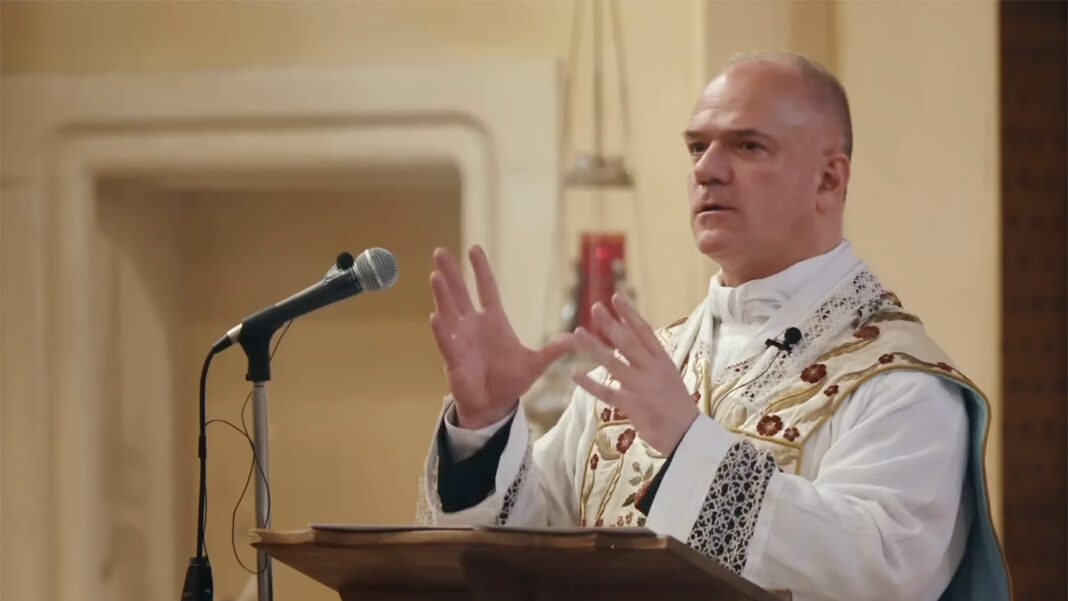
VATICAN CITY (RNS) — A breakaway traditionalist Catholic group, the Society of St. Pius X, is defying Vatican orders by proceeding with its plan to ordain new bishops without papal consent on Wednesday (July 1) during a ceremony in Écône, Switzerland.
After repeated warnings that the episcopal consecrations would constitute a schismatic act and trigger automatic excommunication, Pope Leo XIV issued an open letter asking the group to desist.
“I implore you and ask you with all my heart: Turn back!” the pope wrote in a letter addressed to the superior general of the society, the Rev. Davide Pagliarani, dated June 29.
The showdown could mark the end of nearly two decades of Vatican efforts to draw the SSPX back from the margins of Catholic life, where the society has remained staunchly opposed to Vatican II reforms, to synodality and to ecumenism. By moving ahead with new bishops despite Vatican warnings, the SSPX may force Leo to close that ambiguous chapter.
In his letter, Leo recognized the positive aspects of SSPX and its members, which he said justified the “benevolence” of his predecessors, and underlined the church’s intention to be open to “dialogue and understanding.” But he also warned that threatening the unity of the church “is a sin of extreme gravity,” adding that he feels “the duty to ask you to desist from your intention.”
In a response letter published on the society’s website, Pagliarani asked the pope to “consider the authenticity of this intention before making a decision concerning the Society of Saint Pius X,” adding that “it is not yet too late.” The letter suggested the consecrations did not represent a schismatic act and in it Pagliarani repeated his desire to meet Pope Leo in person.

The Society of St. Pius X is a traditionalist priestly society founded in 1970 by French Archbishop Marcel Lefebvre as a response to the reforms of the Second Vatican Council, which ran from 1962 to 1965. The council had elevated the role of laypeople in the church, promoted interreligious dialogue and paved the way for liturgical reforms that allowed Mass to be celebrated in vernacular languages rather than in Latin only – developments the society opposed.
On June 30, 1988, Lefebvre consecrated four bishops without approval from Rome, which according to canon law leads to excommunication latae sententiae, meaning automatically. Then-Pope John Paul II said the act frustrated years of dialogue between SSPX and the Holy See and that the society held an “incomplete and contradictory notion of Tradition,” in a motu proprio, a document personally issued by the pope, the same year called “Ecclesia Dei adflicta” (The afflicted Church of God).
Cardinal Joseph Ratzinger, later Pope Benedict XVI, attempted conciliatory efforts with the rogue society. Once pope, he remitted the 1988 excommunications in 2009 but did not grant the bishops canonical status, proving the doctrinal dispute still remained.
During the 2015 Jubilee year of mercy, Pope Francis allowed SSPX priests to hear valid confessions and opened a path for the official recognition of marriages performed by the society. But Francis also issued strong restrictions on the Latin Mass with his 2021 apostolic letter “Traditionis Custodes” (Guardians of the Tradition), deepening traditionalist resentment toward Rome.
With its bishops aging and claiming growth in France and the United States, SSPX announced the consecration of four new bishops without papal approval in February, leading to a series of open letters and in-person meetings between the society’s leadership and Vatican officials. The head of the Vatican Dicastery for the Doctrine of the Faith, Cardinal Víctor Manuel Fernández, met with Pagliarani on Feb. 12, promising dialogue if they did not ordain new bishops. But SSPX quickly rejected the Vatican’s olive branch.
In a public warning in May, Fernández cited John Paul II and said the episcopal ordinations would represent a “schismatic act.”


SSPX sent an open letter and a “profession of Catholic faith” dated June 24 to the pope and the cardinals who had gathered for an extraordinary Vatican summit June 26-27. The profession of faith reads as a manifesto of the society’s beliefs, rejecting Vatican II reforms, synodality, ecumenism and interreligious dialogue, describing non-Christian religions as “the work of the devil.”
The document also insisted their posture on the question of liturgy, which they celebrate according to the Old Rite and in Latin, is not born from nostalgia but from what they see as a broader doctrinal decay. Ultimately, the church has strayed from tradition and must renounce its errors if there is to be any dialogue, the document read. The letter accompanied the profession of faith and stated the July 1 ordinations as a matter of fact.
“There’s been a creeping inevitability of this move,” said Stephen Bullivant, professor of theology and the sociology of religion at St. Mary’s University, London, and director of the Benedict XVI Centre for Religion and Society. Any rapprochement “would be on Rome’s terms, which is very hard to imagine the SSPX being able to accept,” he added.
He said SSPX had the choice of either ordaining its own bishops or “borrowing” some of the “bishops without portfolio,” who exist in irregular canonical situations.
Bishop Joseph E. Strickland, whom Francis removed from governance of the Diocese of Tyler, Texas, in 2023 after repeated criticism of the then-pope, told Religion News Service he had been in informal contact with SSPX clergy. Asked whether he would collaborate with the society if approached, Strickland said he would “have to do a lot of praying.”
“I want to be a Catholic bishop rooted in orthodox tradition,” he said, adding that if the SSPX became the only place where that tradition was preserved, “that is what I would be looking for.”
Bullivant and data scientist Stephen Cranney are the authors of a forthcoming book, “Trads: Latin Mass Catholics in the United States,” which offers a research-driven portrait of Latin Mass-goers and traditionalist groups in the U.S.
In interviews with traditional Latin Mass Catholics, they found that many did not identify with the SSPX but still saw the society as a kind of liturgical safety net if Rome further restricted the Old Rite. They also estimated that only about 105,000 to 110,000 people regularly attend Latin Mass in the U.S.
“It’s a small, but significant, minority,” Bullivant said. “But it’s a minority that’s talked about and creates a lot more noise, positive and negative, than its sheer numbers might belie.”
For Bullivant, the SSPX’s influence has depended in part on that unresolved status — close enough to Rome to attract Catholics wary of outright schism, but distant enough to present itself as immune from Vatican pressure.
“Its liminal situation is part of the attraction,” Bullivant said. If the consecrations Wednesday go forward, that may be over.
Aleja Hertzler-McCain contributed to this report.