








(RNS) — In the face of an accelerating U.S. pressure campaign, deteriorating public utilities and economic inefficiency, Cuba’s communist government on Thursday (June 18) announced sweeping economic reforms, the largest privatization since before Fidel Castro’s revolution in 1959.
Since January, the Trump administration has made repeated threats of military action, and its sanctions and an oil blockade have been compounding Cuba’s existing fuel shortages, power outages and scarcity of food and medicines.
Amid the mounting internal and external pressure, faith communities have been speaking up and meeting with both the U.S. and Cuban governments.
U.S. Republican administrations have long seen faith groups as a cornerstone for humanitarian aid and community trust as they push for regime change in Cuba. In the last few months, the top U.S. diplomat in Cuba, Mike Hammer, has met with top Catholic bishops, a Catholic priest known for being critical of the Cuban government, a Methodist bishop and members of the Alliance of Evangelical Churches in Cuba, which includes several groups more often critical of the government, including the Assemblies of God.
Despair has become intense, said Rita María García Morris, the executive director of the Centro Cristiano de Reflexión y Diálogo (Christian Center for Reflection and Dialogue) based in the Cuban province of Matanzas, who with her team has helped meet the daily needs of vulnerable people and to advocate for peace, including several meetings with Hammer and U.S.-based pastors.
“Suicide, mental illnesses and hopelessness are extreme, extreme,” said García Morris in Spanish. “Our psychologists cannot keep up. We have a team of psychologists working even at night with phone calls, and they cannot keep up.”

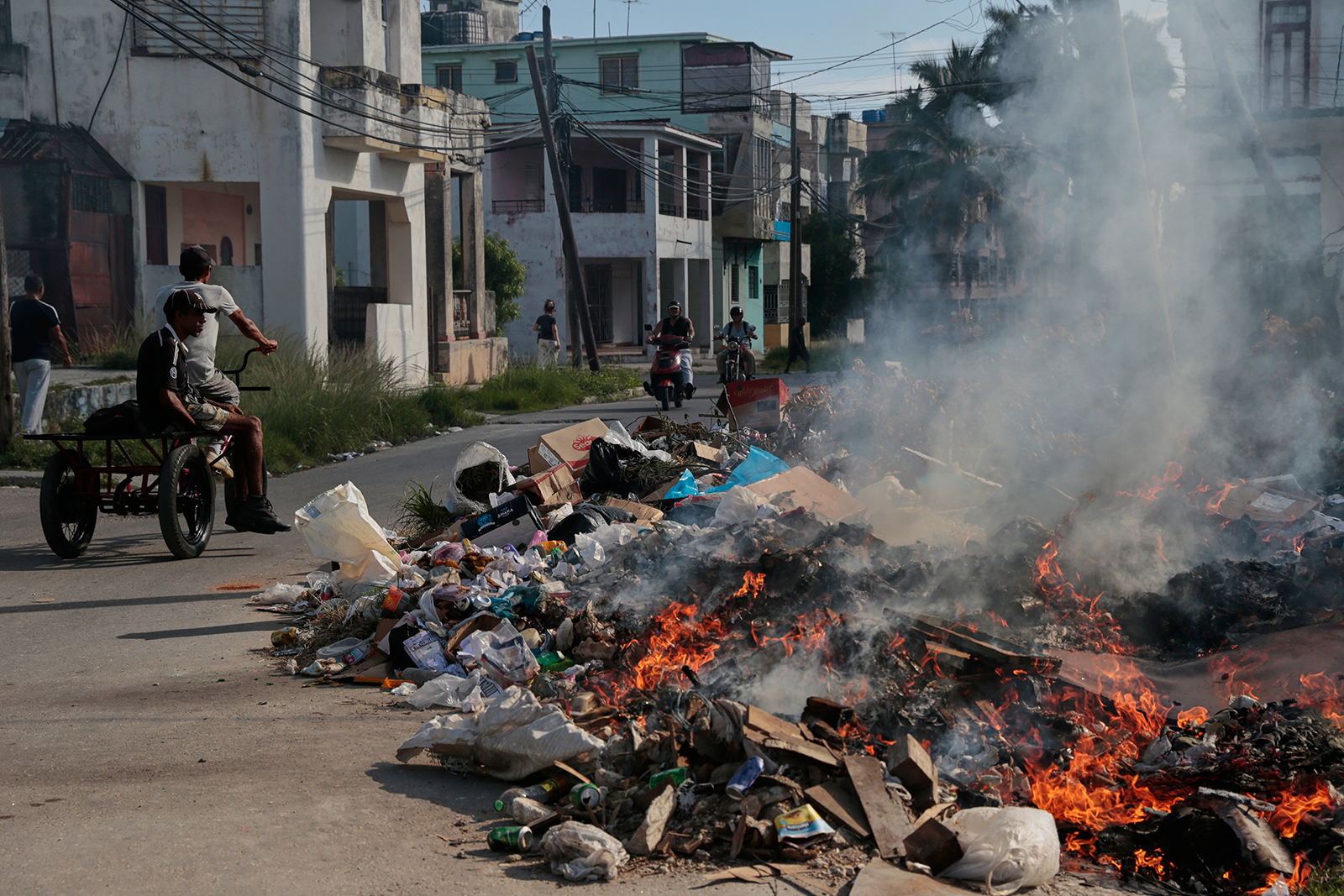
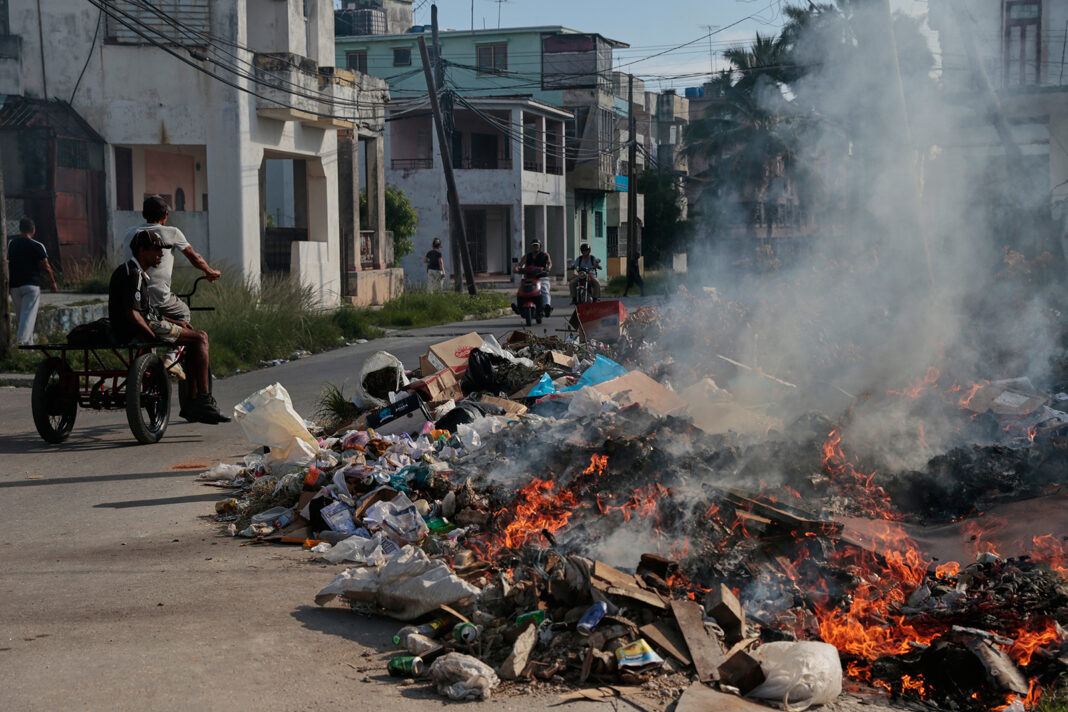
A pile of trash burns in Havana, Cuba, Wednesday, June 17, 2026. (AP Photo/Jorge Luis Banos)
García Morris, a Presbyterian ruling elder, said that suffering due to days-long blackouts and spoiled food is widespread. In December, she had to travel to the Dominican Republic because she had developed diabetic ketoacidosis, a condition that can become life-threatening, because she was not able to keep her insulin refrigerated.
Cuban state media has said the survival rate for children with cancer has fallen from 85% to 65% since the oil blockade began and that more than 75% of essential medications produced on the island can’t be made right now because of unavailable components.
The power outages and lack of flour are also limiting the Catholic church’s ability to produce unconsecrated bread for Communion. Puerto Rican parishes and Dominican religious sisters worked to send nearly 300,000 hosts to Cuba this month.
Outreach Aid to the Americas (OAA) distributes humanitarian aid to Cuba through largely evangelical churches independent from the government.
Teo Babun, OAA’s Cuban-American president and CEO, was quoted on the important role of faith communities in a 2004 Bush administration report issued by the Commission for Assistance to a Free Cuba. The evangelical businessman told RNS that “most of those reports interestingly enough are applicable today.”
He expressed confidence that the U.S. government and evangelical organizations are ready to provide a greater surge of humanitarian aid, even before a regime change.
“ We are aware of a lot of conversation taking place regarding Cuba and the aid that needs to be put together,” he said. “ They are becoming more and more familiar with the fact that the evangelical church has tremendous, broad resources and experience working in Cuba to be able to assist in providing humanitarian assistance at the right time.”
Since the beginning of the year, the U.S. State Department has funneled humanitarian aid to Cuba through the Catholic church, citing concerns about government corruption. The first batch of $3 million was designated after last fall’s Hurricane Melissa and took over four months to distribute.
The State Department announced in February another $6 million in aid to be distributed through the Catholic church, but Secretary of State Marco Rubio said in May that half of that amount was still being held up by Cuban government permitting. The department made a third offer of $100 million in assistance distributed through both the Catholic church and “other reliable independent humanitarian organizations” last month.
The Catholic Church has also been continuing their long history of diplomacy promoting dialogue, rather than military conflict, in the U.S.-Cuba relationship. In February, several high-level meetings at the Vatican involving U.S. and Cuban leaders speaking about the Cuban crisis were publicized.
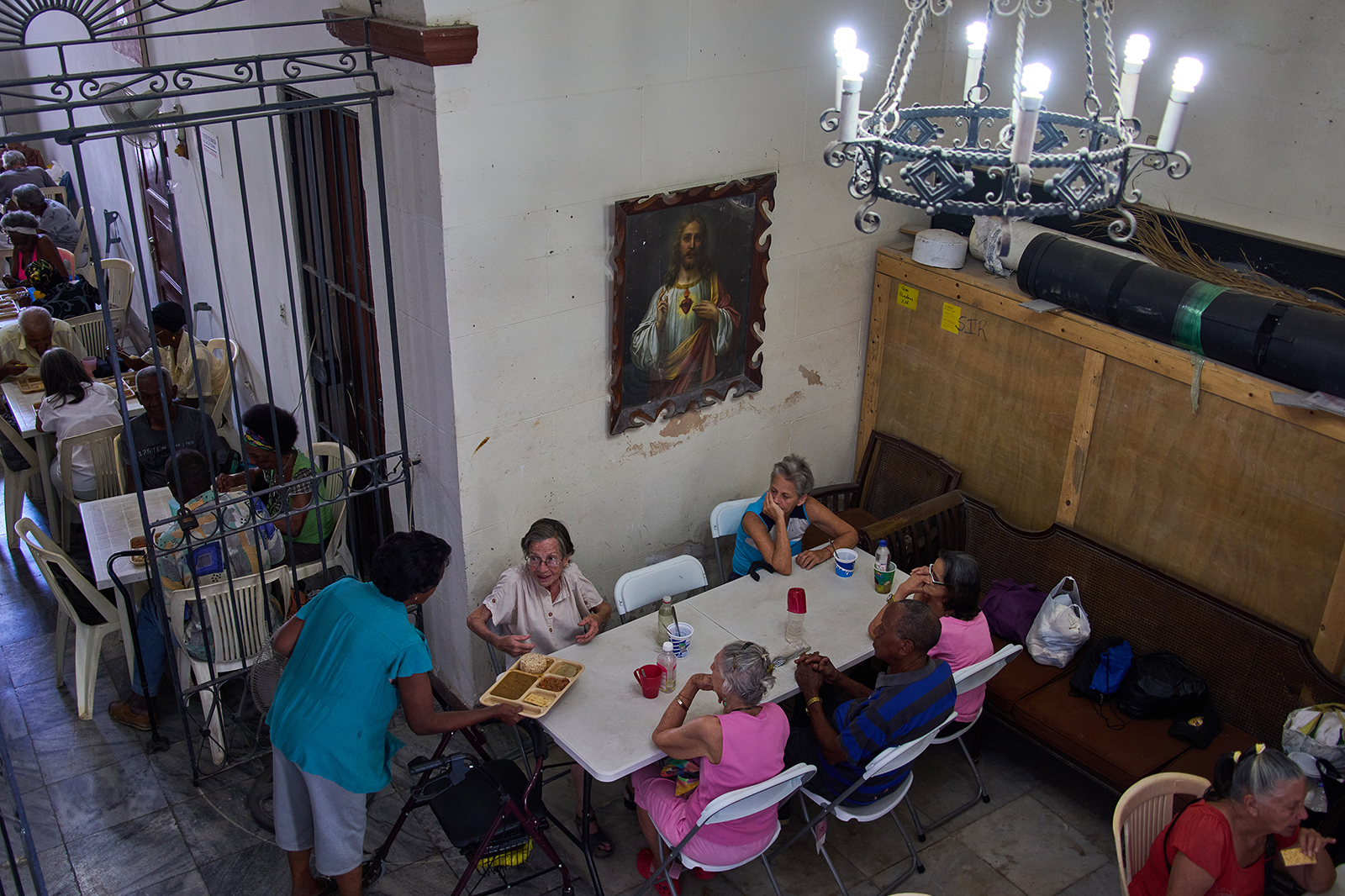
Carmen Casado, 84, is served a free meal of ground meat, rice, red beans and crackers through a program run by the Church of the Holy Spirit at a dining hall adjacent to the Catholic church in Old Havana, Cuba, Thursday, April 21, 2026. (AP Photo/Ramon Espinosa)
“This is the oldest diplomatic corps in the world and is certainly one of the most effective,” said Peter Martin, a former U.S. diplomat to the Holy See who now teaches at Boston College.
Those diplomats have played key roles in Cuba’s recent history. On Pope Francis’ 78th birthday, President Barack Obama announced that he would begin normalizing relations with Cuba, a sharp break in over 50 years of policy — and he personally thanked Francis for his “moral example” and role in brokering key prisoner releases that allowed for the agreement.
That announcement came after decades of work by the Vatican and U.S. bishops. U.S. bishops began to back Cuban bishops’ calls for an end to the U.S. embargo on Cuba in 1972, and Vatican leaders had played a key role in easing government repression of religious groups in the once-atheist country, starting with a 1989 trip by Cardinal Roger Etchegaray.
“Vatican officials always urge leaders to consider the human cost of war, aggression and economic sanctions,” Martin said. “In my experience, when Holy See officials raised these issues, they weren’t asking us to turn a blind eye to the Cuban government’s abuses; they were simply pressing us to engage in dialogue and consider policies that would not harm the most vulnerable.”
Anna Lee Stangl, head of advocacy for CSW, an ecumenical Christian religious freedom organization, told RNS that it was possible to both believe that U.S. sanctions are “unjust” and that the Cuban government is engaging in “the systematic and serious violation of individual people’s basic human rights.”
Her organization’s research with sources on the ground in Cuba informs the U.S. government’s assessment of religious freedom in Cuba, and she said they continue to collect credible reports about religious leaders experiencing harassment, fines, surveillance and unjust incarceration.
Catholics weren’t the only religious groups to contribute to the Obama administration policy.
“They wanted to hear from us and valued the expertise because they knew that our partners on the ground had the knowledge of exactly what was happening on the ground unfiltered,” said Catherine Gordon, Presbyterian Church (USA)’s representative for international issues, citing high-level meetings between denominational faith offices and the National Security Council.
Though the Vatican has continued to play a role in U.S.-Cuba diplomacy, faith groups opposing punitive U.S. economic policy on Cuba had not seen much success since the Obama years. In his first term, President Donald Trump reimposed restrictions on the island country, and despite some faith groups expecting the Biden administration would echo Obama’s Cuba policy, he continued Trump administration policies and added new sanctions.
Gordon said her coalition, largely left-leaning Protestant faith groups who had helped shape Obama’s Cuba policies, have been shut out ever since. Under Biden, “ we were seen as another network to promote their agenda with,” said Gordon, but despite assurances the administration was reviewing Cuba’s state sponsor of terrorism designation, “ they were never working on it,” she said, saying the Biden administration’s engagement with those groups was in “bad faith.”
Under Trump, those organizations, which work together under the Interfaith Working Group on Cuba, have tried alternate strategies to keep their ideas in conversation. In February, they delivered a letter to the White House and Congress calling on policymakers to end sanctions, enable humanitarian assistance and engage in diplomacy.
At the end of March, a group including leaders from the World Council of Churches, World Communion of Reformed Churches, the Anglican Communion, the World Methodist Council, Presbyterian Church (USA) and the United Church of Canada made a solidarity visit to Cuba, designed to highlight Cuban suffering and condemn U.S. sanctions, and met with Cuban government leaders.
And in April, Gordon and the working group also organized a webinar with Obama administration alumnus Ben Rhodes, who highlighted the importance and potential power of faith communities in shaping policy on Cuba. “There are faith-based arguments that can be made about the human suffering,” Rhodes said.
But they say they’ve largely been hitting walls in their efforts. Carol Blythe, the advocacy coordinator for the Alliance of Baptists, described feeling unheard in a January Zoom meeting with a State Department staffer when she asserted that their counterparts in Cuba are able to worship freely, counter to the department’s assessment of Cuba as a Country of Particular Concern for religious liberty.
At the end of 2024, Blythe, along with Stan Hastey, a retired denominational leader for the Alliance of Baptists, spearheaded a report about religious liberty based on a survey of pastors in Cuba and the testimonies of U.S. partners, which they delivered to the State Department.
“We contend that there is no systematic, ongoing, egregious violations of religious freedom that specifically include (1) torture; (2) prolonged detention without charges; (3) forced disappearances; or (4) other flagrant denial of life, liberty, or security of persons,” several denominations wrote in a letter introducing the report to then-Secretary of State Antony Blinken.
In the report, which emphasizes the improvements in religious liberty in Cuba, one U.S. pastor who served in Cuba argued that policing seditious political dissidence and controlling religious expression are significantly different.
The State Department and the U.S. embassy in Cuba did not respond to requests for comment.
“I believe that the church, international Christian leaders, can really call for peace and insist that the governments have a dialogue,” García Morris said. “The church in Cuba and the United States has not been indifferent. I believe that it has worked and continues working to prevent a much bigger and worse catastrophe.”