











This essay contains spoilers. Keep reading at your own cinematic risk.
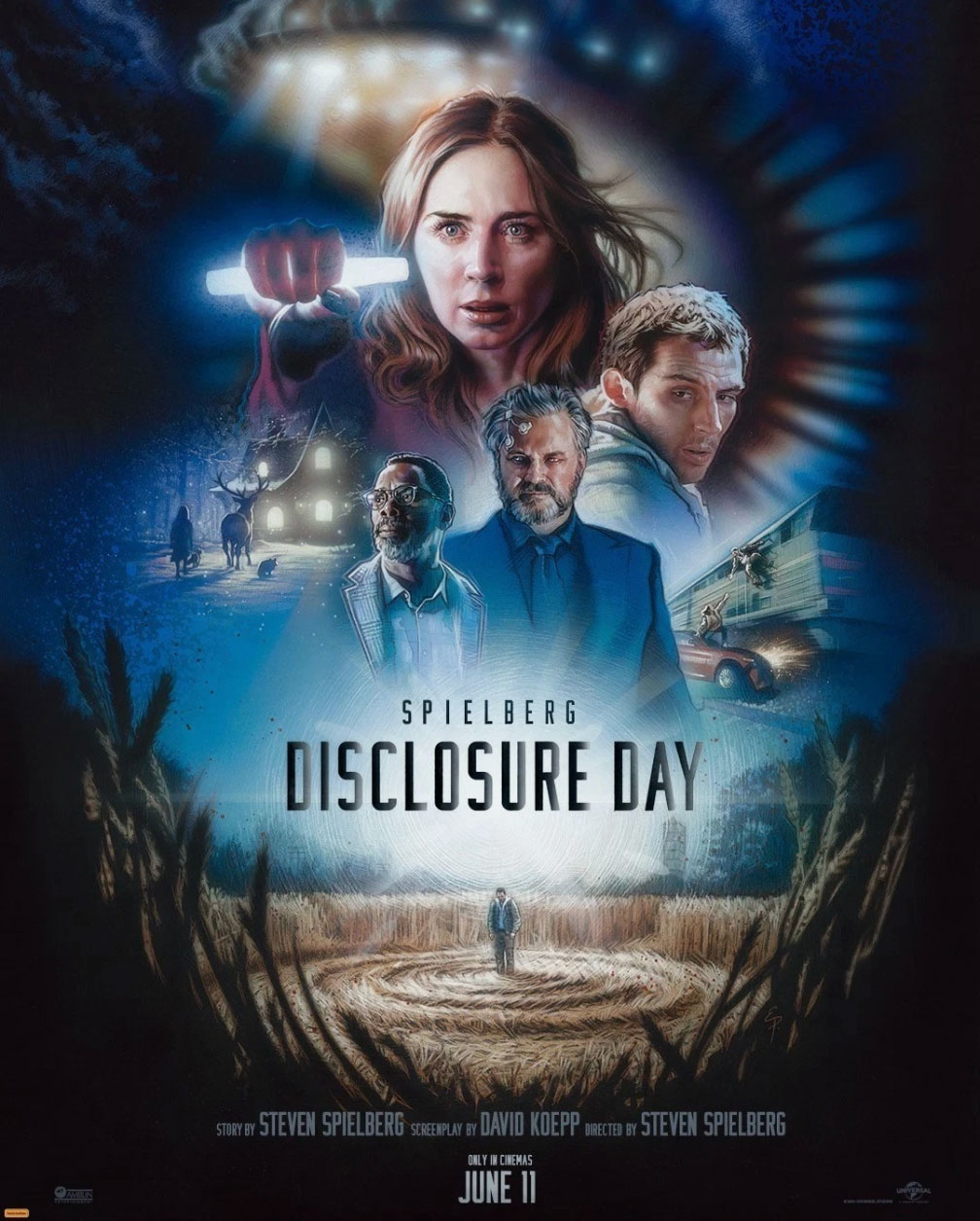
(RNS) — I went to see “Disclosure Day,” Steven Spielberg’s new film, expecting a science-fiction thriller. But I also came away with a theological essay.
To understand “Disclosure Day,” you have to see it as the third installment of a trilogy that Spielberg never announced but has been making for almost a half-century.
First, there was “Close Encounters of the Third Kind” (1977), the story of an Indiana electrician named Roy Neary (Richard Dreyfuss) who becomes obsessed with visions of a particular mountain after a UFO encounter. He makes a pilgrimage to Devils Tower in Wyoming, where humans and the alien visitors meet in a spectacular exchange of light and music. The aliens are not the typical fiends of Cold War-era science fiction. They are soft, docile, childlike and androgynous. They return their human abductees unharmed. The encounter is peaceful and spiritual.
I, and more than a few other rabbis, would show this movie as part of a study session on the Jewish festival of Shavuot. Why? Shavuot commemorates the giving of the Ten Commandments at Mount Sinai. The transformative encounter at a mountain — a story of transcendence. “Close Encounters,” it seemed to many of us, was a parable about the divine revelation.
Second, there was “E.T. the Extra-Terrestrial” (1982). A visitor from outer space arrives. He is sweet and benign. He heals a dying plant with his touch. He forms a telepathic bond with a lonely boy named Elliott — a true sense of empathy — in which the child actually experiences what E.T. is enduring. The authorities pursue E.T. and they close in. E.T. appears to die. He revives. In his farewell, he touches Elliott’s forehead with a glowing finger and says: “I’ll be right here.”
When I saw the movie, almost 45 years ago, the symbolism grabbed me. This was a modern retelling of the gospel story. (I was not alone in thinking that; any number of Christian preachers saw it as well). Spielberg himself has denied ever intending it, but the resonances run so deep they exceeded the filmmaker’s own intentions.
If only Spielberg could have had a cup of coffee with the late great psychoanalyst Carl Jung. As early as 1946, Jung began ruminating on the cultural fascination with UFOs. In a letter dated Sept. 14, 1960, he wrote: “The science fiction about traveling to the moon or to Venus and Mars and the lore about Flying Saucers are effects of our dimly felt but none the less intense need to reach a new physical as well as spiritual basis beyond our actual conscious world.”
Which brings us to “Disclosure Day,” and to Spielberg completing the trilogy. The film stars Emily Blunt as a Kansas City meteorologist who begins experiencing phenomena she cannot explain, and Josh O’Connor as a cybersecurity whistleblower who has decided the truth about what’s out there “belongs to 7 billion people.” I won’t say more about the plot, except that what arrives in this film neither destroys nor threatens. The question it leaves audiences with, posed in the film’s promotional tagline, is: “If you found out we weren’t alone — if someone showed you, proved it to you — would that frighten you?”
It’s Spielbergology — from the Sinai revelation in “Close Encounters,” to the Christ event in “E.T.,” to the ultimate big reveal in “Disclosure Day.” It’s the promise of ultimate transcendence.
Or, as Jung put it in his Letters Vol II: “These [UFO] symbolisms, which are cropping up everywhere nowadays, paint a picture of the end of time with its eschatological conceptions: destruction of the world, coming of the Kingdom of Heaven or of the world redeemer.”
There’s a pattern that goes beyond Spielberg. Alien films are a kind of cultural barometer, registering what we fear and what we hope for at any given moment in history.
During the Cold War, the aliens came to destroy us. “The War of the Worlds” in 1953 and its post-9/11 remake with Tom Cruise in 2005 gave us creatures whose only purpose was annihilation. But by 2016, something had shifted. In “Arrival,” the problem is no longer that they want to destroy us; we simply don’t understand each other’s languages.
And now, in this fraught moment, Spielberg gives us “Disclosure Day,” and the aliens are benign once more — distant cousins of E.T. We are desperate for a different kind of story.
That is why this movie is really not about alien life. It’s about empathy — feeling from inside another’s reality, even when that reality is alien to you in every sense of the word.
There’s a verse from Leviticus that Rabbi Akiva called the great principle of the entire Torah: “Love your neighbor as yourself.” This is not because your neighbor is familiar, and not because you share a language or a ZIP code or a tribe, but because they are kamokha, like you; and b’tzelem Elohim, in the image of God.
And now, the real spoiler.
The last word of the movie is “listen.” Listen as in Sh’ma. Listen as in listening to each other, to the inner language.
That is the key to the whole thing: listening. It goes way beyond the movies.
Imagine what would happen if Israelis and Palestinians could really listen to each other. The real peacemakers in that conflict, the ones who make peace piece by piece, are the ones who are truly listening to each other. It is the realization that hearing the other might make you vulnerable, but it does not diminish you and it does not weaken you. I can listen to Palestinians talk about how they still carry the keys to their families’ houses in pre-state Israel, and they can listen to Israeli Jews talking about the farhud, the Nazi-inspired pogrom in Baghdad that murdered an estimated 180 Jews exactly 85 years ago this month.
Sh’ma: Listen, hear, be present.
Spielberg had a Jewish education. He did not love his bar mitzvah experience, he’s shared. In fact, he threw oranges at the guests in protest. Like many Jews of his generation, he rebelled. “Schindler’s List” was, in a sense, his homecoming to Judaism.
But, Sh’ma. Maybe that was the word that stuck. That simple command was always there. That is the real disclosure.