











(RNS) — On Tuesday (April 21), the 5th U.S. Circuit Court of Appeals gave Texas the green light to require every public elementary and secondary school classroom in the state to display the King James Version’s translation of the Ten Commandments. In its decision in Nathan v. Alamo Heights Independent School District, the court’s 9-8 majority both rejected long-standing precedent and grounded its ruling in an interpretation of the First Amendment’s establishment clause that is at odds with how the Supreme Court has understood it for over 60 years.
The precedent is Stone v. Graham, in which the Supreme Court in 1980 ruled unconstitutional a comparable Kentucky law requiring a copy of the Ten Commandments to be posted in every public elementary and secondary school classroom. That decision relied on the so-called Lemon test, a three-pronged Supreme Court standard created in Lemon v. Kurtzman (1971) to determine if government actions or laws violated the First Amendment’s establishment clause. To be constitutional, a law had to have a secular purpose, have a primary effect that neither advanced nor inhibited religion and should not foster excessive government entanglement with religion.
Because the Supreme Court has in recent years abandoned this test — notably in Kennedy v. Bremerton School District (2022) — the appeals court felt entitled to consider Stone as no longer binding.
The Stone court rejected as pretextual a provision of the Kentucky law mandating that after the last of the displayed Commandments there be a notation in fine print reading, “The secular application of the Ten Commandments is clearly seen in its adoption as the fundamental legal code of Western Civilization and the Common Law of the United States.” A claim of educational function could not be used to hide religious purpose, said the court.
The Texas law in question contains no such claim, nor does the 5th Circuit assert one. Rather, it contends (without citing any cases) that “courts now ask a question rooted in the past: does the law at issue resemble a founding-era religious establishment?” To answer this originalist question, the court adopts six “hallmarks” of 18th-century religious establishments:
(1) government control over religious doctrine, governance, and church personnel; (2) compulsory church attendance; (3) compelled financial support, especially in the form of land grants and religious taxes; (4) prohibitions on worship in dissenting churches; (5) use of church institutions for civil functions; and (6) restriction of political participation to members of the established church.
Because the Texas law “bears none of the hallmarks of a founding-era establishment of religion,” the court concludes that it does not violate the establishment clause.

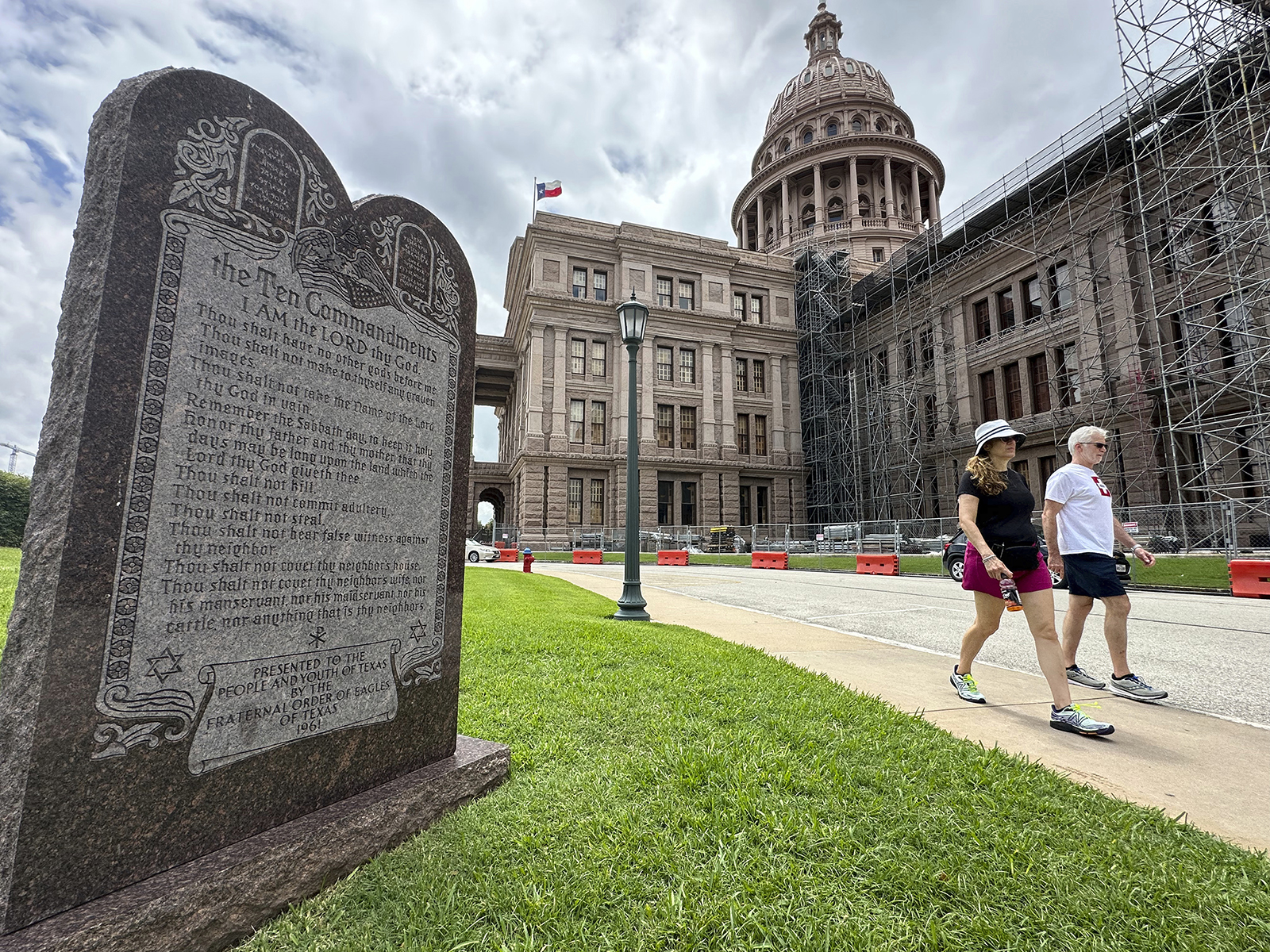
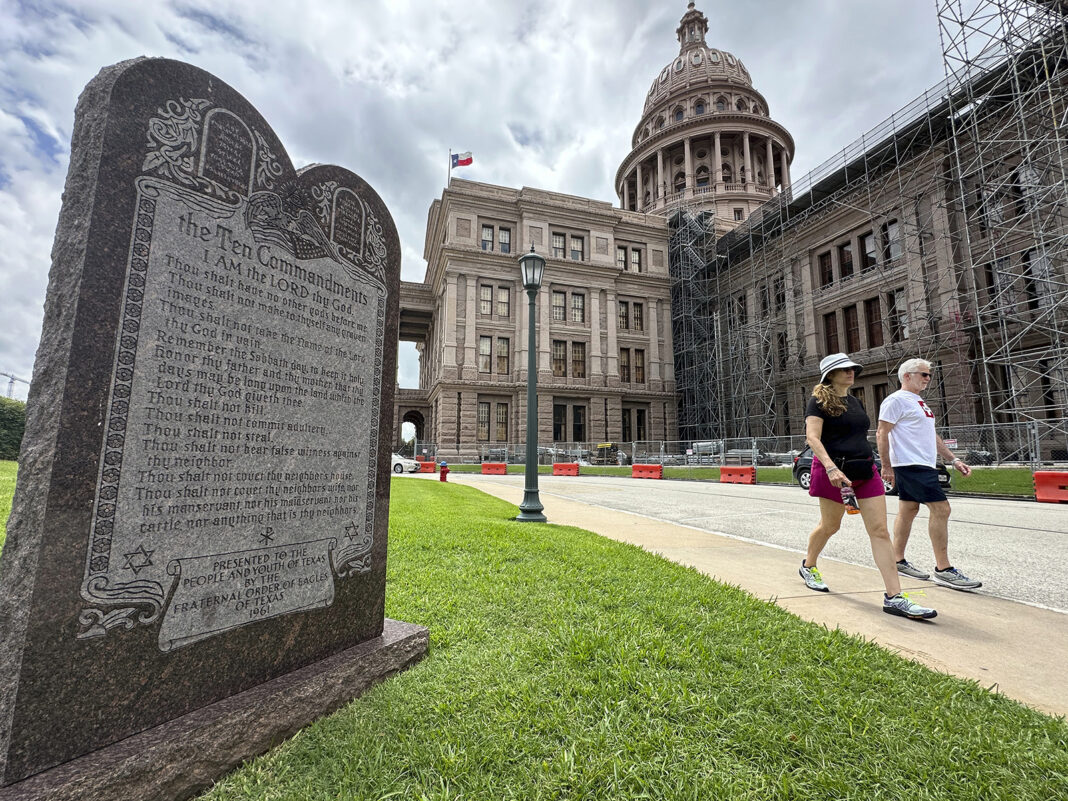
Visitors walk past a granite monument of the Ten Commandments outside the state Capitol, June 20, 2024, in Austin, Texas. (AP Photo/Paul Weber)
A problem with this way of understanding the establishment clause is that the clause does not say “Congress shall make no law creating a religious establishment.” It says, “Congress shall make no law respecting an establishment of religion.” And the man who presided over the drafting of that language, James Madison, did not mean to restrict it to prohibiting a formal establishment like the Church of England. As he later explained, “The Constitution of the U.S. forbids everything like an establishment of a national religion.” (italics added)
Under “everything like” Madison included the hiring of congressional and military chaplains and “Religious proclamations by the Executive recommending thanksgivings & fasts.” There can be little doubt that, had state laws been placed under the aegis of the Bill of Rights when he was alive, he would have also included the posting of religious injunctions in public schools.
Be that as it may, by the 5th Circuit’s standard of review, establishment clause bans going back to the school prayer and Bible-reading decisions of the 1960s would be thrown out, since they do not violate any of the “hallmarks.” Or, as one of the three dissents in the case points out, “The majority’s reduced Establishment Clause would allow state governments to evangelize by affixing a crucifix — or a mezuzah, or a statue of Buddha, etcetera, to the exclusion of other symbols — purchased with state funds, in every classroom.” For that matter, a law erecting a cross on a courthouse or state capitol would also be allowed.
To be clear, there are ample grounds for the Supreme Court not to adopt the 5th Circuit’s standard. As another dissent points out, the court’s abandonment of the Lemon test does not automatically nullify establishment clause bans that employ it, or render all its prongs null and void. The court could, for example, hold on to a requirement of secular purpose.
What’s clear, however, is that the 5th Circuit has opened the door to a degree of government endorsement of religion that goes well beyond anything the country has experienced since the last days of state religious establishments in the early 19th century. That ought to give all of us pause.