







(RNS) — Stories about the undue influence of billionaires on American life and politics have become dishearteningly common. Much of that commentary has focused on Silicon Valley tech billionaires. But a new book sheds light on the outsize influence of billionaires operating in other sectors: arts, crafts and conservative Christianity.
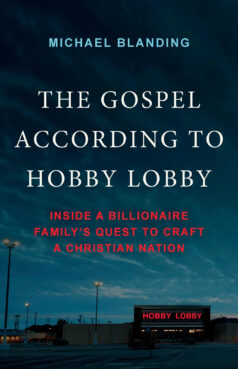
In “The Gospel According to Hobby Lobby: Inside a Billionaire Family’s Quest to Craft a Christian Nation,” journalist Michael Blanding tells the story of the Greens, the billionaire family that owns and operates the behemoth Hobby Lobby chain of craft supply stores.
Central to the story is how the Greens’ particular brand of conservative evangelical Christianity, and the Republican politics that accompanies it, informs how they’ve used their fortune to try to remake the world in accordance with their conception of God and moral goodness. Their story is noteworthy in large part because of how successful they’ve been in converting their colossal wealth into political, social and religious influence.
In his book published by PublicAffairs last month, Blanding charts various ways the Greens have used their money to prop up conservative religious and political actors, from sizable donations to Bill Gothard’s Institute in Basic Life Principles (of “Shiny Happy People” infamy) to repeated multi-million dollar donations to the conservative Christian legal advocacy organization, the Alliance Defending Freedom. The latter organization was a key architect of the legislation and litigation that overturned Roe v. Wade and has been a key driver of anti-LGBTQ+ laws in the U.S. and abroad.
Blanding also recounts the Green family’s (mis)adventures in acquiring, often in a legally dubious manner, artifacts for their Museum of the Bible. In so doing, he identifies ways they’ve used their fortune to influence which scholars get access to important biblical artifacts, which risks warping biblical scholarship to align scholarly conclusions with those of their funders.
As a professor of philosophy and law, I see “The Gospel According to Hobby Lobby” as important for what it reveals about both the political weaponization of the First Amendment and how easily money can corrupt even sincere attempts to discover and promote the truth.
Blanding offers a well-rounded account of the Green family, seamlessly weaving together the theological, religious, economic, social and political forces that have shaped them, and which they have in turn shaped. Moving chronologically, the book begins with an account of the Pentecostal Christianity into which the patriarch of the Green family, David Green, was born.
David was the son of poor but devout Pentecostal ministers. All five of his siblings took on roles in ministry, leaving David feeling like the “black sheep,” Blanding reports. Despite being shy and a struggling student, David discovered he had a knack for retail while working department store jobs in his native Oklahoma as a teen and in his 20s. Through hard work and attentiveness, he quickly ascended the managerial ranks of the TG&Y department store chain.
Yet, David said that his mother was unimpressed. He has recounted that when sharing his professional accomplishments, her response was, “Oh yeah, what are you doing for the Lord?”
Much of David’s subsequent motivation appears as his attempt to answer that question by using his money to further God’s kingdom, as he understands it.
Blanding writes from the perspective of a charitable outsider, typically letting the Greens and other characters speak for themselves. He does this while avoiding giving the Greens a free pass when their views are out of step with the available evidence (which they often are). The family declined to speak with him for the book, so Blanding’s reporting relies on past interviews, legal documents and a variety of other sources, many of which contain the Greens’ own accounts of their story.
For example, according to the book, David recounted that on Christmas Day 1994, he was dismayed to find no references to Christmas in that day’s copy of The Sunday Oklahoman. He has since claimed this event was pivotal in his decision to start advocating for his Christian faith more publicly. Yet Blanding reports that on Christmas Day 1994, the newspaper had in fact “contained dozens of mentions of Christmas, starting with a large front-page photo of a live nativity scene with baby Jesus in the manger.”
More significantly, when the Greens sued the federal government over the Affordable Care Act’s requirement that certain employee health insurance plans cover contraceptives, they did so by claiming that some forms of contraception could prevent fertilized eggs from implanting in the uterus, which they considered a type of abortion. However, Blanding notes that scientific studies available during their suit discredited these claims. (The Greens eventually won in a contentious 5-4 Supreme Court decision along partisan lines.)
As Blanding reports, in a family meeting in the early 2000s, David’s oldest son, Mart, made explicit an idea that had long guided much of the Greens’ actions. “What is the one word our family is going to be known for 50 years from now?” His answer: “Bible.”
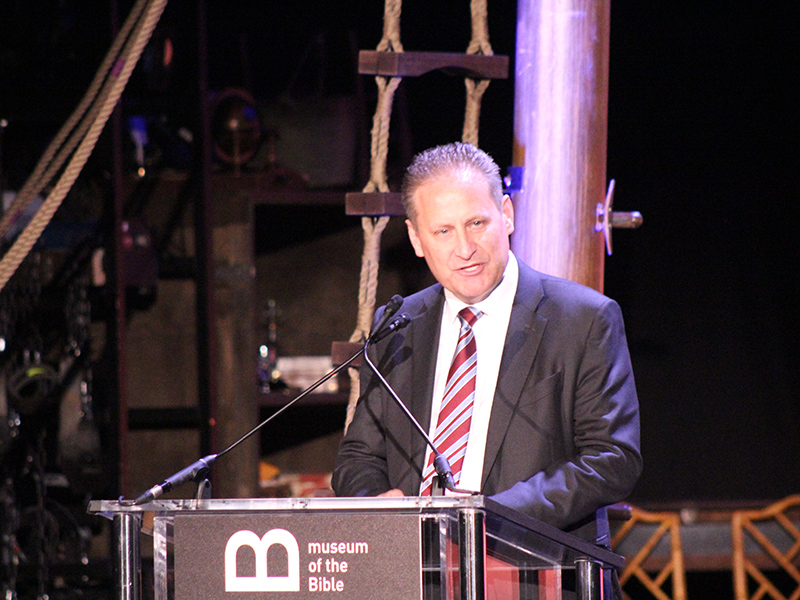
In addition to giving large sums of money to those promoting Bible translation and dissemination, the Greens eventually decided to get more directly involved in sharing the Bible through the creation of the Museum of the Bible in Washington, D.C.
Blanding colorfully covers the haphazard process by which the Greens acquired artifacts for the museum. This included Mart and his brother Steve making frequent trips to the Middle East and paying top dollar for items from vendors who often gave farfetched explanations for how they had come to acquire the items they were selling. Eventually, a federal investigation revealed that the Greens had purchased thousands of items that were stolen or fake.
Blanding tells of warehouses full of improperly stored ancient artifacts alongside Hobby Lobby’s kitsch, and of a horrified staffer who watched one of the Greens’ guests, Marco Rubio, stand carelessly over a precious artifact with coffee cup in hand.
I found it striking how the Greens’ behavior aligns so neatly with the kind of insouciance to legality and consequences that is so often found among the uber-rich. While their motives are perhaps more noble than those of Elon Musk or Jeff Bezos, the numbing effects of extreme wealth appear similar.
The Museum of the Bible is a tale of acting first and thinking later (if at all). This belies a more general problem. The Greens have been quick to act in trying to bring the world into alignment with their understanding of the Bible. But the Greens are not biblical scholars and have not put in the work to obtain true expert knowledge of the Bible.
Instead, the Greens have paid for access to scholars whose views align with what the Greens already think. Enmeshing themselves with this relatively small subset of evangelical scholars (and pseudo-scholars like David Barton) appears to have given them a false sense of confidence in the accuracy and rigor of their views about the Bible and its role in American history. In short, they’ve obtained the best sources of confirmation bias money can buy.
We live in a world that’s increasingly shaped by the views and preferences of billionaires. That includes the Greens and their views of the Bible and U.S. politics. And in that sense, the kind of understanding that Blanding provides us of the Greens helps us understand ourselves and our world.
(Mark Satta is associate professor of philosophy and law at Wayne State University in Detroit. His research focuses on the First Amendment, civil rights, philosophy of law, and social epistemology, among other areas. The views expressed in this commentary do not necessarily reflect those of Religion News Service.)