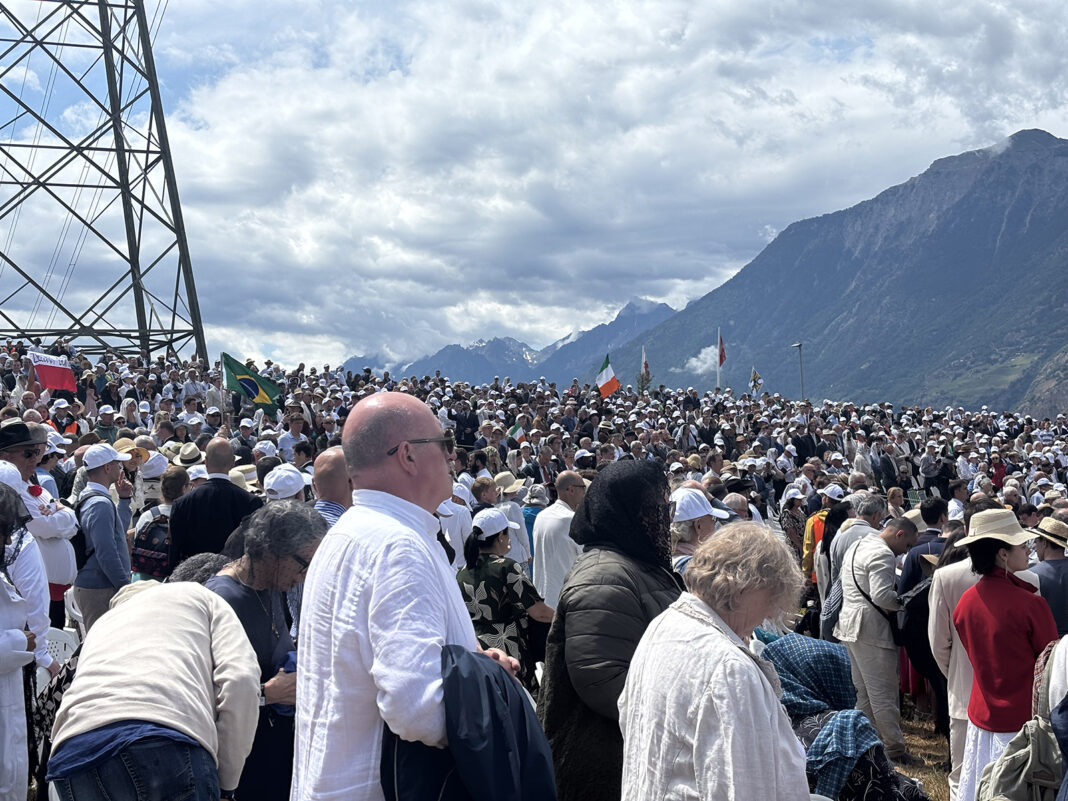
ÉCÔNE, Switzerland (RNS) — A group of traditionalist Catholics directly defied Pope Leo XIV on Wednesday (July 1) by ordaining four new bishops without his consent, calling it their “sacred duty” during a ritual-laden ceremony at the society’s seminary in the Swiss village of Écône.
The Society of St. Pius X (SSPX) had received repeated warnings from the Vatican that their episcopal consecrations would constitute a schismatic act and trigger the automatic excommunication of all bishops involved. On Thursday (July 2), the Vatican went further than expected, declaring that the four new bishops, the two bishops who consecrated them, all priests of the SSPX and all lay Catholics who “adhere formally” to the group were now in schism and excommunicated.
In an eleventh-hour appeal, Pope Leo had published a letter dated June 29 addressed to the superior general of the society, the Rev. Davide Pagliarani. “I implore you and ask you with all my heart: Turn back!” the pontiff wrote, saying the consecrations would be a “sin of extreme gravity” for threatening the unity of the church.
Yet in a meadow filled with more than 1,000 clergy and another 15,000 faithful wearing free “Écône 2026” hats — which rendered the crowd as white-capped as the Alps around them — the SSPX proceeded as planned, with a statement read at the start of the ceremony declaring that “every punishment or sanction” brought against them “will have no validity.”
Since his inaugural Mass, Pope Leo has championed a message of unity for the Roman Catholic Church. Now he faces the largest internal crisis of his young papacy.


“We are accused of not loving the pope,” Pagliarani said in French during a sermon at the ceremony. “It’s precisely because we love the pope as the vicar of Christ that we do not want to see the pope humiliated anymore, next to false priests representing false religions.”
The Society of St. Pius X, a priestly fraternity, was founded in 1970 by French Archbishop Marcel Lefebvre in opposition to the reforms of the Second Vatican Council from 1962 through 1965, which promoted the role of laypeople, ecumenicism and interreligious dialogue and enabled Mass to be celebrated in vernacular languages instead of Latin. In 1988, Lefebvre consecrated four bishops in Écône without approval from Pope John Paul II.
Wednesday’s ceremony came 38 years to the day after Lefebvre was excommunicated alongside those four bishops — including Bishop Alfonso de Galarreta, who led Wednesday’s consecrations and was again excommunicated Thursday. In 2009, after years of strained relations between SSPX and the Holy See, Pope Benedict XVI remitted the 1988 excommunications as a step toward healing the rift. But doctrinal differences remained unresolved, with the SSPX still in a “canonically irregular” status within the church, according to the Vatican.
Pope Francis continued conciliatory efforts with the SSPX, allowing the society’s priests to hear valid confessions in 2015 and, with the authorization of the local bishop, to officiate marriages formally recognized by the church in 2017. But Francis also announced restrictions on the Latin Mass in 2021, angering many traditionalists.
The latest consecrations could prompt Pope Leo to end the Vatican’s decades of dialogue with the breakaway society. The Vatican’s July 2 decree of excommunication states that the SSPX now administers the sacraments illicitly and can no longer officiate marriages or hear valid confessions, walking back years of accommodation.


The SSPX justified this week’s consecrations by invoking a state of necessity: Only two of the four bishops consecrated in 1988 are still alive, limiting the society’s capacity to ordain new priests. The expanding global community of 800 churches in 77 countries includes 1,482 vocational members — with 733 priests and 264 seminarians — serving an estimated 150,000 to 200,000 lay followers.
At the start of the ceremony, the Rev. Foucault le Roux, secretary general of the society, explained the logic behind the consecrations, saying that since the Vatican II reforms, “the authorities in the church have been animated by a spirit that is contrary to that of the faith and have been acting against holy tradition.”
Attendees from at least 70 countries travelled to Écône to celebrate the four new bishops — one from the United States, one from Switzerland and two from France. The cloud-covered slopes below the SSPX seminary were filled with nuns in black habits, Girl Scouts offering bottled water, tonsured monks and layfolk waving national flags.
True to the SSPX tradition, the entirety of the five-hour Mass, from Gregorian chant to the giving of the episcopal insignia, was conducted in Latin, except for the introduction, the sermon and occasional announcements.
Though Pope Leo’s plea proved unable to stop the event, the weather did — for nearly an hour. Thunder and torrential rain just before Holy Communion forced the ceremony to pause, sending those without umbrellas or ponchos seeking shelter beneath tents.
Those who remained sang “Ave Maria” and “Christus Vincit” on repeat, many clutching dripping rosary beads, until the storm subsided. It hardly dampened the mood.
“It’s something that’s once in a lifetime,” said Alexander De Volleda, 25, who was baptized by an SSPX priest in Florida and recently moved to Spain. “It’s sort of like a Mecca (for) ‘trads’ coming here,” he continued, referring informally to traditionalist Catholics.
Some attendees, though, expressed more trepidation about the consecration of new bishops without papal approval. “I thought that, at the very least, I would like to see the ceremony, even if I’m maybe not quite 100% of the way there,” said Dennis Vu, 30, who flew in from just outside of Pittsburgh, Pennsylvania.
Vu, a traditionalist Catholic who “really dislike(s) the Novus Ordo” — the form of Mass introduced in 1969 and celebrated in most Catholic churches, typically in languages other than Latin — sympathizes with the SSPX but is not formally affiliated.
“I told some of my friends that I was going, but I made sure it was specific friends,” Vu said. “I can’t tell too much, because then they’ll think I’m schismatic.”