RIVERSIDE COUNTY, Calif. (RNS) — When Abdul Wahab talks about the proposed Crescent Gardens Cemetery, a dedicated Muslim burial site, he often returns to a simple reality.
“People are going to leave this world anyway,” he said. “We don’t have a choice. We need the graves.”
Wahab is a board member of the Muslim Mortuary & Cemetery Committee, the nonprofit that has for years tried to move the cemetery plan forward against some local opposition primarily concerned with groundwater contamination.
Traditional Islamic burials generally involve ritually washing and burying the body in a shrouded white cloth as soon as practical after death, often within 24 hours. This tradition of burying the body without a casket has led some neighboring residents to raise concerns over water pollution. However, the Muslim Mortuary & Cemetery Committee told RNS all burials it oversees require the deceased to be placed in a covered cement box.
“We don’t require caskets, but we require cement boxes for everyone,” Wahab said, citing California burial regulations
The cemetery project has required years of environmental studies, public hearings, and meetings with residents as it moves through the county approval process. Riverside County’s environmental impact report is expected in 2027.
County resident Anita Wakefield said she worries the proposed cemetery could affect the quality of nearby Canyon Lake’s water supply. “My biggest concern is whether this could affect our drinking water,” she said.
A petition circulated among locals late last year urged: “SAY NO TO ‘dead-people-goo’ WATER CONTAMINATION.”
Other neighbors have said they don’t want the view of a cemetery from their homes.
One of those locals is Milvarene Monica Osterhout-McNeil, who told ABC Los Angeles she was concerned about the “psychological impact of having that right out your kitchen window.”
Meanwhile, Muslim organizations across Southern California have backed a petition urging Riverside County officials to approve the cemetery. Supporters say Crescent Gardens would help meet future burial needs for Muslim families, provide a place where burials can take place according to Islamic tradition and emphasize dignity and care for the deceased.
Many Muslim families seek burial in dedicated Muslim cemetery sections where those customs can be observed and relatives can be buried near one another.

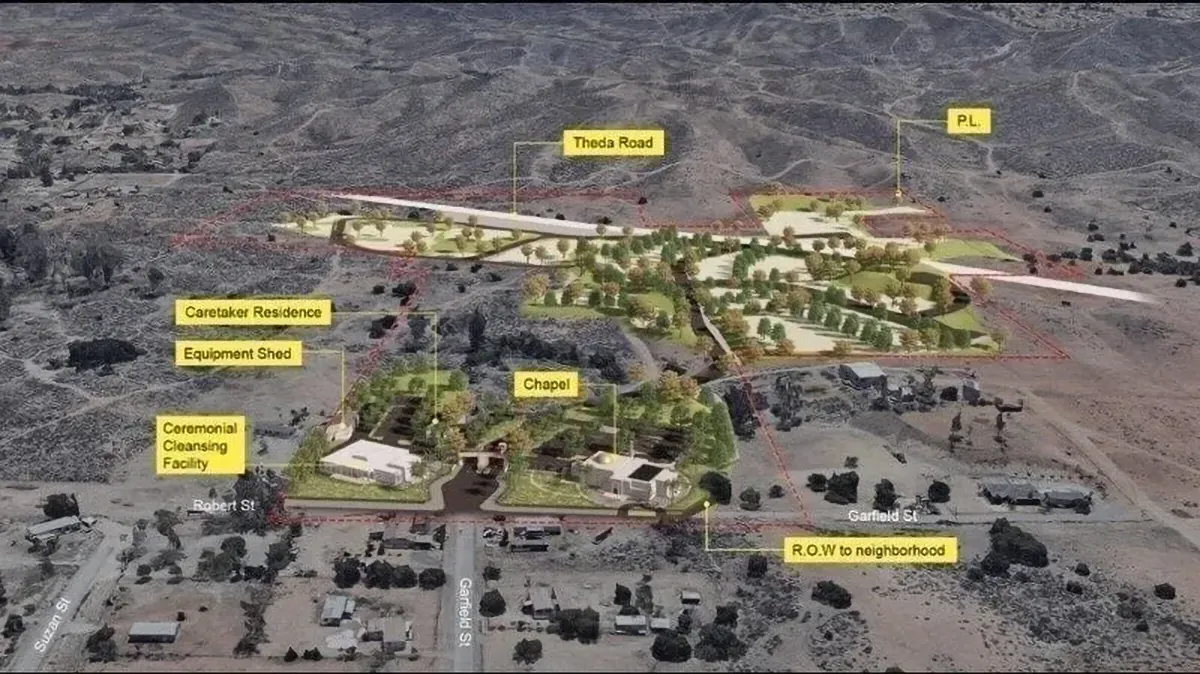
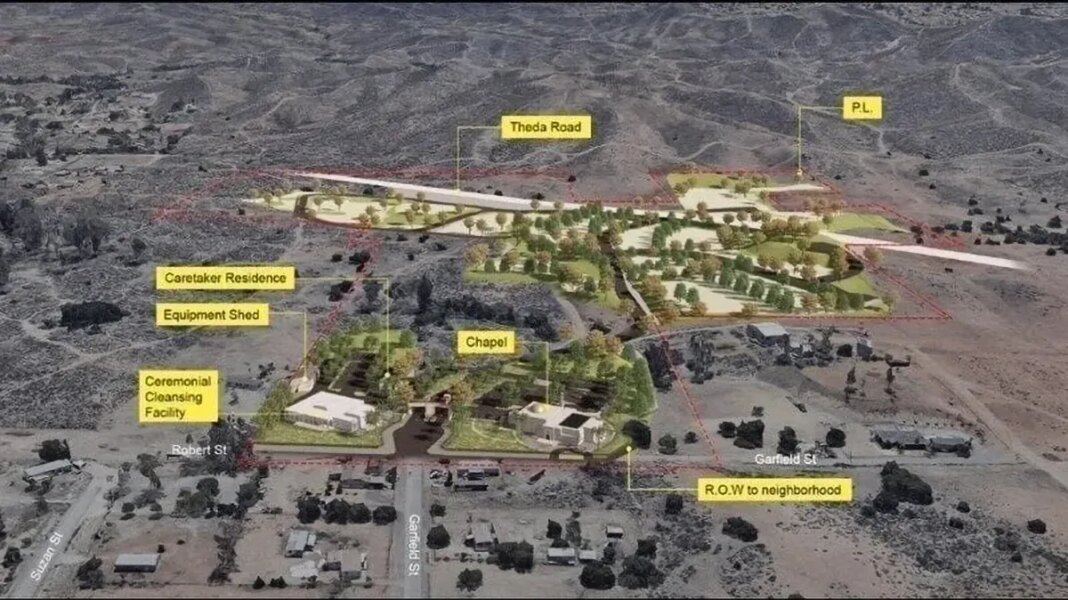
An illustration of the proposed Crescent Gardens Cemetery. (Courtesy image)
In Southern California, community leaders say planning for Muslim burial spaces often begins years before it is needed.
“As soon as the cemeteries get full, we have to look for alternate sites,” said Ahsan Baseer, president of the Islamic Society of Corona-Norco. “That’s what we are looking at, an alternate site.”
Efforts to secure dedicated Muslim burial space in Southern California date back to the early 1990s, according to Wahab. Over the years, the Muslim Mortuary & Cemetery Committee has helped establish smaller Muslim burial sections in cemeteries across the region, including Westminster, Anaheim, La Verne and Colton.
As those burial sections filled, committee members started searching for land that could accommodate a dedicated Islamic cemetery. The search spanned 21 cities before they settled on a patch of just under 85 acres in Riverside County. The MMCC purchased the property in August 2021 and has spent the years since working through the county’s approval process.
The plans dedicate 25 acres for 20,000 burial plots and estimate 10 to 15 burials a month. It would also be the MMCC’s first stand-alone cemetery, after decades of establishing Muslim burial sections within existing cemeteries across Southern California.
To address community concerns about water contamination, Riverside County Supervisor Karen Spiegel requested additional water quality studies from the MMCC, according to a statement from her office. Spiegel “takes the community’s concerns seriously” and will continue to monitor the project as more information becomes available, her office said.
Sylvia Ornelas, community affairs supervisor and public information officer for the Elsinore Valley Municipal Water District, said as part of the environmental review process, the district reviewed the project and suggested mitigation efforts. Those suggestions included clear minimum distance requirements between burial sites and streams that flow into Canyon Lake, measures to prevent stormwater runoff from affecting nearby waterways and long-term monitoring of water quality.
Baseer said he understands why residents have questions but believes some concerns stem from misunderstandings about Muslim burial practices. “People always try to find some excuse,” he said, adding that reactions can change when people hear the words “Islamic” or “Muslim cemetery.”
“We have gone through every study they asked for,” Wahab added.
Away from public hearings and environmental reviews, many Muslim families are already making plans of their own.
Some purchase burial plots years in advance. Others enroll in burial programs run by mosques and community organizations, paying monthly fees so arrangements are already in place when a loved one dies.
“It’s not the question of space, it’s a question of assurance,” said Syed Mohamed Aftabuddin, a committee member with the Sri Lanka Muslim Association of California.
Burial programs like the one offered through the Sri Lanka Muslim Association of California allow members to plan years in advance, rather than making arrangements after a death.
The plots are already secured, and the association helps coordinate funeral arrangements when a member dies. “If somebody passes away, you never know when, right?” Aftabuddin said. “Otherwise, you have to run from cemetery to cemetery.”