





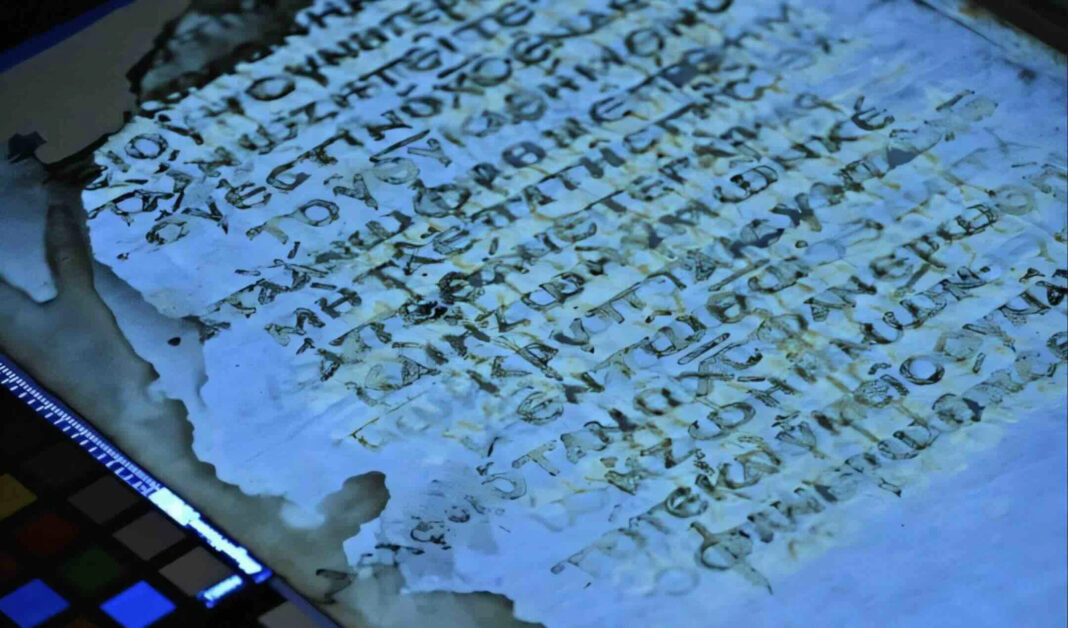
(RNS) — An international research team has recovered 42 lost pages from Codex H, a sixth-century Greek New Testament manuscript of St. Paul’s letters, using multispectral imaging and carbon dating.
The new discovery, led by Garrick Allen, a professor of divinity and biblical criticism at the University of Glasgow in Scotland, offers insight into how early Christians read and understood Scripture — and provides a point of connection for contemporary Christians.
Monks annotated the letters of St. Paul with poems, prayers and reflections at the remote Great Lavra Monastery on Mount Athos in Greece. Codex H is also one of the earliest-known examples of the Euthalian Apparatus, a system of chapter lists and headings to organize Paul’s letters, relied on long before the chapter and verse system used today.
“We mark up our own Bibles or make annotations or think about the complexities of these texts that were part of a much longer tradition of people who have been doing this same activity for 2,000 years,” Allen told RNS in an interview Monday (April 27), after the university announced the discovery days earlier.
Among the findings, Allen said, was a small Byzantine poem written in the margins.
“It’s both serious and silly at the same time,” he said. “It says something like, ‘let Plato and Plutarch be silent before Basil the Great, who thinks about the great moral laws of the world,’ or something like this. It’s insinuating that the literature these communities were reading was on par with the great ancient Greek classics.”
Reading the prayers and poems written in Greek offers a more personal glimpse into the people behind the manuscript, Allen said. “These are little snapshots into the lives of people we have no record of otherwise — their desire to be close to God, to be part of something bigger than themselves, to belong to a much longer tradition that we’re still part of today,” he said.
RELATED: Worship attendance at churches up for the first time in decades, according to new report
By the 13th century, Codex H had been disbound, likely due to wear and tear that made the text difficult to read, according to Allen.
“Because parchment was expensive, monastic libraries often recycled older material for use as binding or flyleaves, and they repurposed Codex H to repair other manuscripts in the collection,” Allen said. “This is why parts of the manuscript are so dispersed today.”
Its pages were retraced in fresh ink in an effort to preserve them, then reused in other volumes — a process that fragmented the manuscript. Today, those pieces are scattered across libraries in Italy, Greece, Russia, Ukraine and France, according to the report by the University of Glasgow.

Multispectral imaging and carbon dating have been used on Codex H. (Photo by Damianos Kasotakis/University of Glasgow)
“That process left a secondary imprint, as the new ink transferred onto facing pages, creating faint, mirror-image outlines that remain barely visible today,” Allen said.
As a result, each surviving page preserves both its original text and a reversed impression from the page it once faced. Researchers used that effect to recover roughly 50% more of the manuscript’s content, including text from pages that didn’t physically survive.
“It preserves about 100 annotations or corrections to the text from later readers, and you can get an insight into the way that people are comparing different copies of Paul’s letters and trying to create the right text,” Allen said.
In the university report, Allen said the team applied multispectral imaging to surviving pages to reveal faint “ghost” text, traces of writing that no longer exists physically, which allowed researchers to reconstruct multiple pages of content from a single leaf. He said that specialists in Paris conducted radiocarbon testing to verify the parchment dates to the sixth century.
Key findings include ancient chapter lists for Paul’s letters that differ from modern chapter divisions, providing evidence of how sixth-century scribes corrected, annotated and engaged with the texts, and sharing insight into how the physical materials of manuscripts were recycled after centuries of use.
“It shows that the New Testament, and the Bible more broadly, is something that’s always in a state of flux, something that’s always changing,” Allen said. “It’s something that religious communities continue to make each generation as they continue to use these texts in important ways.”
The research team has worked on the project for the past three years as part of a broader effort examining early New Testament manuscripts, and the research was funded by the Arts and Humanities Research Council. The recovered text does not reveal previously unknown biblical passages, but it offers insight into the lives of early Christians who produced and studied these texts.
“The (Great Lavra Monastery) hasn’t changed much in 1,000 years, in some ways,” Allen said. “So, when you go to that space, you can imagine this manuscript being used by the community there today.”