









(RNS) — The closest Kareem Sarsour had come to seeing his father in more than two months was standing outside an Indiana county jail where he is being held by immigration officials.
Salah Sarsour, a Muslim Palestinian leader and green card holder, was detained by U.S. Immigration and Customs Enforcement in March. Kareem Sarsour’s visit requests have been repeatedly denied.
“It’s heartbreaking and deeply upsetting to know my father is only a few steps away, yet I can’t see him, check on him, or give him a hug,” Kareem said. “It was a very painful ride back knowing we left my father there.”
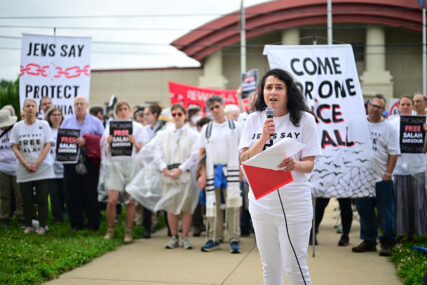
But on Sunday (June 14), Kareem Sarsour’s spirits were buoyed as he stood beside dozens of American Jews who drove in from neighboring states to rally outside the Clay County Jail to demand Sarsour’s release.

Jodi Melamed, leader with the Milwaukee chapter of Jewish Voice for Peace, speaks during the event. Photo courtesy of Jews for Salah
Many American Jews feel an obligation to support Sarsour, said Jodi Melamed, an organizer with the Milwaukee chapter of Jewish Voice for Peace.
“It is very rare, especially since Oct. 7, 2023, to have so many Jews from such a wide variety of perspectives on Israel come together to defend a Palestinian for Palestinian speech,” said Melamed.
National Muslim advocacy groups see Sarsour’s arrest as part of a politically motivated campaign to stifle pro-Palestinian speech in the United States. That view is increasingly shared by other faith groups in the U.S., including some Jews.
Progressive Jewish advocacy organizations condemn what they view as a misguided attempt to fight antisemitism by targeting Palestinians like Sarsour.
“The administration is specifically conflating the fight for Jewish safety with the ways that people are standing up for Palestinian rights, and then using that as a strategy to push an anti-immigrant agenda and crack down on civil liberties broadly,” said Jamie Beran, chief executive officer of Bend the Arc, a Jewish social justice organization.
Homeland Security officials have described Sarsour as a national security threat with ties to terrorist groups.
In an April statement, the agency said Sarsour, who grew up in the occupied West Bank, had been convicted of throwing molotov cocktails at armed Israeli forces before being granted entry to the United States in 1993. A spokesperson also alleged that Sarsour lied in his green card application.
Sarsour’s lawyers have argued that U.S. officials knew about his history since 1993, when his visa application was approved. They say his detention was politically motivated.
In a status hearing on June 8, Sarsour’s attorneys asked a federal judge to release him, saying his health has deteriorated.
Sarsour was also denied a Quran and has been repeatedly interrupted by guards when he is trying to pray, his attorneys wrote in a May 29 letter to U.S. District Court Judge James Patrick Hanlon. When Sarsour, who is diabetic, asked for an adequate diet, his lawyer Luna Droubi said he was told to purchase barbecue pork rinds from the commissary, which would violate Muslim dietary laws, which forbid pork products.
U.S. Rep. Gwen Moore, D-Wis., who was able to visit Sarsour on the day of the protest, said he was not receiving adequate medical care for his diabetes.
“Salah is being targeted for his advocacy for Palestinians, but his mistreatment is part of the Trump administration’s larger campaign of hate against immigrants,” she said in a statement Sunday.
Sarsour was president of the Islamic Society of Milwaukee, the largest mosque in that city, before his arrest. He was also a board member of American Muslims for Palestine, a national organization focused on education about Palestinians.

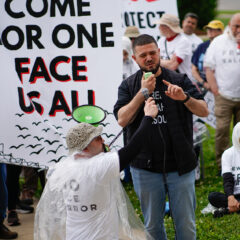
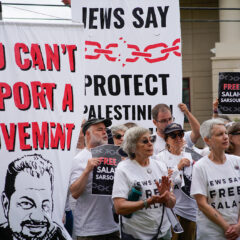
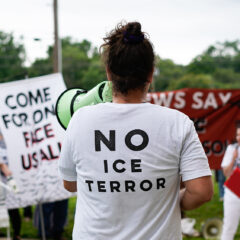
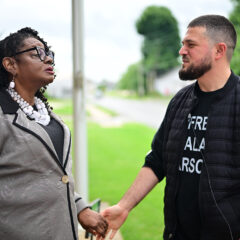
Melamed, a longtime friend of Sarsour’s, described him as a bridge builder with strong ties to interfaith communities in Milwaukee. As a board member of the mosque’s K-12 school, Sarsour helped create a strong Holocaust education program, helping bring Holocaust survivor Hedy Epstein to the school more than once.
“He’s the papa bear of our interfaith community, and that’s why it’s so hard and so shocking and really cruel,” Melamed said of Sarsour.
American Jewish communities are divided over support for Israel. But there is wide agreement among American Jews that the Trump administration’s massive deportation agenda is unjust and in many cases unlawful.
“It should be a given that we’re here because we are Jews,” said Rabbi Bruce Elder of Congregation Hakafa in Glencoe, Illinois, who spoke at the protest. “You cannot separate the Jewish immigrant experience from other immigrants that are coming through. Our Jewish textual tradition calls for us to be here.”
Elder, who is also affiliated with the Jewish Council on Urban Affairs and T’ruah, the rabbinical human rights group, said he does not think support for the Palestinians should be tied to antisemitism.
“The cover of fighting antisemitism from an administration that has some of the most racist antisemites — using that to try to divide us against other folks, to me, is an incredible concern,” he said.
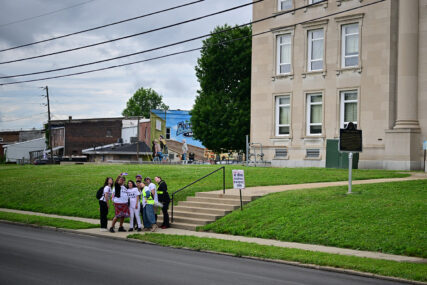
A group of attendees takes a photo together, many wearing shirts that read “Free Salah” on the front. Photo courtesy of Jews for Salah
Progressive Jewish groups have also supported and advocated for several international student leaders targeted with detention or deportation for their pro-Palestinian activism, including former Columbia University students Mahmoud Khalil and Mohsen Mahdawi.
In Colorado Springs, Colorado, local Jewish advocates and Christian groups have supported Hayam El Gamal and her five children, who were released after 10 months from ICE custody. ICE had been trying to deport the family since El Gamal’s ex-husband was charged with attempted murder for throwing molotov cocktails at protesters who’d gathered in support of Israeli hostages in Gaza — an attack his family said it knew nothing about.
Erin Adlerstein, who organized a Jewish-led rally last month asking for due process for Hayam El Gamal and her children, acknowledged the horror of Mohamed Soliman’s attack on the Boulder Jewish community. “But as a neighbor of the El Gamal family, it just does not serve me in any way to hold these children responsible for the actions of their father,” Adlerstein said.
For Kareem Sarsour, the presence of Jews at the protest demanding his father’s release was meaningful.
Interfaith unity, he said, counters ICE’s goal of “breaking us as a community and picking on us one by one.”