











(RNS) — Bezalel Smotrich, Israel’s finance minister, declared the end of the Hebron Accord on Tuesday (June 16), further undermining agreements with the Palestinian Authority and furthering Israel’s efforts to extend control over the West Bank.
But Israel’s Foreign Ministry quickly clarified only parts of the agreement are canceled that had given the Palestinian Authority and the Hebron municipality three decades of control over planning and construction at the burial site of the patriarch Abraham.
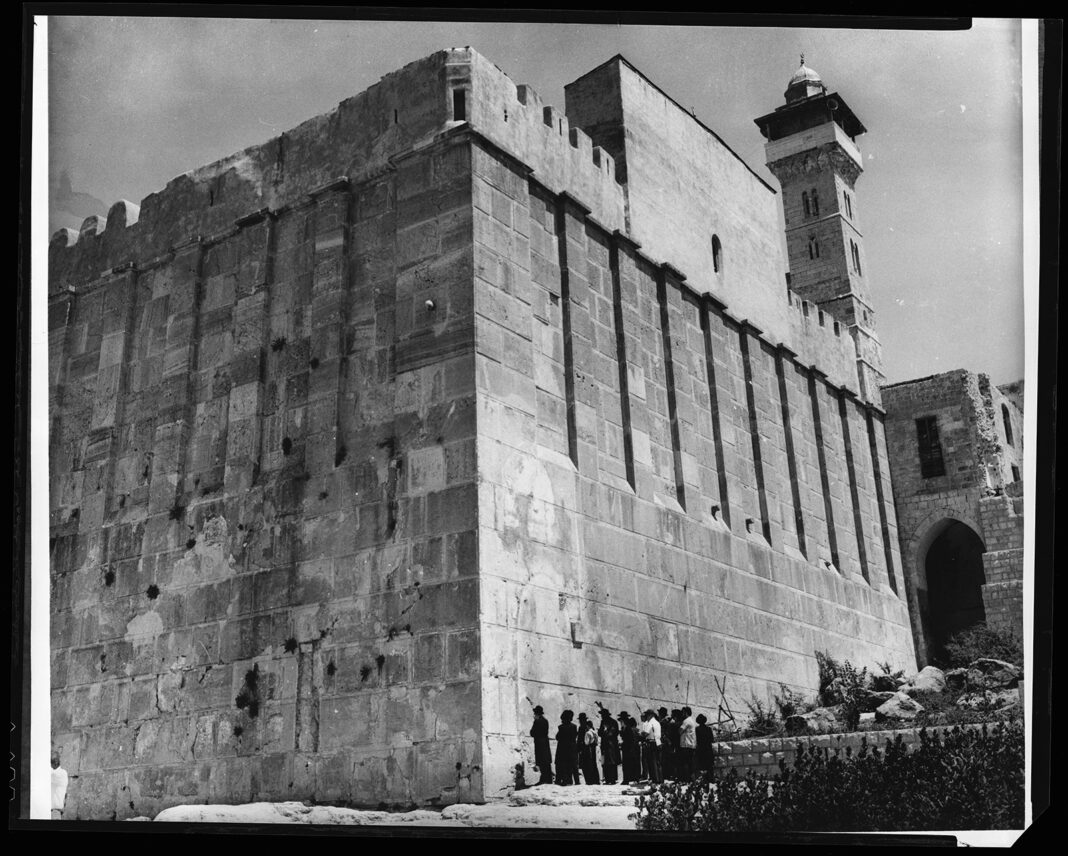
The site, known to Muslims as the Ibrahimi Mosque and to Jews as Ma’arat HaMakhpela — the Cave of the Patriarchs, in English — is the second-most-sacred site to both Jews and Muslims in the Holy Land. According to tradition, it was purchased by Abraham and, in addition to his own grave, houses those of the biblical patriarchs Isaac and Jacob, as well as the matriarchs Sarah, Rebecca and Leah.
The Security Cabinet decision gives Israeli authorities increased control over the holy sites in Hebron, as well as other holy sites in the West Bank, such as the tomb of the matriarch Rachel in Bethlehem. It also means Israelis living in Hebron will no longer need to depend on the Palestinian Authority for day-to-day sanitation and road maintenance issues.
The Hebron Accord, facilitated by the U.S., divided the city into two security zones, allowing 80% Palestinian control. It was signed in 1997 as part of a series of agreements often referred to as the Oslo Accords that established the Palestinian Authority and its jurisdiction over the West Bank.
The dilution of the Hebron Accord comes at a time when the status quo around several of the region’s holy sites is facing an uncertain future.
In May, reports indicated that U.S. and Israeli leaders were mulling cutting Jordan’s royal family out of their traditional role as custodians of the Temple Mount. Last week, Theophilos III, the Greek Orthodox patriarch of Jerusalem and one of the key custodians of Christian sites in the Old City, met with President Donald Trump in Washington and Greek Prime Minister Kyriakos Mitsotakis in Athens to gather support for his church’s continued custodianship of the Church of the Holy Sepulchre.
Smotrich, the head of the Religious Zionist party in Israel’s Knesset and a leader in the settlement movement, made the remarks at the dedication of a new settlement in the Hebron hills region of the West Bank on Tuesday.
“For many years, one of the most absurd clauses of the Oslo Accords remained in place, in which authority over the Jewish settlement in Hebron and the holy sites were dependent on the terrorist municipality of Hebron,” Smotrich told the crowd, according to Israeli media. “Yesterday we put an end to that.”
The Foreign Ministry responded on X, saying the Hebron Accord has not been canceled.
“Several months ago, the Security Cabinet adopted a decision that specifically concerns jurisdictions in the field of planning and construction with regard to the Jewish community in Hebron and Jewish heritage sites,” the Foreign Ministry said on X. “This decision was made following years of a complete lack of cooperation on these matters by the Hebron Municipality. Beyond that, no changes have been made.”
Jewish leaders in Hebron also stressed that much of the accords will remain in place, but the Palestinian Authority’s veto power over construction of new buildings would be circumvented.
“There are some responsibilities that have been returned to the Jewish municipality,” Noam Arnon, a spokesman for the Hebron Jewish community, told Religion News Service. “Authority over building and planning and the Jewish buildings and Jewish community now will not be in the hands of the Palestinian Authority but in the hands of the Jewish authority.”
Less than a day after Smotrich’s announcement, construction of a large yeshiva complex and more than 500 housing units was approved in the Hebron Area — the first time in decades without Palestinian consent, Israeli media reported.
Arnon noted that Israeli authorities had already begun work on modernizing the water, electrical and air conditioning system on the Jewish side of the Cave of the Patriarchs, something that previously would have required the Palestinian Authority’s green light.
He said that the changes would not impact the Muslim side of the site and that it would not impact Muslim Palestinians’ freedom of prayer there.
The head of Hebron’s Jewish community, Eyal Gelman, called the changes “a historic decision.”
“Israel deepens its roots … lifting the honor of the entire nation,” the Jewish Community of Hebron said in a June 16 statement. “These powers will allow the Hebron local council to build and expand in the city of the founding fathers and mothers.”
Hebron has long been one of the starkest flashpoints in the Israeli-Palestinian conflict. Unique in the West Bank, it’s the only place with an Israeli settlement in the middle of a major Palestinian urban center.
The West Bank’s largest city, Hebron has an Arab population of over 200,000, while some 700 Jewish Israelis live on a few streets of its old city, not far from the Cave of the Patriarchs.
The Hebron Accords expelled the Israeli military from most of the city that came under Palestinian control but kept Israeli soldiers in about 20% of Hebron around the Jewish settlement, resulting in some 35,000 Palestinians living under Israeli rule.
Smotrich’s declaration Tuesday has been widely criticized by leaders in and outside of the region.
Palestinian Authority President Mahmoud Abbas “stressed that such unilateral measures are rejected and condemned, and constitute a violation of signed agreements with the Israeli side, as well as a breach of international law and international legitimacy, which prohibit altering the status quo in the occupied territory of the State of Palestine,” according to a statement put out by his office.
The Organization of Islamic Cooperation, which represents 57 Muslim nations, similarly warned that Israel’s plans in Hebron amount to undermining its political, historical and legal status.
Washington responded by warning against annexation as President Donald Trump and Prime Minister Benjamin Netanyahu spar over Trump’s own unilateral moves to end the U.S.-Israel war with Iran.
“As the president has clearly stated, he does not support Israel annexing the West Bank,” a State Department spokesperson told Israeli media. “A stable West Bank keeps Israel secure and is in line with this administration’s goal to achieve peace in the region.”