







(RNS) — Amidst wars, wildfires and ICE raids, we are woefully short these days of images of a better future for Earth and its inhabitants. Here then, in the summer of our discontent, are two transcendent portrayals of a world to be hoped for.
The first is one of Vermeer’s rare landscapes, his “View of Delft,” which Proust, after seeing it in the Mauritshuis in the Hague, called “the most beautiful picture in the world.” It shows sunlight playing across the Dutch town after a rainstorm — most importantly illuminating, between the two spires in the middle, the roofs of the home and the church of the artist’s principal patrons.
In his fascinating new book, “Vermeer: A Life Lost and Found,” British art historian Andrew Graham-Dixon convincingly argues that Vermeer was part of a sect of liberal dissenters from Dutch Calvinism known as the Collegiants. Committed to tolerance for all religious communities, the Collegiants asked of members only an approval of the teachings of Jesus and accorded women in church full equality with men.
Vermeer created most of his paintings for Maria de Knuijt and Pieter Claesz van Ruijven, the married couple that led the sect in Delft. As Graham-Dixon shows, they convey spiritual messages that point to the Collegiant conviction that the true church is more hidden than on display.
Painted in the peaceful aftermath of the terrible Eighty Years’ War with Spain and the devastating Thirty Years’ War, “View of Delft” is more than a representation of Vermeer’s hometown after storm clouds have passed away. It is a vision of the Heavenly Jerusalem, led by a community that believed the End Times had arrived. In Graham-Dixon’s words, “It is a picture so lovingly dwelt upon it seems made of love itself: a dream of the new millennium, made to last a thousand years.”
Next, two centuries later, there’s Thomas Cole’s own post-rain landscape: “View from Mount Holyoke, Northampton, Massachusetts, after a Thunderstorm,” commonly called “The Oxbow.” The painting features a tiny self-portrait of the artist looking away from his easel, where he is painting a comparable scene of the mountain looking down on the Connecticut River valley.
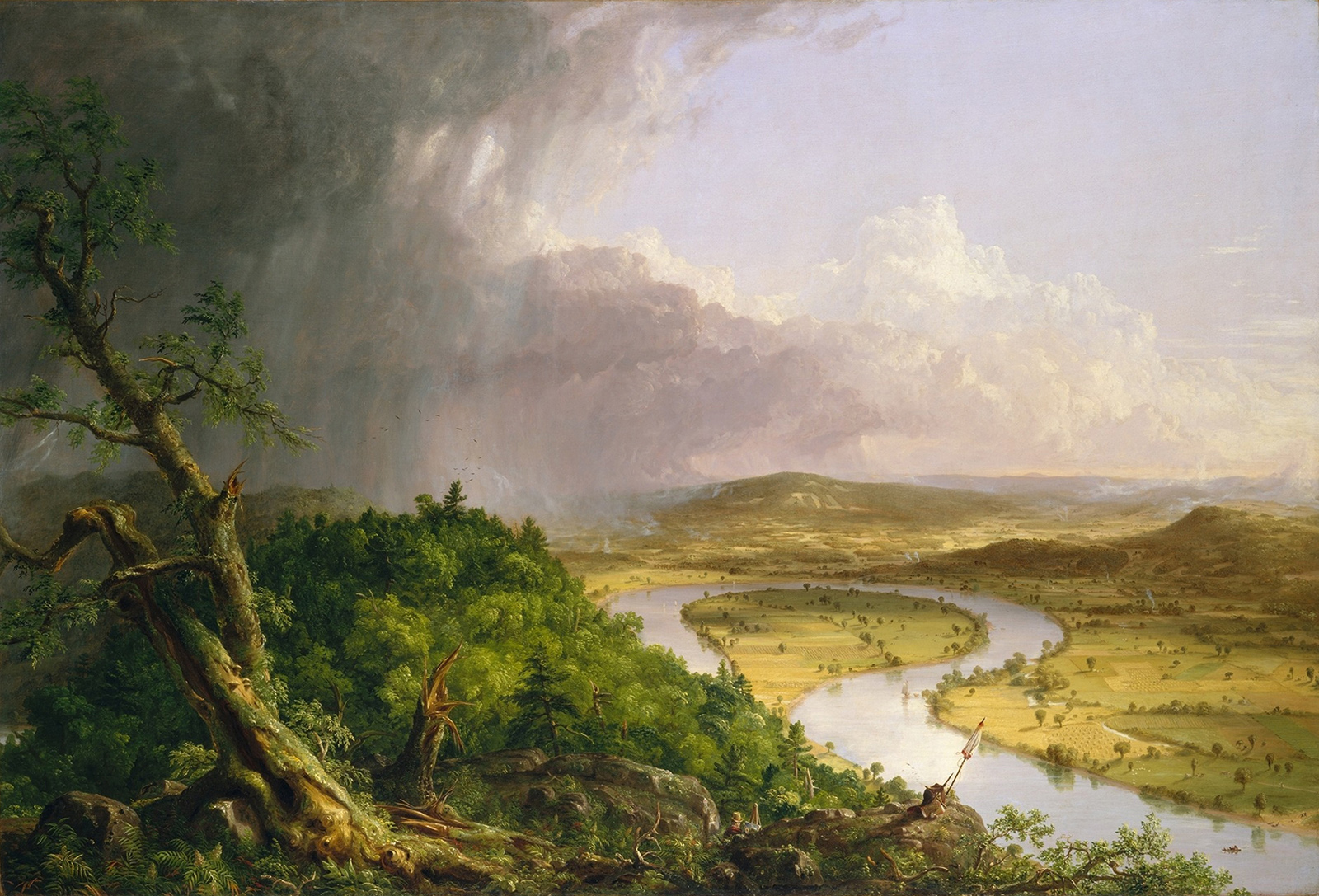
While Cole, the founder of the Hudson River School, loved the wilderness, unlike his younger contemporary, Henry David Thoreau, he greatly valued the tamed topography alongside the river. As he put it in his “Essay on American Scenery,” written at the beginning of the year he painted “The Oxbow”:
In what has been said I have alluded to wild and uncultivated scenery; but the cultivated must not be forgotten, for it is still more important to man in his social capacity — necessarily bringing him in contact with the cultured; it encompasses our homes, and, though devoid of the stern sublimity of the wild, its quieter spirit steals tenderly into our bosoms mingled with a thousand domestic affections and heart-touching associations — human hands have wrought, and human deeds hallowed all around.
Cole’s intention was to insert “The Oxbow” between the second and third paintings in “The Course of Empire,” a five-part series that begins with “The Savage State” and “The Arcadian,” or “Pastoral State,” and proceeds to “The Consummation of Empire,” “Destruction,” and “Desolation.” It served to portray an ideal agrarian state, as outlined in his essay: “On the margin of that gentle river the village girls may ramble unmolested — and the glad school-boy, with hook and line, pass his bright holiday — those neat dwellings, unpretending to magnificence, are the abodes of plenty, virtue, and refinement.”
Would the United States embrace that ideal or take the ultimately disastrous path of Imperial Rome? The river’s oxbow poses the question — one that two centuries later finds us closer to the second alternative.
Cole was himself a devout Christian, raised in the English Dissenting tradition in Bolton, Lancashire, and eventually, after immigrating to America, becoming a pillar of the Episcopal church near his home in the Catskills. The conjoined wilderness-agrarian scene in “The Oxbow” conveys a prelapsarian hope that his adopted country would not be seduced, as his native Lancashire was, by the siren call of industrialization.
“Nature has spread for us a rich and delightful banquet,” he warns in his essay. “Shall we turn from it? We are still in Eden; the wall that shuts us out of the garden is our own ignorance and folly.”
The Heavenly Jerusalem of “View of Delft” and the American Eden of “The Oxbow” both express the postmillennial conviction that it is up to humankind to spend a thousand years improving the world to prepare the way for Christ’s return (“post-” as in after the millennium). A conviction of this sort may be found among American Christian nationalists today. But theirs is a far cry from the tolerant, harmonious visions of Vermeer and Cole.


