










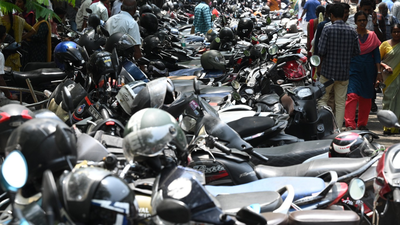
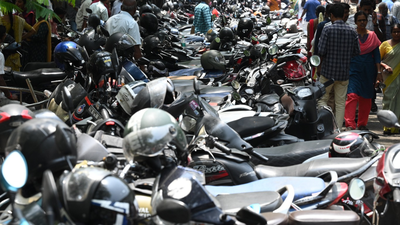
Every day in every Indian city, from the cramped lanes of Old Delhi to the gated high-rises on Bengaluru’s Outer Ring Road, is a losing battle. Cars spill onto footpaths, two-wheelers clog intersections and residents welfare associations send angry messages about who parked where first. What began as a minor inconvenience for the city has ballooned into one of India’s most acute civic challenges with the demand for parking far outstripping the infrastructure built to accommodate it.Parking, say city planners, is not just a matter of space for cars but of how cities utilize their scarce public land. India’s parking problem is an obvious symptom of years of rapid motorisation, poor urban planning and patchy enforcement. Flyovers, metro lines and expressways have multiplied but parking is one of the least planned aspects of urban transport.

India’s parking crisis
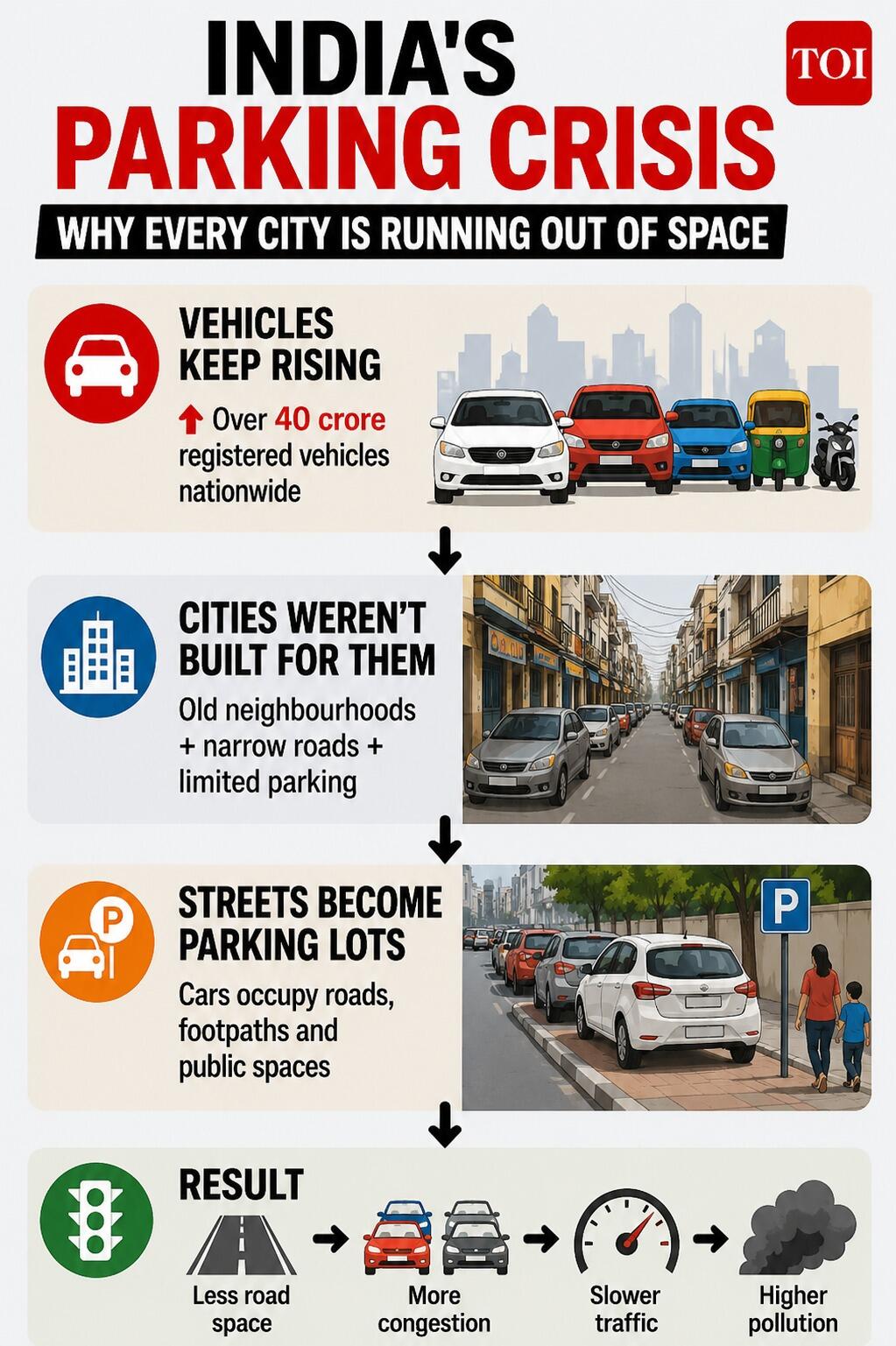
Vehicle boom renders master plans obsoleteVery few city master plans had anticipated the pace of growth of vehicles across India. The total number of registered motor vehicles in the country is well above 40 crore (400 million), which is almost double in just a decade, as per data from the Ministry of Road Transport and Highways (MoRTH). Two-wheelers account for most of the rise. Ownership and parking demand continue to grow with income, easy vehicle financing and suburban sprawl.

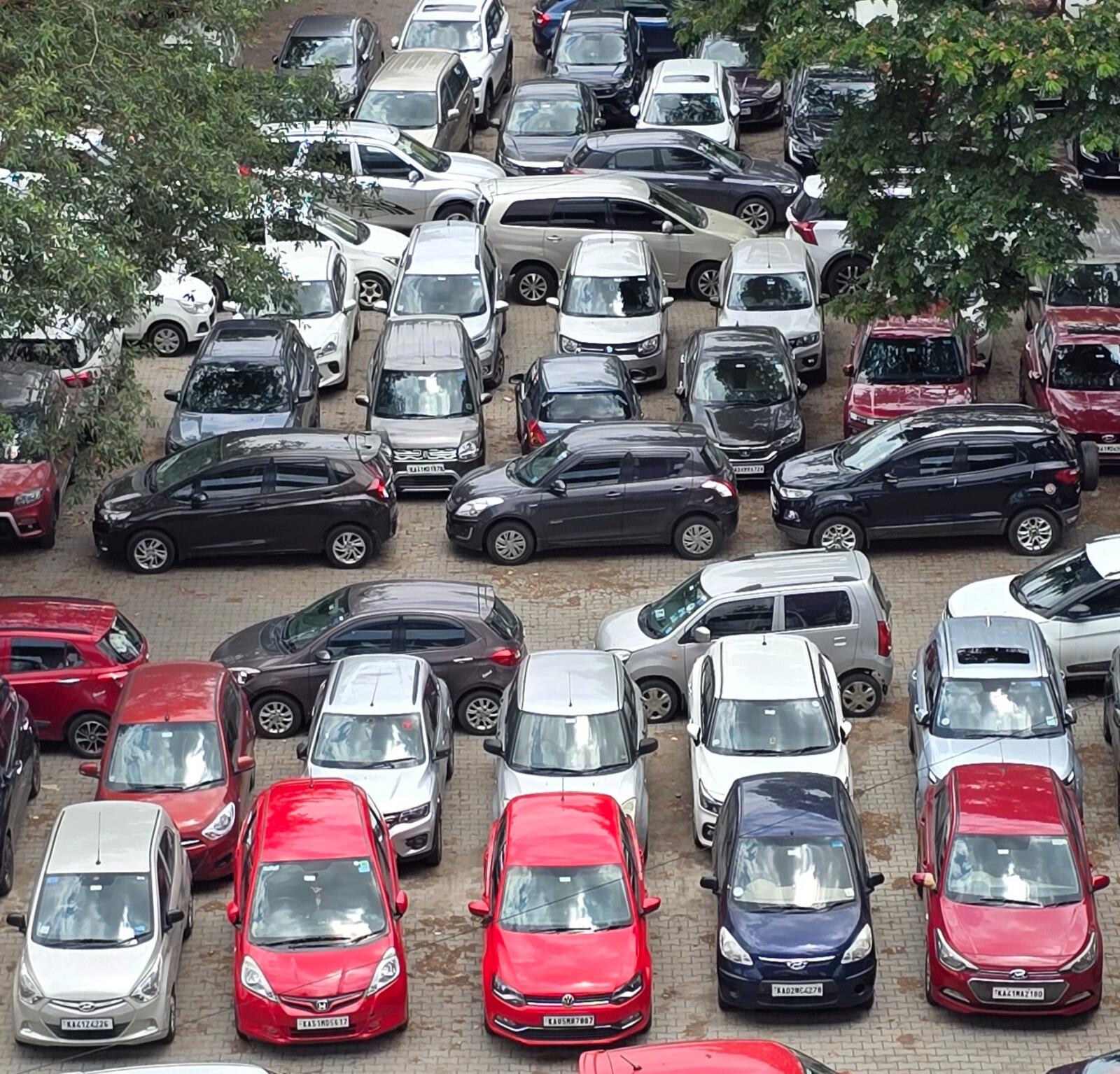
(Photo credit: TOI) Many cars are parked outsdie a metro station in Bengaluru
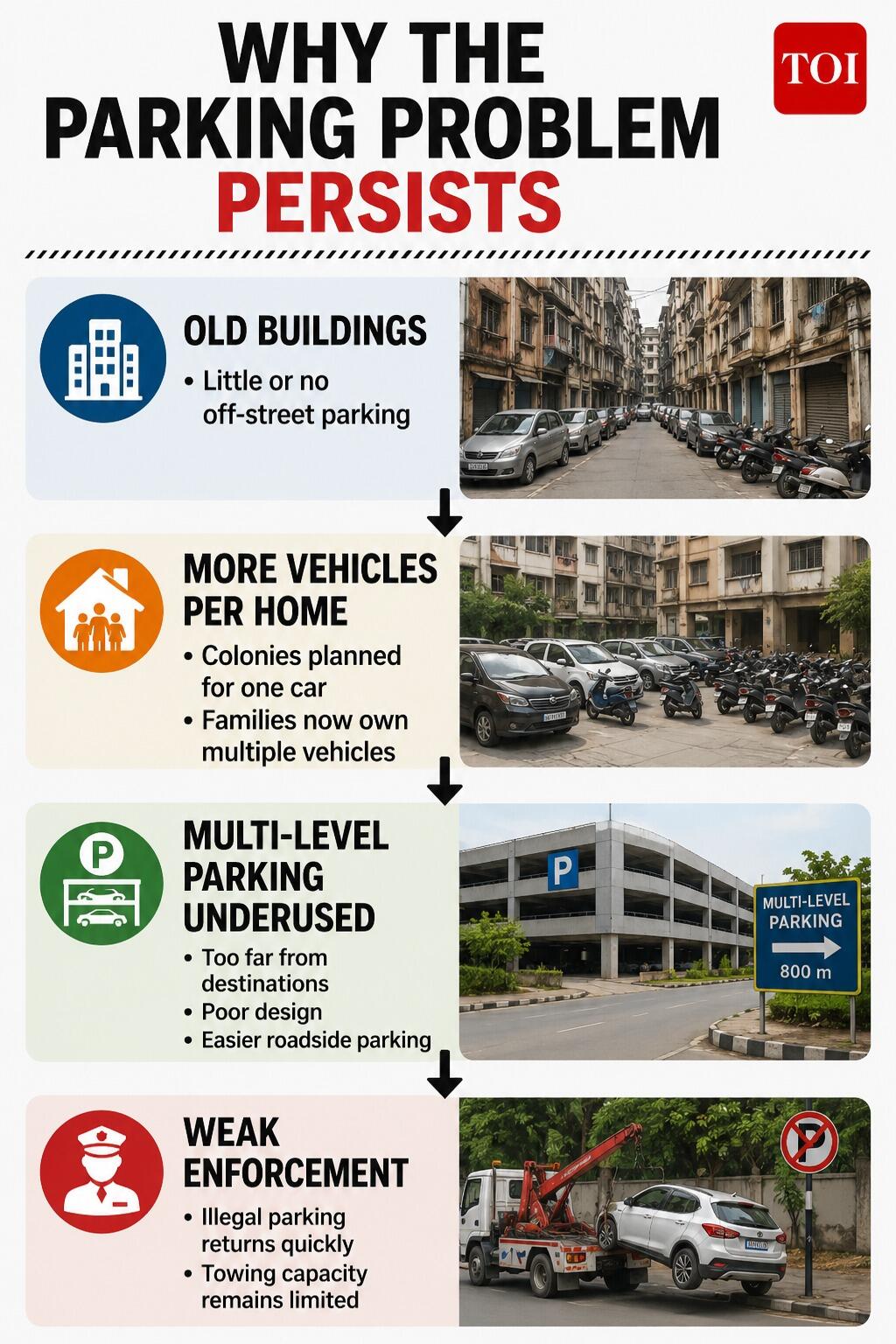
But most Indian cities were built at a time when private vehicles were a fraction of what they are today. Minimum parking norms were eventually incorporated in building regulations, but these do not apply to older localities and even where they do, enforcement has been patchy. Roads designed for traffic frequently turn into parking lots.Delhi is an example of this pressure. The registered vehicle fleet had crossed 1 crore at one point but aggressive de-registration of overaged diesel and petrol vehicles has brought the count down to around 87.6 lakh (8.76 million) active vehicles, putting severe strain on neighborhood streets and arterial roads alike.Aging cities, aging infrastructureThe problem is particularly serious in historic city centres. Long before the automobile came into being, areas such as Delhi’s Chandni Chowk, the heritage districts of South Mumbai, Hyderabad’s Old City and Bengaluru’s Pete areas were developed. The streets are narrow, making off-street parking difficult; to widen the streets would require the demolition of many buildings and the displacement of people.

Why the parking problem persists
The same problems face newer suburbs. The residential colonies planned in the 1980s and 1990s were often planned for one vehicle per household. Today, many families own more than two cars and two-wheelers. There’s not much parking in the basement and it fills up fast, spilling out onto residential streets and narrowing usable lanes.Economics of informal parkingWhen formal parking is at a premium informal parking will be used. Self-styled attendants often work on the streets outside busy markets, hospitals and transit hubs, collecting fees without receipts or formal authorization. Arbitrary charges and lack of accountability are common complaints, as municipal authorities have a hard time distinguishing between legitimate contractors and illegal operators.

Why can fix India’s parking mess?
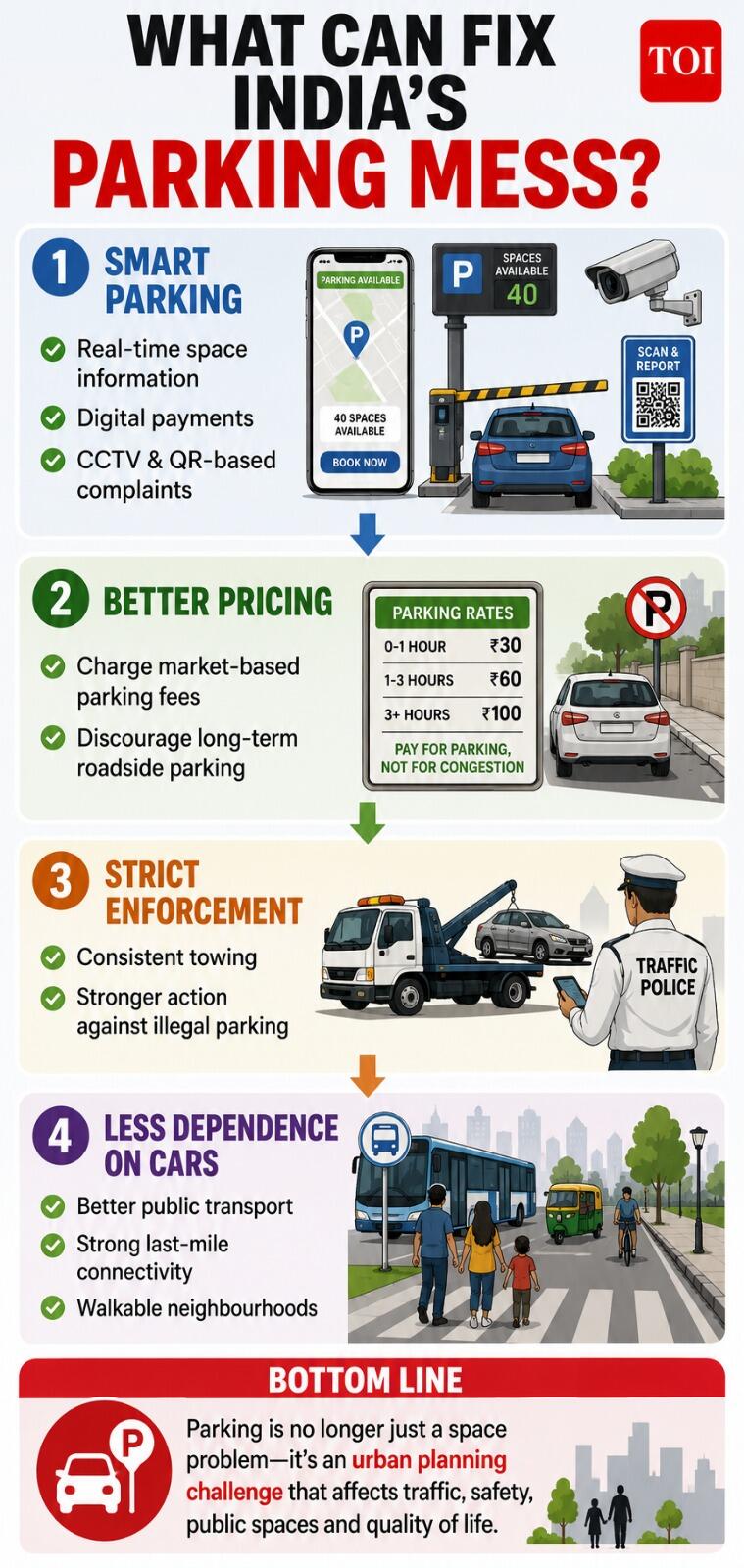
So, parking management has been as much a governance challenge as an infrastructure one. Hence, the municipal corporations have the responsibility to properly regulate parking concessions to avoid leakage of revenues and conversion of public roadways into private parking space.Underutilized multi-level parking facilitiesIn order to increase the capacity, most of the major cities have constructed Multi-Level Parking (MLP) facilities but many of them are below their capacity. Drivers are unlikely to stop at MLPs that are too far of a walk from where they are going. Complicated entry/exit design, clunky payment systems and cheaper or more convenient roadside alternatives all contribute to further reducing adoption. But officials are still expanding organized parking despite these impediments. The Delhi Development Authority (DDA) is creating thousands of equivalent car parking (ECS) spaces through new hubs and surface lots while also revising the rules for housing parking allocation to maximize its utilization and curb neighbor disputes.Enforcement constraintsTraffic police write hundreds of thousands of tickets a year, but there are too many violations for enforcement to keep up. Delhi Traffic Police data has always indicated improper or obstructive parking as one of the most common traffic violations. To put things in perspective, the officers had issued over 1.37 lakh wrong-parking challans in September 2025 alone, while the number was over 1.01 lakh in November 2025.Even with large fines, illegally parked cars are often back within hours. Towing operations are still small in scale compared with the number of violations, and local merchant associations often oppose aggressive enforcement in commercial areas for fear of affecting customer foot traffic.Technology-based management solutionsCities are shifting to digital solutions alongside physical infrastructures. Delhi has updated its parking management norms to include CCTV surveillance, complaint mechanisms through QR-codes, better lighting and stricter monitoring of parking operators.Delhi Police have also tried out roadside management initiatives such as better street markings and designated parking zones in major commercial areas. Digital space monitoring, real-time occupancy tracking and demand-based pricing are part of larger urban mobility strategies with similar projects being rolled out in Bengaluru, Pune and other cities.Future pathMany urban planners say that just adding more parking garages won’t solve the crisis, because unpriced space generally leads to more driving. Sustainable solutions require strong public transit, last-mile connectivity, and reasonable pricing tied to parking policy.All over India, agencies are beginning to think of parking not as a free public service, but as a pro-active demand management tool. Strong resolve needs strict enforcement of building bye-laws, digital management, market-linked pricing and better public transport. Until these strategies are ramped up, finding a parking space will continue to be a daily pain point in India’s urban landscape.