










(RNS) — No matter how many Americans say they don’t want to see politics and religion mix, it’s inevitable those two forces will collide in one way or another. For instance, when the average American thinks about Donald Trump’s supporters, there’s a high likelihood that they will conjure images of white evangelicals who have cast ballots for him in huge majorities over the last three election cycles. This connection is continuing to emerge in the polling data, with an increasing number of politically conservative Americans self-identifying as evangelical/born again even if they don’t go to church that much.
Of course, the current and former president is a deeply polarizing figure. While he has certainly amassed a base of tens of millions of Americans who proudly call themselves MAGA, his personality and policies have also alienated tens of millions of Americans as well. But has the strong alliance between Christians and Donald Trump actually pushed some people out of church?
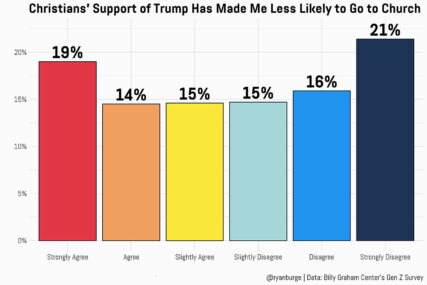
We now have data to answer this question with a great deal of specificity among those who would be the future of the church: Generation Z. The Billy Graham Center Research Institute fielded a survey of 2,365 Gen Z adults (ages 18-28) through NORC’s AmeriSpeak panel between Aug. 9 and Sept. 26, 2024. This effort was supported by the Lilly Endowment, and the lead investigator for this project was Rick Richardson at Wheaton College. Buried in a battery about political de-motivators for church involvement was this statement: “Christians’ support of Trump has made me less likely to go to church.”


So, it’s fair to say young adults are pretty evenly divided on this idea. But these results are confounded by a few variables: Younger adults tend to be more left-leaning in their politics, and a significant share of Gen Z claims no religious affiliation, which means a lot of these respondents wouldn’t be going to church much anyway.
Let’s explore the results to this question through a couple of lenses, starting with the political partisanship of the respondents.


Independents are an interesting case because their answers should presumably be less tainted by a political bias. Among this group, 42% said Christians’ support of Trump was making them less likely to go to church — a slightly smaller number than in the full sample.
What about the religious affiliation of the respondents?


But even among Gen Z Christians, there’s a significant share who said Trump made it harder for them to attend at all: 44% of those who identified as a generic Christian, 42% of Catholics and 30% of Protestant young adults said they were turned off by the Christian-Trump alliance.
Is this connection between Christians and the Trump administration having a deleterious impact on the attendance of Gen Z Christians, though?

So, it’s not fair to use this data to make the claim that young Christians would be flocking back into the church if the church would drop politics. However, the other way to interpret this data is that about 40% of young adult Christians see the church’s association with Trump as an impediment to them becoming more involved with their faith community. According to this result, more daylight between the church and the GOP may lead to an uptick in attendance among young Christians at every level of the attendance continuum.
The question is: Can we estimate what share of Generation Z might be more inclined to show up to church if the association between Trump and Christianity weakened in the years ahead?
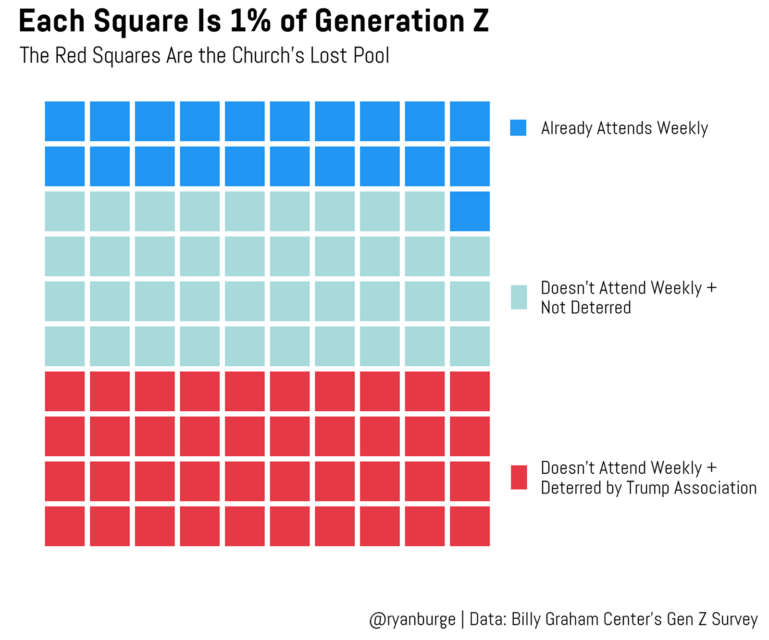

To assess this question, the sample of young adults was broken down into three categories: those who attend church weekly, those who don’t attend weekly but not because of the Trump-Christian association, and those who don’t go to church that much and pointed to the Trump connection as at least one reason making them less likely to show up for Sunday worship.
About 20% of Gen Z is already going to church on a regular basis. The remaining 80% are evenly split on whether Christian support of Trump has impacted their churchgoing. Said simply: 40% of Gen Z said politics was keeping them away from a local church.
Again, it’s important to note that we can’t say if this is the only reason these members of Gen Z are staying away from a house of worship. Their lack of attendance could stem from a variety of concerns based on religious beliefs, life circumstances and any number of other factors. But the data from this survey does point to a large share of Gen Z being repelled from American Christianity due (in some part) to its predilections toward the GOP.
Newton’s Third Law of Motion says that “for every action, there’s an equal and opposite reaction.” That maxim certainly applies to the world of physics, but it also is instructive in the social world. It’s undoubtedly the case that the growing alliance between Christianity and Donald Trump has drawn some people closer to evangelicalism while pushing others away. Among Gen Z, a significant share report that it has created a barrier to entry for them when it comes to regular worship.
Understanding what impact that will have on the future of American Christianity is a necessary academic pursuit.
(Ryan Burge is a professor of practice at the John C. Danforth Center on Religion and Politics at Washington University and author, most recently, of “The American Religious Landscape: Facts, Trends, and the Future.” Rick Richardson is professor of evangelism and leadership, director of WCBGC Research Institute and director of the Church Evangelism Institute at Wheaton College. The views expressed in this commentary do not necessarily reflect those of Religion News Service.)