



CHAPEL HILL, N.C. (RNS) — The prompt for the after-dinner discussion was a familiar phrase: “We hold these truths to be self-evident.”
Some 90 members of nine religious congregations gathered in the fellowship of hall of University Baptist Church recently to begin a study of the Declaration, with its foundational claim that “all men are created equal.”
They are just one of some 30 interfaith “clusters” in 16 states participating in Faith250, a new initiative intended to mark the country’s 250th anniversary, or semiquincentennial, this July 4th. These clusters are now pouring over “America’s sacred texts” as part of a mission to revive democratic values they feel have been eroding.
“People are really concerned about what’s happening in our democracy,” said Meg Peery McLaughlin, the co-pastor of University Presbyterian Church and a program organizer. “They have been hungry for a place to bring their concerns about what’s happening and encounter what our shared faith may have to say to it.“
In addition to the Declaration of Independence, the faith clusters will study other foundational texts including Katharine Lee Bates’ 1893 anthem “America the Beautiful,” Emma Lazarus’ 1883 poem, “The New Colossus,” and Frederick Douglass’ 1852 speech, “What to the Slave is the Fourth of July?”
The Chapel Hill cluster comprises members of 22 faith communities, including Protestant churches, a synagogue and a Church of Jesus Christ of Latter-day Saints congregation. In this liberal town, home to the University of North Carolina at Chapel Hill, many congregations are critical of the Trump administration and its upending of democratic norms — from attempting to subvert the integrity of elections to mass deportations without due process to unprecedented corruption.

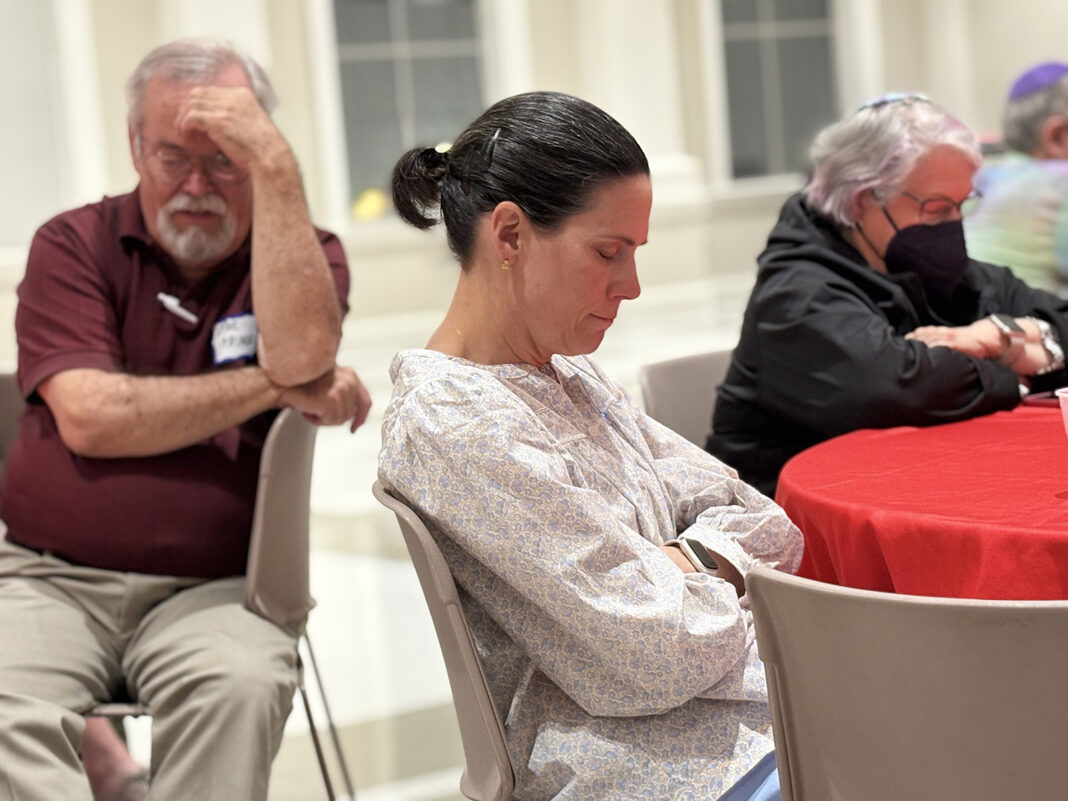
Karen Vandersea bows her head during a closing prayer at the Faith250 kickoff dinner on April 12, 2026, at University Baptist Church in Chapel Hill, N.C. (RNS photo/Yonat Shimron)
RELATED: When Trump’s satire hits too close to home for American Christians, Antichrist claims emerge
Over a dinner fried chicken, mac and cheese and sweet potato casserole, many congregants said they decided to participate because they felt disillusioned and dismayed at the direction of the country.
“I have no idea what is the truth from our government anymore,” said Joseph Watson, a pharmaceutical developer and a member of University Baptist Church, a congregation affiliated with the Cooperative Baptist Fellowship. “I’m hoping this can ground me in just what the purpose was, and I hope it inspires me because it’s getting hard to care about things like I used to because it feels overwhelming what’s happening every day.”
The Chapel Hill cluster began with clergy getting together to study the four founding texts this past fall. Two in the group, Peery McLaughlin and Rabbi Jen Feldman of Chapel Hill’s Kehillah Synagogue, had both heard about Faith250 and presented the initiative to their colleagues as a way help congregants reflect on their shared values amid democratic backsliding.
Faith250 is the brainchild of Michael Holzman, rabbi of the Northern Virginia Hebrew Congregation in Reston, Virginia. Holzman was upset to learn that Trump had sidelined the nonpartisan congressional commission working for nine years to plan the country’s 250th anniversary.

The Rev. Meg Peery McLaughlin, co-pastor of University Presbyterian Church in Chapel Hill, N.C., sets the scene for the discussion at the kickoff dinner for the Faith250 initiative on April 12, 2026 at University Baptist Church. (RNS photo/Yonat Shimron)
A few years earlier he had begun applying the Jewish tradition of Scripture study to non-sacred texts.
“I asked myself, ‘What if we just applied that technique to American stories and American documents?’” Holzman said.
He ran the idea by his interfaith colleagues who seized on it as a way to mark the semiquincentennial. One United Methodist bishop told him, “You’re solving a problem most of us don’t even realize we have yet,” by which he meant, to celebrate the 250th in a nonpartisan, reflective and thoughtful way.
With some grant funding and a small part-time staff, the project has been rolled out nationwide. As of last week, some 209 congregations, Christian, Jewish and Muslim, have signed up.
The third leg of the project — after the clergy study and lay study — is a civic ritual that brings together the cluster’s participants and the broader community for a shared event demonstrating a commitment to democracy. The Faith250 project does not prescribe the action. It’s up to each cluster to decide.
In Chapel Hill, members have yet to decide what they will do ahead of July 4. They are just beginning their study. But by June they hope to have a plan.
“This is a time when democracy is under profound threat, and Judaism teaches us that hope is founded in action,” said Feldman. “I’m looking for ways that we could do a values-led action in the face of the threats to democracy in our country.”
Organizers of the initiative said they recognized it is unlikely to draw conservative congregations to the effort.
“It is true that the congregations which are drawn to multi-faith work and dialogue-focused programming are going to be the ones that are center left,” Holzman said. “The right has embraced a scorched earth approach to politics, one that sees viewpoint diversity as impurity and pollution. So no, I do not expect congregations that have associated themselves with the MAGA movement to be part of Faith250.”
But both clergy and lay people said they saw the value of ideologically left and center congregations uniting and deliberating about democracy together. There are now plans to do a second round of Faith250 conversations timed to happen around Thanksgiving.
“If people could come together and quit blaming and pointing fingers and complaining and come up with some solutions to what our country’s facing today, I would really want to be part of that,” said Linda Kopel, a member of University Presbyterian Church. “Maybe faith is the one place where we can meet and talk.”
RELATED: Trump slammed the first US pope. The country’s bishops now appear more united than ever.