



NAIROBI, Kenya (RNS) — Two years ago, a Catholic priest and his driver set out on one of the most dangerous roads in South Sudan and were never seen again. Now, church leaders in the country say they want to know what happened to the two, and they’re putting a spotlight on the growing number of disappeared in the country.
“It’s a question of justice. We want the government to take its responsibility regarding the disappearance of these two. They are not alone; many people have also disappeared,” said Catholic Bishop Eduardo Hiiboro Kussala of the Tombura-Yambio Diocese in South Sudan.
The Nagero-Tombura Road in South Sudan is a critical transit corridor that priests and pastors travel to bring the gospel to remote South Sudan communities, such as Western Equatoria. The road cuts through territory where armed men commit deadly robberies, kidnappings and other attacks.
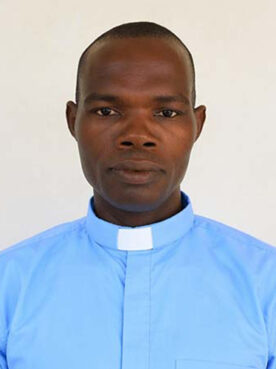
It is on this road that the Rev. Luke Yugue Mbokusa, pastor of the Nazareth Nagero parish, and his driver, Michael Gbeko, disappeared without trace while traveling from Nagero County to Yambio County on April 27, 2024.

The Rev. Luke Yugue Mbokusa. (Photo courtesy of Diocese of Tombura-Yambio)
Kussala released a letter on the anniversary of their disappearance, calling for action. “We need to know what went wrong. We need truth, not silence. We need accountability, not uncertainty,” he said.
In an interview, the bishop said it was unlikely the priest and driver were still alive, but he stressed: “It’s a question of justice. We want the government to take responsibility regarding the disappearance of these two. They are not alone; many people have also disappeared.”
The Rev. Tut Kony Nyang, general secretary of the South Sudan Council of Churches, an ecumenical group that represents the Roman Catholic, Anglican and Presbyterian churches, among others, said death has become normalized in South Sudan. “This is the tune of the day in South Sudan. The disappearances and the losses of people,” he said, adding that churches are raising their voices because “what we have is just a power of words and ethics.”
He also suggested that the disappearances are linked to militarized politics and ethnic divisions. “People may disappear because of the tribe they belong to,” he told RNS, suggesting the priest may have been targeted for that reason.
Mbokusa was the priest in charge of the Nazareth Nagero parish in the Diocese of Tombura-Yambio, near the country’s border with Congo and the Central African Republic. Those two African countries are also embroiled in conflict.
Of South Sudan’s estimated 12.4 million population, approximately 60% are Christian, with Roman Catholic, Episcopal (Anglican) and Presbyterian denominations being dominant. About one-third of the population are followers of African traditional religions.
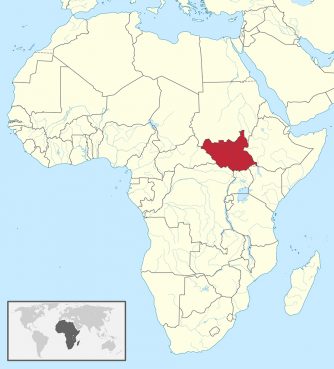
South Sudan, red, in central Africa. Map courtesy of Creative Commons
Muslims account for approximately 6%-8%, while there are also tiny populations of Hindu, Baha’i and Jewish religions.
Although it’s difficult to find exact statistics due to the conflict, the International Committee of the Red Cross and the South Sudan Red Cross said in a recent news release that it was following 5,700 cases of missing persons. The real count is likely higher because the cases are not documented, said the organizations.
Mbokusa’s disappearance is considered a high-profile incident. The rebel faction, the Sudan People’s Liberation Movement and Army in the Opposition, controls the area where the two disappeared. The faction has recently engaged in deadly clashes with the national army, the South Sudan Defence Forces, that left at least 250 people dead in Nasir City in Upper Nile State.
But much of the violence in the territories is not directly done by the two bigger groups, according to Catholic Bishop Christian Carlassare of Bentiu Diocese.
“It is a constellation of groups or local militias responding to local commanders that do not have a national political agenda, but only local claims,” Carlassare told RNS. “Even in the case of Father Yugue, I think the attackers might have been local militias.”
The bishop said the government and opposition have relied on militias for certain purposes but at times militias turned against them. “People are at the mercy of those holding guns, because weapons are power … used against people,” Carlassare said.
Pastors and priests are not direct targets, he added, but they may find themselves caught up.
“Those with guns may not mind. It is the situation the people of South Sudan are in. … Weapons are a curse,” he said.