



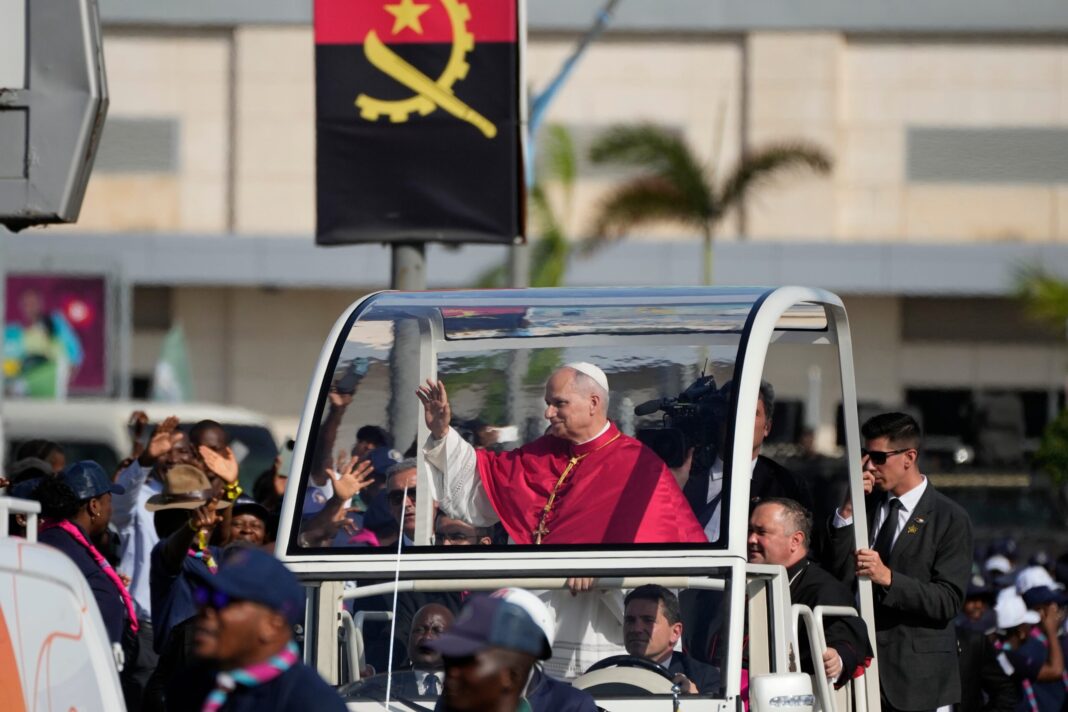
NAIROBI (RNS) — Pope Leo XIV arrived in Angola on Saturday afternoon, touching down in the capital, Luanda, to begin a three-day visit expected to focus on economic inequality, youth unemployment and governance in one of Africa’s most resource-rich nations.
The visit, part of his broader tour of Africa, brings the pope to a country where vast oil and mineral wealth contrasts sharply with widespread poverty — a reality religious leaders say is likely to shape his message in the days ahead.
Religious leaders in the country told RNS they expect the pope will address both moral and structural challenges facing the country.
“This visit is coming at a time when many people are questioning the direction of the country,” Fr. António Caetano Neto, a Catholic priest in Angola, told RNS by phone. “There is hope that the pope will speak about justice, accountability and the dignity of ordinary people.”
Angola is overwhelmingly Christian, with more than 90% of the population adhering to various denominations. A former Portuguese colony, Angola is home to one of the oldest Catholic community in sub-Saharan Africa and remains predominantly Roman Catholic, with estimates ranging between 41% and 60% of the population. However, in recent years, the country has seen a rapid expansion of Protestant denominations, with about 38% of the population now identifying as Protestant. A smaller percentage adheres to indigenous and syncretic belief systems.
The country of roughly 39 million people gained independence from Portugal in 1975 but was immediately plunged into a civil war that lasted until 2002 and killed more than half a million people. The legacy of that conflict continues to shape Angola’s social and economic realities.
Since the end of the war, Angola has emerged as one of Africa’s leading oil producers and a major exporter of diamonds and other minerals. Yet economic growth has not translated into broad-based prosperity, with critics blaming corruption and weak governance for allowing wealth to accumulate among a small elite while roughly one-third of of Angolans continue to live on less than $2.15 a day as of 2023, according to World Bank projections.
“The reality of Angola is one of contrasts,” said Father Maurício Capembe, vicar general of the Archdiocese of Lubango, in a phone interview. “We have natural wealth, but also widespread poverty. The pope’s message is expected to challenge both leaders and citizens to reflect on justice and the common good.”
According to the Vatican’s official program, Pope Leo XIV will meet government authorities, civil society representatives and members of the diplomatic corps, as well as bishops, clergy and religious sisters during his stay. Leo is the third pope to visit the country, after Pope Benedict in 2009 and Pope John Paul II in 1992.
Leo is also expected to travel to Muxima, one of Angola’s most important Catholic pilgrimage sites, and later to Saurimo, a city in the country’s diamond-rich northeast.
Vatican officials have indicated that outreach to young people will be central to the visit. Angola’s population is predominantly young — nearly three-quarters of the population is under the age of 30 — with many facing unemployment and limited opportunities despite the country’s natural resource wealth.
“The church is very present among young people, but they are also among the most affected by unemployment and inequality,” Neto said. “The pope’s voice can help bring attention to their struggles.”
A key moment of the visit will be the pope’s trip to the Sanctuary of Mama Muxima, located about 130 kilometers from Luanda.
Built in the late 16th century by Portuguese colonizers, the shrine has historical ties to the trans-Atlantic slave trade, where enslaved Africans were baptized before being sent to the Americas.
Beyond the social and economic expectations, church leaders say the visit carries deep spiritual significance for many Angolans, particularly in a country where faith remains central to daily life.
“For the faithful, this is first a moment of grace,” Neto said. “People are preparing through prayer and reflection because the presence of the pope strengthens their faith and reminds them that the church is universal and close to them.”
Capembe said the visit is also seen as an opportunity for renewal at both personal and national levels.
“A papal visit is not only about public messages,” he said. “It is also about encouraging people to return to the core values of the gospel — reconciliation, unity and hope — especially in a society still healing from its past.”
Angola’s vast reserves of oil, diamonds and other minerals have made it one of Africa’s wealthiest countries in terms of natural resources, but inequality remains high and access to basic services uneven.
The Catholic Church has increasingly taken on a role in addressing these disparities, speaking out on issues such as environmental degradation, displacement linked to extractive industries and the need for ethical governance.
Observers say Pope Leo XIV is likely to elevate those concerns, building on messages he has already delivered during his African tour, where he has emphasized justice, accountability and the dignity of the poor.
“This is a national moment, but it must also be an honest one,” Pastor Daniel Kafunda, a Pentecostal leader in Luanda, told RNS in a phone interview.
“Angola cannot continue to speak about growth while many people are still struggling to survive.”
Church communities across Angola have been preparing for weeks, with some faithful traveling long distances to participate in papal events. In the southwestern city of Lubango, groups are undertaking journeys of more than 1,000 kilometers by road to attend celebrations in Luanda.
For many Angolans, the significance of the visit extends beyond religion to broader questions about the country’s future and the kind of leadership needed to address its challenges.
“People are not just waiting for prayers,” Kafunda said. “They are waiting for a message that challenges us to build a more just and honest society.”