











(RNS) — Christians should care about cruelty to animals, even, perhaps especially, the animals we eat.
The Bible is filled with principles that govern the ways in which animals are to be cared for, slaughtered, eaten and sacrificed. Laws and regulations in our own government today that eliminate or reduce unnecessarily cruel and inhumane conditions for animals simply reflect biblical wisdom regarding the good stewardship of God’s creation.
Christians should know, then, that the 2026 Farm Bill, which was passed by the U.S. House of Representatives in April and is expected to go before the Senate this month, departs from this biblical wisdom. The bill contains a provision, referred to as the Save Our Bacon Act, directed at overriding some state laws against animal cruelty. The act specifically targets legislation in California and Massachusetts (passed by voter approval) requiring “that hogs, calves and chickens that are on confined farms or sold in the states are raised with adequate room to turn around, lie down and extend their limbs.”
To be very clear: The proposed change will nullify the basic requirement that living, breathing, sentient creatures created by God have room to move and rest throughout the short duration of their lives. Requiring such minimum comfort “hardly seems an unreasonable request for a modern, enlightened society,” as Kathleen Parker recently mused. Indeed, such cruelty directly counters Scriptures in both the Old and New Testaments that command us not to muzzle an ox while it is threshing.
As some critics point out, the provision not only removes animal welfare protections, but will also hurt small-scale farmers. Moreover, a report from Harvard Law School finds that the act could have unintended effects on hundreds of local and state laws and regulations “related to livestock production and livestock products that are intended to protect public health, farmers, and consumers, such as vaccination and food safety requirements.”
Ultimately, while it may feel impossible to untangle all the layers of competing needs and interests entailed in the bill, Christians have an ethical, God-ordained duty to care well for all of creation by supporting practices that are humane and healthy for both people and animals. Opposing cruelty is foundational to any system of Christian ethics, but it is also essential to our mere humanity.

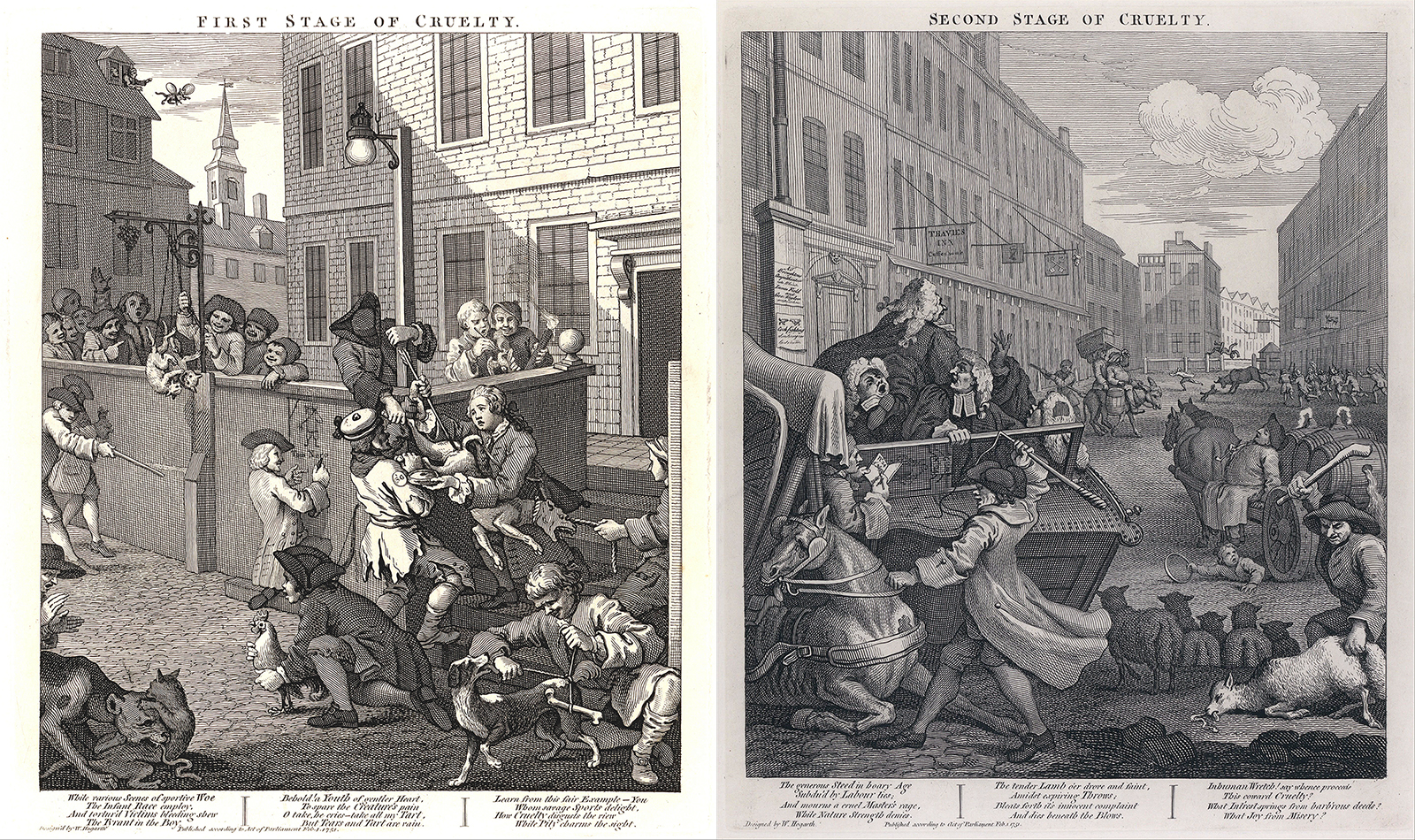
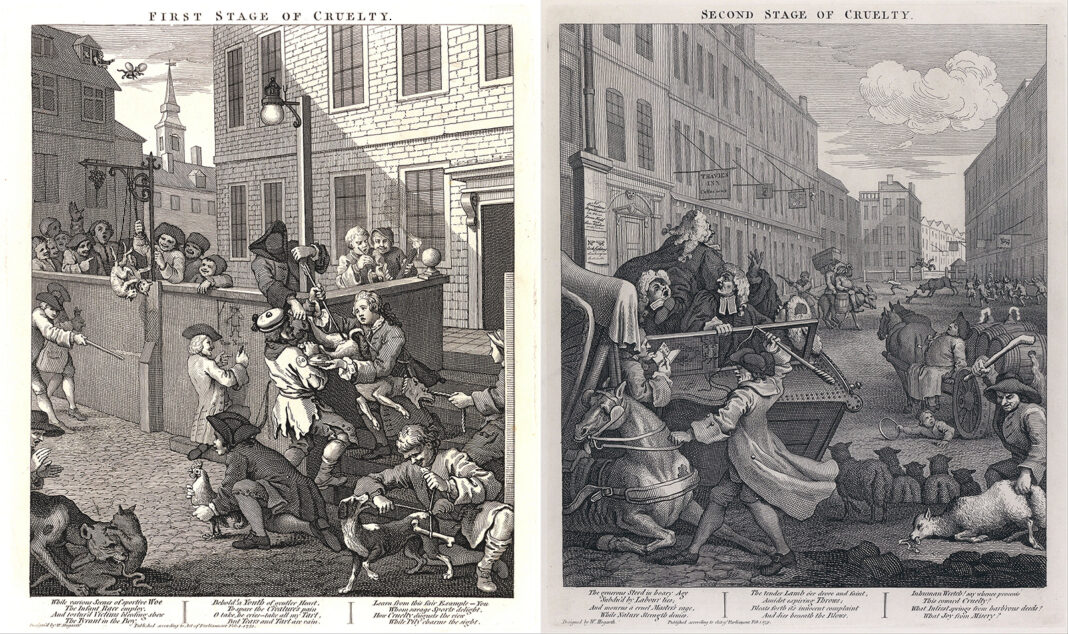
William Hogarth’s “The First Stage of Cruelty: Children Torturing Animals,” left, and “The Second Stage of Cruelty: Coachman Beating a Fallen Horse.” (Images courtesy of Wikimedia/Creative Commons)
This is not a new idea, of course, but it is one that gained new currency in the early modern period when urbanization and industrialization severed old ties between humans and the natural world. It was in the midst of this great shift that the English painter William Hogarth produced a series of prints titled “The Four Stages of Cruelty“ (1751), which vividly portrays the natural course of cruelty for the one who practices it.
The series depicts a character, aptly named Tom Nero, over the course of a life characterized by acts of heartless cruelty — first acts committed by him, but ultimately upon him. The first print shows Tom sadistically torturing a dog on a city street with another boy while others commit abuses on other animals nearby. Only one boy seems to be pleading for them to stop.
The second print depicts Tom grown and working as a coachman. His horse has collapsed from exhaustion, and Tom is wielding the stick with which he has mercilessly beaten the horse, surrounded by other men heaping abuses on other creatures on the city street.
In the third print, we see Tom in the moments after he has murdered his pregnant lover, details of the event described in a letter written by his lover, included in the scene. Tom’s pockets are full of stolen goods and weaponry.

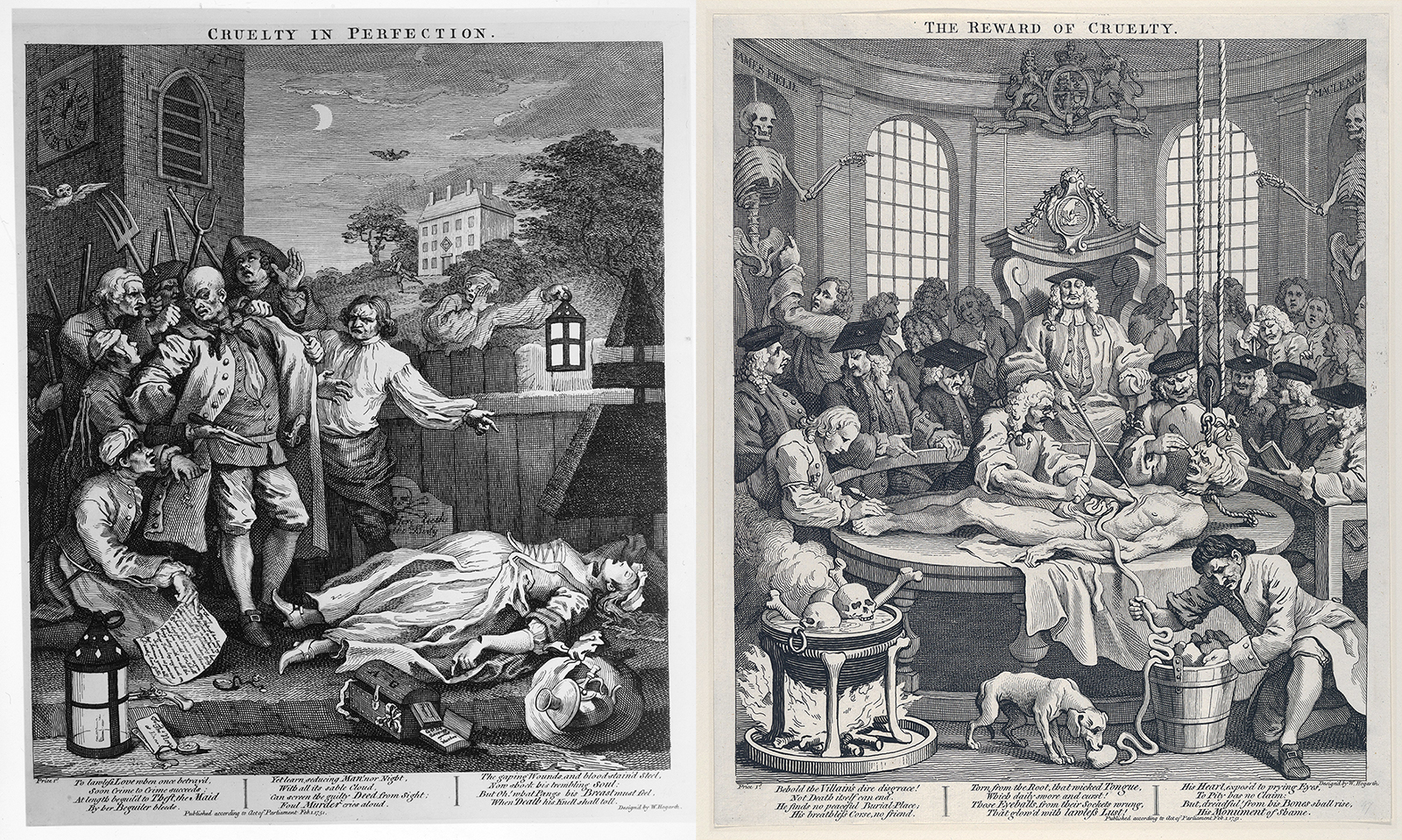
William Hogarth’s “The Third Stage of Cruelty: Cruelty in Perfection,” left, and “The Fourth Stage of Cruelty: The Reward of Cruelty.” (Images courtesy of Wikimedia/Creative Commons)
The fourth and final in the series conveys the moral lesson with the inevitable consequences for such a life: Tom has been executed by hanging, his body is being dissected by heartless operators and bears signs and symbols that reflect all the cruelties he has committed over the course of his life.
Hogarth’s series brings starkly to life the truth that cruelty begets cruelty and ultimately consumes the one who is cruel. This is a truth that was embraced by the earliest evangelical reformers, whose broad reforms during the 18th and 19th centuries changed the world in ways we take for granted today.
Hogarth’s work was produced during the decades when evangelicalism was growing as a movement in England and the Colonies. Within a few decades of this series, a generation of evangelical leaders would rise up who would see with new eyes the various forms of cruelty that were all around in everyday life and challenge them: slavery, the inhumane working conditions of the poor, the injustice of the system of criminal law and animal cruelty.
These evangelicals — including John Newton, William Wilberforce and Hannah More — successfully advocated for reforms in all of these areas. While they were fighting to abolish the slave trade — fueled by the virtue of benevolence and in recognition of the demoralizing and coarsening effects all forms of cruelty have on all those who participate in it — these evangelicals also advocated for animal welfare. In fact, in 1824 Wilberforce helped found the Society for the Prevention of Cruelty to Animals. This is a legacy that, sadly, has been largely forgotten by evangelicals today. But it is a legacy worth remembering and keeping today.
Industrialization and bureaucracy bring greater distances between us and the animals we eat, and it’s easy to feel removed from the practices by which living, breathing, sentient animals become the products we consume — because we are so greatly removed.
But that distance does not remove our ethical and moral responsibility to fulfill the stewardship mandate God gave us in a way that reflects the nature of his goodness and care. It is good and right to care well for the lives of the creatures who aid and sustain human life.