(RNS) — Most people have seen President Donald Trump’s AI-generated image of himself as Jesus.
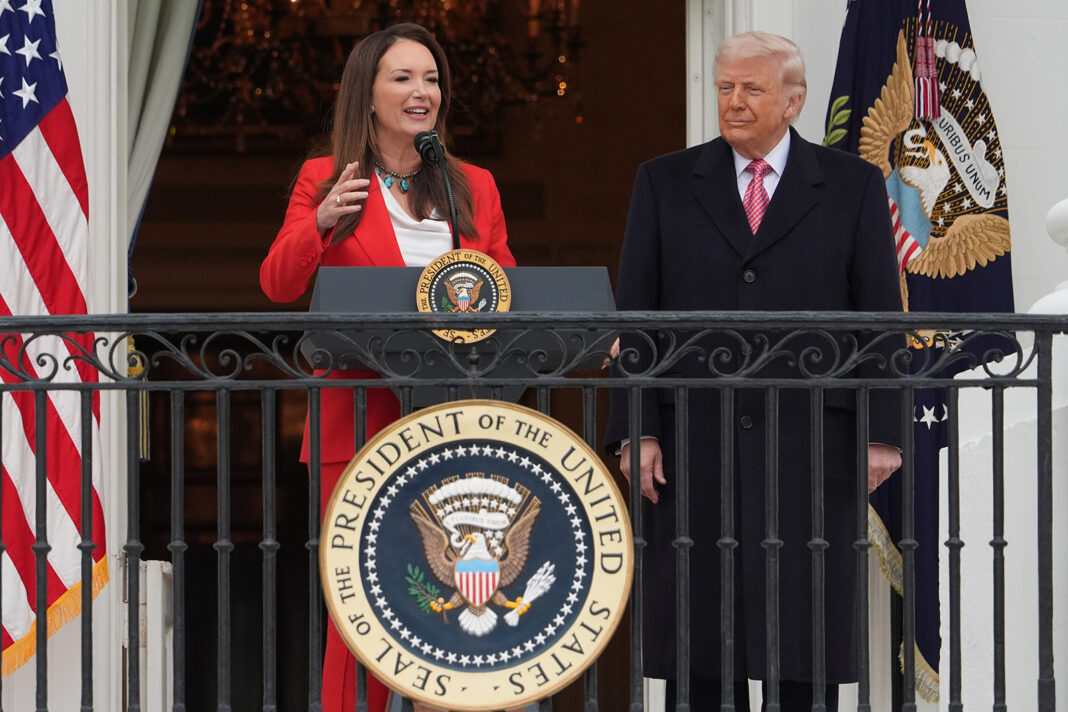
What they may not know is that on Easter Sunday, Brooke Rollins, the secretary of agriculture, sent an email to each of her nearly 100,000 agency employees, characterizing our country as a Christian nation. The Easter-themed email declared “He is Risen indeed!” and described the resurrection as the “foundation of our faith.”
Rollins shattered even the pretense of separation of church and state, violating one of the most important of our constitutional protections and one of the central foundations of our nation and governance. Through her words, she created division among USDA staff, who have expressed shock and dismay at this blatant display of proselytizing.
These efforts to shatter the walls between church and state aren’t any sort of secret: They’re being done right out in the open. In just a few weeks, seemingly the entire Trump administration will join what appears to be a government-sanctioned faith rally, which of course is populated almost entirely by conservative Christians. If there was any doubt about the goals of the event, Trump made it quite clear when he announced it earlier this year, stating that “We’re going to rededicate America as one nation under God.” And all this comes on the heels of the president’s handpicked chair of his so-called Religious Liberty Commission, Texas Lt. Gov. Dan Patrick, calling the separation of church and state “the biggest lie that’s been told in America since our founding.”
The Trump administration has scoffed and trampled on all sorts of norms, but these recent and impending events are the latest examples of its disdain for the idea that every American is free to practice faith without favoritism, fear of retaliation or discrimination. This administration has created an expectation of discrimination, one that permeates every level of our society. These are leaders who oversee millions of dollars in vital programs, and they have the power to punish and reward employees responsible for them. Suggesting preferred status or relationships between, among and for Christians has wide-ranging and long-lasting ramifications.
This is why the Easter message from Rollins is so shocking. In her role as head of USDA, she oversees the distribution of food assistance to over 47 million Americans struggling with hunger. Many of those people receive support from programs like the Supplemental Nutrition Assistance Program, or SNAP; the special nutritional program for women, infants and children, known as WIC; school meals; and other critical food assistance backstops that help Americans feed themselves and their families. Millions of Americans regularly visit food pantries and other direct service organizations, many of which are run through churches and other religious establishments.
What would happen if a family in need didn’t feel comfortable going to a food pantry because they don’t pray the “right” way, and they feared being turned away? What if a food insecure senior felt coerced into joining in prayer or saying grace before receiving food from a church program supported by tax dollars? Or what if a transgender teen struggling with hunger was too afraid to seek help because they feared discrimination?
What if a food pantry decided it had the right to force their religion on those in need?
These aren’t merely hypothetical questions. They are real, serious dilemmas facing Americans every day. And they are being encouraged by Trump and Rollins.
And these actions are nothing new. During Trump’s first term, his administration attempted to roll back religious freedom protections that required faith-based organizations providing taxpayer-funded services to inform recipients of their legal rights to receive those services free from discrimination and opt out of religious programming. The organization I lead, Mazon: A Jewish Response to Hunger, sued the first Trump administration to preserve these protections, and we won.
As a Jewish organization working to end hunger for people of all faiths and backgrounds, especially those already marginalized in our communities, we have an obligation to speak out against such egregious violations of our Constitution. We know all too well how dangerous it is when our leaders purposefully blur the lines between church and state, and what it can lead to when one specific faith becomes the de facto position of the federal government.
Let’s be clear: Rollins leads a government agency, not a religious institution. Our administration represents people of all beliefs, not just one point of view.
Whether it is a head of state depicting himself as a religious figure, or a Cabinet secretary illegally imposing her beliefs on others, or administration leaders recklessly dismantling our social contract to support those in need, the actions coming out of this administration are an affront to all of us. And no matter what individual faiths and beliefs we hold fast, every one of us has the responsibility and obligation to hold them accountable.
(Abby J. Leibman is president and CEO of Mazon: A Jewish Response to Hunger. The views expressed in this commentary do not necessarily reflect those of Religion News Service.)