








(RNS) — On the night of April 18, 1775, Paul Revere’s ride set in motion a chain of events that would alter the course of history. Within hours, at Lexington and Concord, the shot heard round the world marked not only the beginning of a revolution, but also the emergence of a new understanding of freedom.
For those who stood on the village greens, the question was immediate and urgent: Would they submit to authority imposed from afar, or resist it? Beneath that surface, people like John and Abigail Adams had a deeper aspiration that would define America for generations to come.
The revolution that began that morning was not simply a rejection of British rule. It was the beginning of a new idea, that authority could be rooted not in monarchy, but in the people themselves. Freedom, in this vision, required participation, shared responsibility and a form of government that George Washington would describe as “the great experiment.”
This framework, however, has never been easy to grasp.
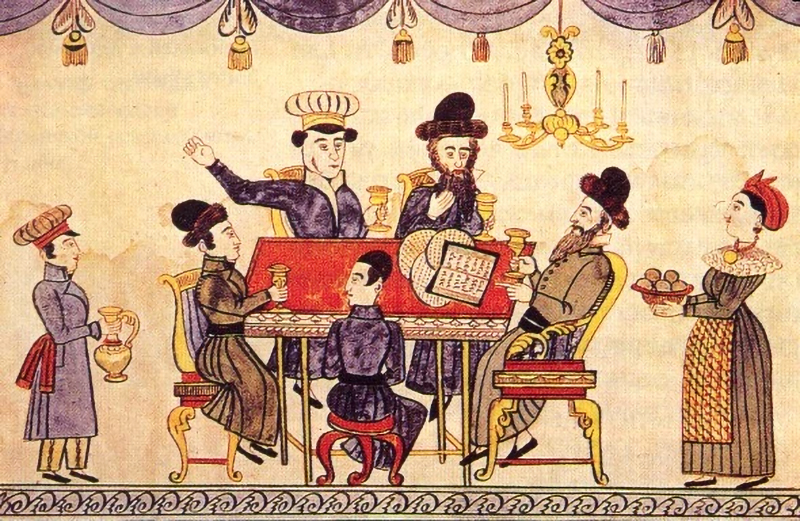
Long before the U.S. founding, Jewish tradition wrestled with a similar question about the nature of freedom. Each year at the Passover Seder, this tension emerges in the voice of the so-called “wicked son,” who asks: “What is this service to you?” The question, despite its direct Biblical source, is often read as a defiant rejection of communal identity.
Our instinct is to recoil at the tone, but in doing so we risk missing the depth of the challenge, one that speaks directly to the civic moment we face in America today.
The Hebrew word for service, avodah, also means work, and it is closely linked to servitude and slavery. The wicked child of the Seder probes its implications. If the Israelites are no longer slaves to Pharaoh, are they not now in service to the King of Kings? With a demanding system of commandments, has one form of bondage simply been replaced by another?


“Jews Celebrating Passover.” Lubok, XIXth century. (Image by anonymous folk artist/Wikimedia/Creative Commons)
This is not a question to dismiss, but one question that every free society must answer.
Jewish tradition responds with clarity that not all authority is the same. Pharaoh’s rule imposed arbitrary power and stripped human dignity. The Torah, by contrast, introduces obligation rooted in moral purpose, calling individuals into a shared covenant. Freedom, in this framework, is not the absence of constraint, but the presence of public responsibility. True liberty is the capacity to build a just society, care for the vulnerable and uphold the rule of law.
The American experiment rests on a similar foundation. Instead of eliminating obligation, the shift from subject to citizen transformed it. Laws, taxes and civic duties were no longer external impositions, but rather expressions of a system sustained by the participation of its people.
That vision, however, depends on understanding. And today, that understanding has eroded.
According to the National Assessment of Educational Progress, as of 2022, only 22% of eighth graders were proficient in civics. Surveys also consistently show that many adults cannot name the three branches of government or pass a naturalization test. These gaps point to a deeper problem, namely that a democracy cannot function if its citizens do not understand how it works.
When that understanding fades, the line between authority and oppression blurs. Disagreement turns into distrust. Gratitude is replaced with grievance. The very habits that sustain a free society begin to weaken.
As Ruth Wisse, a scholar of Yiddish literature and Jewish culture, cautioned in her recent National Endowment for the Humanities Jefferson Lecture, “If there is to be enduring government of, by and for the people, the people would have to be instructed and reminded to respect and confidently to perpetuate their precious inheritance.”
Civic education, long rooted in both democratic and religious traditions, is about equipping young people with the tools to ask hard questions and engage with competing answers. It teaches not only how institutions function, but why they matter, and how individuals are called to participate in sustaining them and in the shared work of self-government.
In this sense, a child with revolutionary questions is not the problem. The greater danger is a society that fails to provide meaningful answers that nurture civic faith and trust.
As we approach America’s 250th anniversary, let us celebrate the choices citizens have made in every generation about how they could better understand and strengthen the freedoms they have inherited. Much focus has been placed over the years on the shot that started the war. And yet, the revolution truly began when Revere and his fellow riders embraced the opportunity to lend their voices and devote their energy to an idea bigger than themselves.
May their ride — and the declaration that followed — inspire our actions in the years to come.
(Rabbi Charles E. Savenor is executive director at Civic Spirit, a national organization that works with Jewish, Catholic and Christian schools to strengthen civic knowledge, civil discourse and democratic responsibility. The views expressed in this commentary do not necessarily reflect those of Religion News Service.)