











(RNS) — How do you get to Great Neck, New York?
You can take the Port Washington branch of the Long Island Rail Road, or you can drive out on the Long Island Expressway to Exit 33. And you can work hard, be successful and want a great community for your family with one of the best school districts in the New York City area.
This is the way it has been in Great Neck for almost a century. The Long Island North Shore town was home to F. Scott Fitzgerald, who located Gatsby’s West Egg at the end of the peninsula, in Kings Point. Groucho Marx lived there in the 1920s. So did Ring Lardner and George M. Cohan.
Over the subsequent decades, and certainly after World War II, Great Neck became a capital city of the Jewish upper-middle class — a classic suburb, like Scarsdale, New York; Newton, Massachusetts; or Highland Park, Illinois. My relatives lived there. My closest friends grew up there. I spent countless hours in its homes, its stores and restaurants, at its shoreline — and, most memorably, at Temple Beth-El, which was the largest Reform synagogue on Long Island.
In its heyday, Beth-El was the spiritual home to as many as 1,800 families. Its spiritual leaders have been distinguished leaders of Reform Judaism. They engaged the first ordained woman cantor, Barbara Ostfeld, to offer prayers in its magnificent sanctuary, which had been designed by Louise Nevelson.
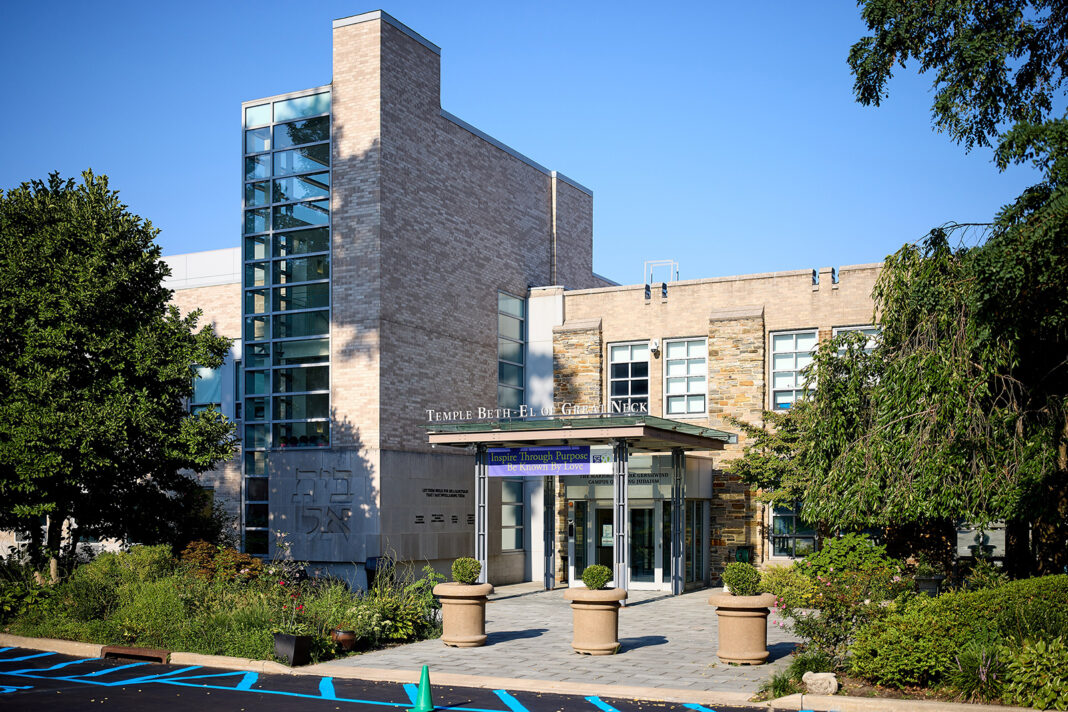
But things change. Recently, an Iranian/Sephardic yeshiva purchased Temple Beth-El.
Many of my friends who grew up at Beth-El experience this as a kind of a loss. I see it as a story of Jewish transformation.
The Persian/Iranian Jewish community is among the oldest continuous Jewish communities in the world, going back even further than Cyrus the Great. The Hebrew Bible ends with him inviting the Jews of his realm to return to Jerusalem, while those who stayed behind in Persia built a rich culture, literature and traditions.
Then came the Iranian Revolution of 1979, and we are still living with its aftermath. It persecuted the Jews of Iran, and many Iranian Jews did what Jews have done throughout history — they left. They came to the United States, in particular Los Angeles and Great Neck.
This is Jewish history, 101. Consider our story: The Jews are expelled from Spain, and those Sephardic Jews arrive in Amsterdam. They help make Amsterdam into a global center of trade.
Eastern European Jews leave the lands of their persecution. They move to, among many other places, the Lower East Side of New York, and they transform American Judaism.
For a variety of reasons, Jews move, and they build again — as Iranian Jews have done in Great Neck.
As for Temple Beth-El, its senior rabbi, Brian Stoller, said to me: “We are a strong and vibrant community of 400 families. Our building was built for a different time. Our leadership engaged in a strategic planning process. We are selling the building, and we are leasing back a part of it from the yeshiva. This will make us one of the most financially secure synagogues on Long Island. We have become the authors of our own future.”
The Beth-El leadership has imitated Joseph, who could see the approach of the seven good years for Egypt and the seven not-so-good years. That is called strategic planning. It means making wise choices, sometimes building relationships with other Jewish institutions, sometimes merging. In Cleveland’s Beachwood suburb and Pittsburgh, historic Reform synagogues have announced unifications in the last couple years — not out of desperation, but out of opportunity and vision.
That should be the wave of the future.
Moreover, the Jews of Great Neck and elsewhere might learn something from Iranian Jews.
In Reform Judaism, we center ourselves around the individual and personal autonomy. But Iranian and Middle East and African Jews (MENA) have a different culture. As Mijal Bitton, a New York Jewish spiritual leader and sociologist, has written:
What made America golden [for MENA Jews] was not that Jewish life could be transformed but that it could be preserved. What they craved above all wasn’t freedom or social acceptance. It was stability and continuity, the opportunity to continue the life that they had led for generations. As I see it, this impulse toward preservation rather than transformation became the foundation of their life in America, leading to their own version of the American dream …
Without romanticizing or idealizing Iranian and Mizrachi Jews, they tend to center themselves around family meals and celebrations. They emphasize continuity, tradition and faith.
Several years ago, I was in a Great Neck Italian restaurant (read: treif, or not kosher) on a Shabbat afternoon. I noticed a group of men eating lunch — each wearing a silk kippah and speaking Farsi.
I approached them and said: “Shabbat Shalom,” and expressed nonjudgmental surprise to see them eating in a treif restaurant on Shabbat. They said, “Yes, it’s wrong according to Jewish law. But we just came from our synagogue [named for a particular city in Iran]. We come here to eat lunch together and to continue our Shabbat spirit.”
As Israeli philosopher Micah Goodman has written:
They [MENA and Iranian Jews] have an intimate relationship with the past, but the past does not control them. They are attached to their past and connected to their tradition without enslaving themselves to past generations. Their relationship is one of fidelity and proximity, rather than power and control.
That is a pretty good way to live your Jewish life.
No doubt, many Great Neck Jews are mourning what their community used to be. But they could choose to look at it differently. They could see their community as part of the larger sweep of Jewish history and migration, and the Iranian Jews in their midst as symbols of Jewish survival and resilience.
Temple Beth-El is not going anywhere. It will be there for generations to come because it has prided itself on being progressive and forward-thinking — ready to embrace the future in a way that has always seemed right and creative. That is exactly what it is doing by working with another Jewish institution and discerning how to live in a diverse Jewish community.
That may not feel like the story we expected. But it is the story we have. And if we pay attention, it might even be the story we need.