








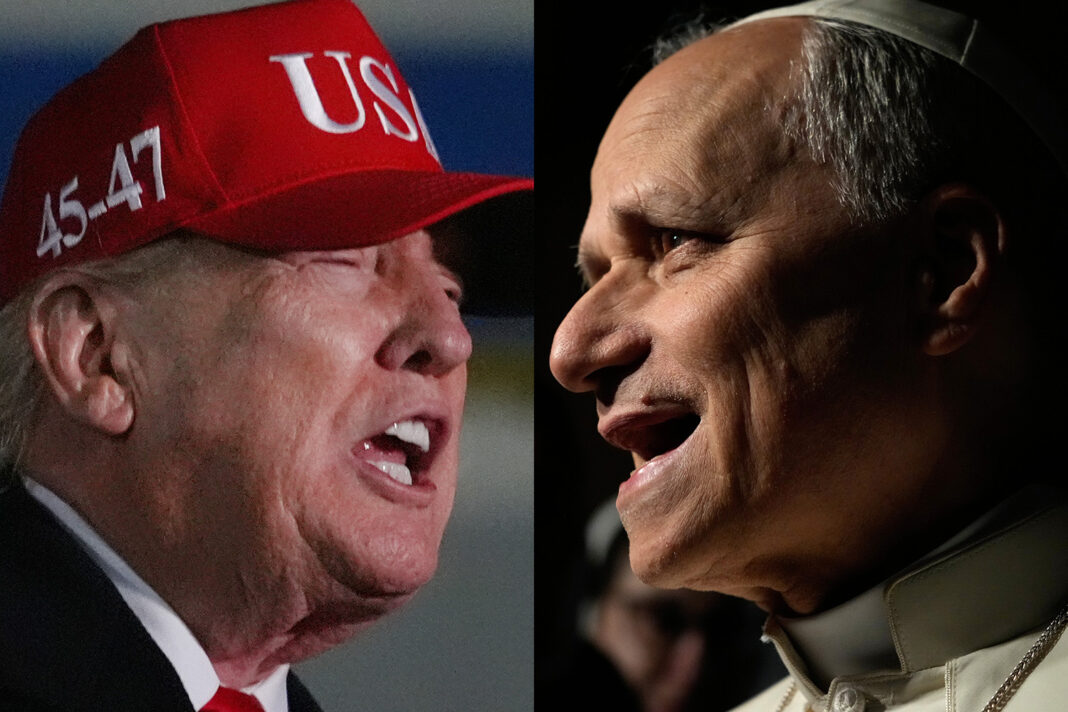
(RNS) — On Sunday night (April 12), President Donald Trump posted a lengthy broadside on Truth Social against Pope Leo XIV that started with “Pope Leo is WEAK on Crime, and terrible for Foreign Policy.” Trump then doubled down, telling reporters: “I’m not a big fan of Pope Leo. He’s a very liberal person.”
Many of us had no idea that the pontiff was WEAK [sic] on crime. I have visited Vatican City, and I have not had to keep my eye on my wallet or passport.
This is not the first time that the president has gone at it with a Christian leader. Recall Episcopal Bishop Mariann Budde preaching after Trump’s inauguration at Washington National Cathedral, imploring him to show the Christian quality of mercy. He complained about her, too.
(Not to be left out, many rabbis crave an insult from Trump. It looks good on a resume.)
And then, Trump posted an AI-generated image of himself — wearing a white robe, laying his right hand on a man who appeared sick or dying, with a bright light emanating from his fingers, and the American flag, eagles and military planes flying behind him. He resembled Jesus, but he told reporters, “I thought it was me as a doctor, and had to do with Red Cross, as a Red Cross worker there, which we support. Only the fake news could come up with that one.” He went on to say that he had saved lives.
What is going on here, theologically?
I suspect my Christian theologian friends would label this as blasphemy. I would offer a different word for it: idolatry.
Idolatry is not merely worshipping many gods or false gods. It is not merely the worship of a golden calf. The original, primordial idolatry is the worship of the self.
It is the ancient sin of Pharaoh, who proclaimed himself a god. It is precisely what Pope Leo XIV had in mind when, just the day before Trump’s attack, he stood at the prayer vigil at St. Peter’s Basilica and declared: “Enough of the idolatry of self and money! Enough of the display of power! Enough of war! True strength is shown in serving life.”
The pope was not being political. He was being prophetic.
I am a Jewish religious leader. The pope is the supreme religious leader of the Roman Catholic Church, and if president Trump’s crude words insulted my Catholic friends and readers, I share your anger and hurt.
The pope and I do not agree on everything, nor should we. On war and peace, our traditions carry different nuances. Iran has been amassing an arsenal, nuclear and conventional, with one goal in mind: wiping out the Jewish state. Many Jewish leaders, and certainly many Israelis, see the war in Iran as milchemet mitzvah, an obligatory, existential war against the ultimate evil of our time.


The pope’s tradition leans more consistently toward aggressive peace-making. I share his ultimate vision of shalom, of peace, but I would argue the path there sometimes requires a harder reckoning with the nature of evil.
These are genuine and honorable theological differences. I would love to have a latte with the pontiff to discuss them.
In fact, not every Catholic thinker would agree with the pope on the war in Iran. Pastor Gerald Murray writes in The Free Press that he believes this war meets the centuries-old conditions for a just war under the doctrine of the Catholic Church:
Waging just war is a last resort to protect the innocent by defeating the enemy. It is a virtuous act to take up arms in defense of the nation against an unjust aggressor.
Does this mean that one must wait for the enemy to attack before a nation can commence morally legitimate military action to neutralize the threat? No, that would be a dereliction of duty if the intent and capabilities of the prospective aggressor were known with certainty. The Iranian regime is a relentless enemy, using proxies to kill Americans and America’s allies. There is no doubt that Iran has been and presently is a grave threat.
Vice President JD Vance, himself a Catholic, doesn’t like what the pope said — and doesn’t believe that the pope should be opining on theology. That is called chutzpah.
But the pope is doing his job because a religious leader is supposed to speak truth to power.
The Hebrew prophets understood this. When King David committed adultery with Bathsheba and arranged the murder of her husband, Uriah, the prophet Nathan did not look the other way because David was the most powerful man in the kingdom. He walked into the palace and said: “You are the man.”
When King Ahab and Queen Jezebel murdered the innocent Naboth to steal his vineyard, the prophet Elijah did not stay home and tend to his own affairs. He confronted the king directly: “Have you murdered and also inherited?” Ahab called him “a troubler of Israel” (I Kings 18:17), and the description fit — because a prophet does not only cause “good trouble” for a king, but for an entire people.
No wonder the Christian author Frederick Buechner said this about the prophetic role: “There is no evidence to suggest that anyone ever asked a prophet home for supper more than once.”
Trump and his supporters have both misunderstood and distorted the role of religion in a democratic society. Religious communities are not supposed to be cheerleaders for the state. They are supposed to be umpires, calling strikes and balls — and mostly, foul balls.
Pope Leo XIV understands this. He told reporters aboard the papal plane: “I have no fear of either the Trump administration or speaking out loudly of the message of the gospel, which is what I believe I am here to do — what the church is here to do.”
And on the same weekend Trump posted an image of himself as the healer of the sick, Leo was on his way to Algeria — to lay a wreath, to pray for the dead and to speak of dignity and reconciliation.
One man seemed to imagine himself as Jesus. The other one simply tried to act like him.