








MUMBAI: Tata Sons posted a 22% jump in profit in FY26, lifted by gains from the listing of Tata Capital – even as its chairman N Chandrasekaran faces a crucial annual general meeting over his future at the conglomerate.Net profit at the holding company of the salt-to-software group rose to Rs 31,961 crore from Rs 26,232 crore in FY25, driven largely by profit on sale of investments of Rs 6,531 crore – against a negligible Rs 72 crore a year earlier – as Tata Capital’s IPO, India’s fourth largest, delivered a windfall.Revenue, which comprises dividend income and brand royalty fees, rose 9% to Rs 42,367 crore. Dividend income declined 10% to Rs 32,528 crore, largely due to a lower payout from TCS. Royalty fees, which Tata Sons charges operating companies for the use of the Tata trademark, rose 23% to Rs 2,294 crore.The strong numbers, however, did little to move the needle on Chandrasekaran’s pay. His annual compensation remained flat at Rs 141 crore in FY26, even as Noel Tata, chairman of promoter Tata Trusts, raised concerns over losses at some of the conglomerate’s newer ventures. Chandrasekaran, who has been leading Tata Sons for over nine years, nonetheless ranks among India’s highest-paid professionals.

At Rs 1.1 lakh per share, Holdco’s dividend up 70% from FY25
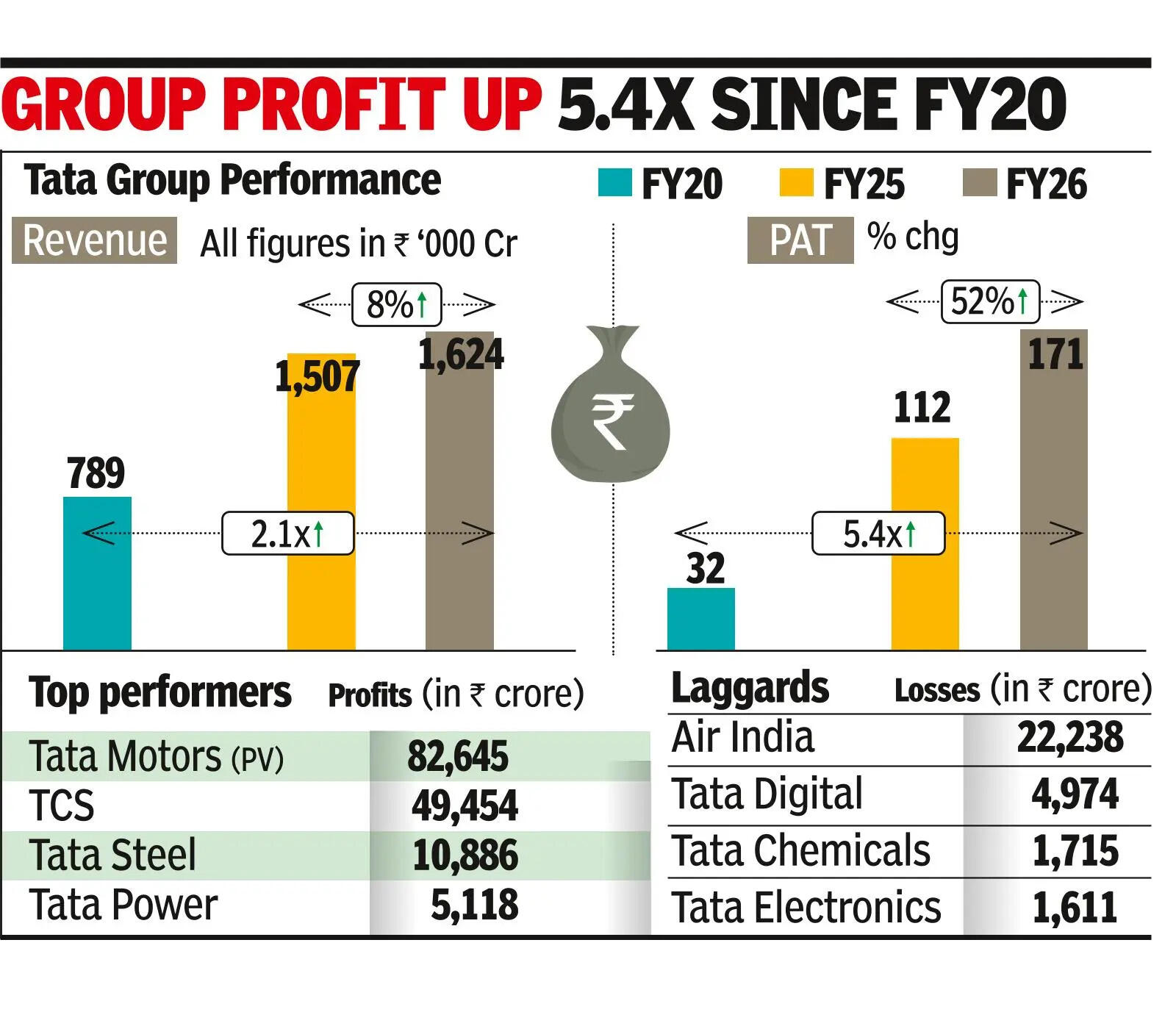
The board declared a dividend of Rs 1.1 lakh per share, up 70% from Rs 64,900 in FY25. Sir Dorabji Tata Trust and Sir Ratan Tata Trust will earn Rs 1,252 crore and Rs 1,054 crore in dividend income respectively. Noel, who holds 4,060 Tata Sons shares, will receive Rs 45 crore.The AGM, called for August 18, will seek shareholder approval for Chandrasekaran’s reappointment as a director, who retires by rotation at the meeting. The vote carries weight beyond procedure: without his directorship, Chandrasekaran cannot continue as chairman till February 2027, when his term comes to an end.The AGM itself faces a potential hurdle. Tata Sons’ articles of association require a representative jointly nominated by SDTT and SRTT to be present for a valid quorum, a condition that has become difficult to satisfy after the Maharashtra charity commissioner barred SRTT from holding board meetings.At a group level, profit rose 52% to Rs 1.7 lakh crore in FY26 while revenue climbed 8% to Rs 16.24 lakh crore. Yet losses at several new ventures continued to weigh. Air India remained the biggest drag, with losses more than doubling to Rs 22,238 crore. Tata Digital, which has drawn particular scrutiny from Noel, saw losses widen to Rs 4,974 crore from Rs 4,610 crore. Losses at Tata Electronics ballooned to Rs 1,611 crore from Rs 70 crore, while Agratas rose to Rs 1,101 crore from Rs 741 crore.Chandrasekaran said the group’s investments in semiconductors, energy transition, aviation and defence manufacturing are targeted at making “generational impact.” He called FY26 Air India’s most challenging year, citing airspace closures, fuel price hikes driven by the West Asia conflict and the AI171 crash, describing the airline’s turnaround as a “five- to ten-year journey.”“Every great airline in history was built over decades, not quarters,” he said. On Tata Digital, he said BigBasket was adapting to the rapid shift towards quick commerce, while Tata Neu would target a 10x increase in payments users and expand into lending and insurance.On Tata Electronics, he said operating profits had achieved breakeven, adding “Chips are the new steel.”