




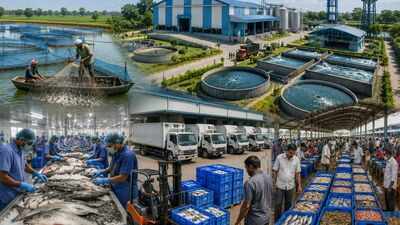
Uttar Pradesh Government, committed to bring about blue revolution in the state, announced yet another welfare scheme in 2026–27 Budget. The Integrated Aqua Park and State-of-the-Art Fish Wholesale Market Scheme is a major infrastructure initiative designed to modernize the state’s fisheries sector. The scheme focuses on strengthening the entire value chain—from fish production to processing and marketing.Key featuresThe initiative is divided into two primary infrastructure projects:1. Integrated aqua park
- Budget allocation: Rs 190 crore (under the
Pradhan Mantri Matsya Sampada Yojana –PMMSY ). - Concept: A one-stop, cluster-based fisheries hub designed to increase farmers’ income, improve productivity, and reduce post-harvest losses.
Integrated facilities include:
- Fish hatcheries and seed production
- Feed mills and modern aquaculture facilities
- Cold storage and ice plants
- Fish processing and value-addition packaging units
- Logistics and marketing infrastructure
2. State-of-the-art fish wholesale market and processing centre
- Budget allocation: Rs 100 crore.
- Concept: An organized marketing system designed to replace fragmented, unhygienic markets, ensuring better prices for farmers and safer products for consumers.
- Project proposals include:
- A modern, hygienic wholesale fish market
- Dedicated fish processing and packaging facilities
- Robust cold-chain infrastructure
- Quality testing and secure storage facilities
Core objectivesThe scheme aims to achieve several strategic goals to bolster Uttar Pradesh’s Blue Economy:
- Boost production: Increase overall fish production and productivity.
- Build the value chain: Create a comprehensive
fisheries value chain within the state. - Reduce waste: Minimize post-harvest losses through better infrastructure.
- Add value: Promote fish processing and value addition.
- Empower farmers: Improve market access and secure better pricing for fish farmers.
- Drive employment: Generate new jobs across fisheries, processing, transport, and allied sectors.
- Expand trade: Increase fish exports from the state.
Complementary budget support (2026–27)To further support the sector, the government has proposed additional funding under the PMMSY:
- Rs 195 crore allocated for the general/male component.
- Rs 115 crore allocated specifically for the women component, designed to encourage and support greater female participation in fisheries and allied activities.
Beneficiaries
1. Direct beneficiaries (the fisheries workforce)
- Fish farmers and fishers: They gain access to modern hatcheries, quality seeds, and feed, as well as better infrastructure to increase their yield and income.
- Fish workers and vendors: They benefit from organized, hygienic wholesale markets and cold-chain facilities, which reduce spoilage and ensure they can sell their products at better profit margins.
2. Business and institutional beneficiaries
- Entrepreneurs and start-ups: The scheme opens up opportunities for private investment in cold storage, processing units, packaging, and logistics.
- Fish farmers producer organizations (FFPOs) & cooperatives: These groups can leverage the cluster-based infrastructure to scale their operations, access wider markets, and negotiate better prices collectively.
- Self-help groups (SHGs) and joint liability groups (JLGs): Community groups involved in allied activities (like net mending, packaging, or small-scale processing) receive institutional and infrastructural support.
3. Priority and special focus groups
Under PMMSY guidelines, certain marginalized or underrepresented groups receive specialized support and higher financial assistance (often up to 60 percent subsidy compared to the general 40%):
- Women: As highlighted by the specific Rs115 crore budget allocation in the 2026–27 state budget, women entrepreneurs and workers are highly prioritized to encourage female participation in the fisheries sector.
- SC/ST and differently-abled individuals: They receive targeted support and higher subsidies to promote inclusive economic growth.
4. Indirect beneficiaries
- Consumers: The establishment of state-of-the-art, hygienic wholesale markets and quality testing facilities ensures that consumers get access to safer, fresher, and higher-quality seafood.
- Rural communities: The massive scale of the Aqua Park and processing centers creates significant direct and indirect rural employment in transport, logistics, maintenance, and processing.
- The state economy: By transforming into a market-driven ecosystem and boosting fish exports, the state of Uttar Pradesh itself benefits through a strengthened “Blue Economy”.
Expected impact
- This scheme is poised to transform Uttar Pradesh’s fisheries sector from a traditional, production-focused model into a highly efficient, market-driven, value-added ecosystem.
- By delivering modern infrastructure, reliable cold-chain facilities, and an organized marketing network, the initiative aims to significantly boost farmers’ incomes, attract private investment, and create widespread rural employment. Ultimately, it lays the groundwork to position Uttar Pradesh as a leading powerhouse for inland fisheries and aquaculture in India.


