











(RNS) — There are moments when a single person seems to gather the entire story of the Jewish people into her heart. Rachel Goldberg-Polin is a perfect example.
On Oct. 7, 2023, Hamas kidnapped her son, Hersh Goldberg-Polin, 23, from the Nova Music Festival. He lost part of his arm. Hamas held him as a hostage in the tunnels of Gaza. In Rachel’s words, he was “tortured, tormented, starved, abused.”
After 328 days in captivity, they executed him. Rachel must now ask, how do I walk through this place without a piece of me here?
In the summer before Hersh’s death, I walked the streets of Jerusalem. I could not walk 50 yards without seeing posters of the hostages. Hersh’s face appeared again and again. He became the most recognizable hostage. His name jumped off of graffiti: “Hersch chai, Hersh lives.”
In the tunnels of Gaza, he had lived with these words of Holocaust survivor and psychiatrist Viktor Frankl: “Those who have a ‘why’ to live can bear with almost any ‘how.’”
Surviving his ordeal became Hersh’s “why.” And saving Hersh became the “why” of his parents, Jonathan and Rachel.
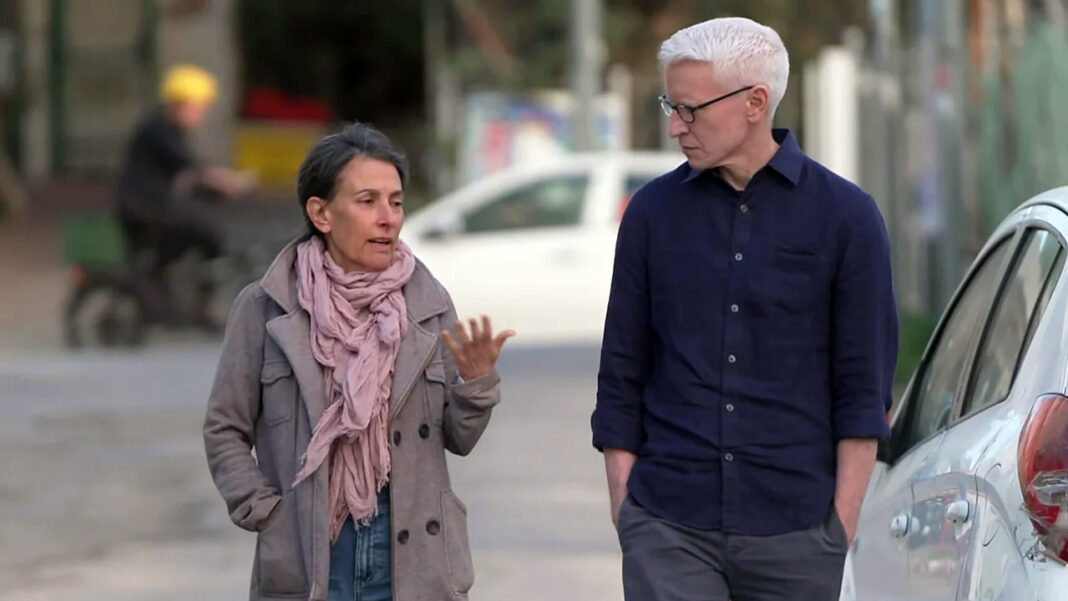
The other evening, I watched Anderson Cooper interview Rachel on “60 Minutes” (she was also interviewed by RNS). In one moment, Cooper had to stop and swallow his tears; it was as if he was approaching a burning bush, and refusing to look aside.


Rachel Goldberg-Polin, left, speaks with Anderson Cooper on “60 Minutes.” (Video screen grab via CBS)
Hersh became the face of Oct. 7. And Rachel, who believes herself to be a “nobody,” has become the face of faith.
That faith began with the birth of her son. She said in the Cooper interview, “The universe really knew what it was doing when it said, ‘Rachel’s gonna have one son … so, this is the one for her.’ I was really blessed.”
Hersh was joyful, funny, creative and idealistic, as she described. And then, Oct. 7.
“The sirens started. … I turned on my phone, and at 8:11 two messages had come in from Hersh,” she said in the “60 Minutes” interview. “The first one said, ‘I love you.’ And the second one said, ‘I’m sorry.’ And that was it. Everything that had ever happened in my life … was over. … I love you. Stay strong. Survive.”
Every morning, Rachel said the traditional prayer, thanking God for restoring her soul, thanking God for his faith in her. That is what faith looks like — a willingness to survive and believing that God reciprocates our faith in the Divine.
There were several scenes in the “60 Minutes” report that totally gutted me: a remarkable video of Hamas taking Hersh into captivity, scenes of him in the tunnel and another that will always be with me. Rachel is standing near the border of Gaza, holding a microphone and howling: “Hersh! It’s Mama. It’s Day 328. We are all here, the families of the remaining hostages. We are working day and night, and we will never stop.”
And then, she offered him the Priestly Blessing — “May God bless you and keep you” — the blessing with which parents bless their children on Shabbat across the desert.
That is what faith sounds like: screaming into the void, and knowing that there might be no response. It’s like prayer itself.
“We ended up finding out they killed him that day. And so I wonder, did he hear me?” Rachel said. “I think there are other ways that you can hear your parents screaming for you, even if you don’t hear them.”
That is what faith feels like — a stubborn insistence that love still connects us, even across the abyss.
At the end of the interview, Cooper asked her: “Do you think you failed?”
Rachel: “Yeah.”
Cooper: “You did more than anybody could possibly do.”
Rachel: “It’s true … and sometimes, 100% is not enough.”
This, again, is what faith looks like — doing as much as you can, even when it might be fruitless.
Six months ago, on the second day of Rosh Hashana, we Jews read the prophetic passage in which Jeremiah comforts the Jews who had been exiled from Judea:
Thus said the Eternal:
A voice is heard in Ramah –
Wailing, bitter weeping –
Rachel weeping for her children,
Refusing to be comforted for her children, for they are gone.
It is uncanny. The biblical matriarch, Rachel, who had been barren, who prayed for children, who finally gave birth to Jacob’s favorite son, Joseph, and who dies giving birth to Benjamin, weeps for her children who are gone.
But the text from Jeremiah continues:
Thus said the Eternal:
Keep your voice from weeping, and your eyes from tears,
For your labor shall have its reward – declares the Eternal.
They shall return from the enemy’s land.
And there is hope for your future – declares the Eternal –
Your children shall return to their land.
For my Christian readers, this is like Mary. Rachel Goldberg-Polin turned her unspeakable anguish outward.
When Rachel eulogized her son, she said that she no longer had to worry about him. She spoke of Hersh being safe, being held, being loved. She spoke of the world to come. She spoke of reunion, which is why the title of her new book is “When We See You Again.”
Who speaks like that? Only someone whose faith does not deny grief, but walks straight through it. Rachel has shown us what it means to cling — to life, to love, to God — even when everything shatters. She has shown us that grief can become what she called “a precious badge of love.”
She has shown us that memory is not just something we carry, but something that carries us.
As Rachel put it: “We got all these people home, not the way we wanted. We wanted them home, alive, but they had come home.”
That, too, is faith — in this people, and in the power to come home.