






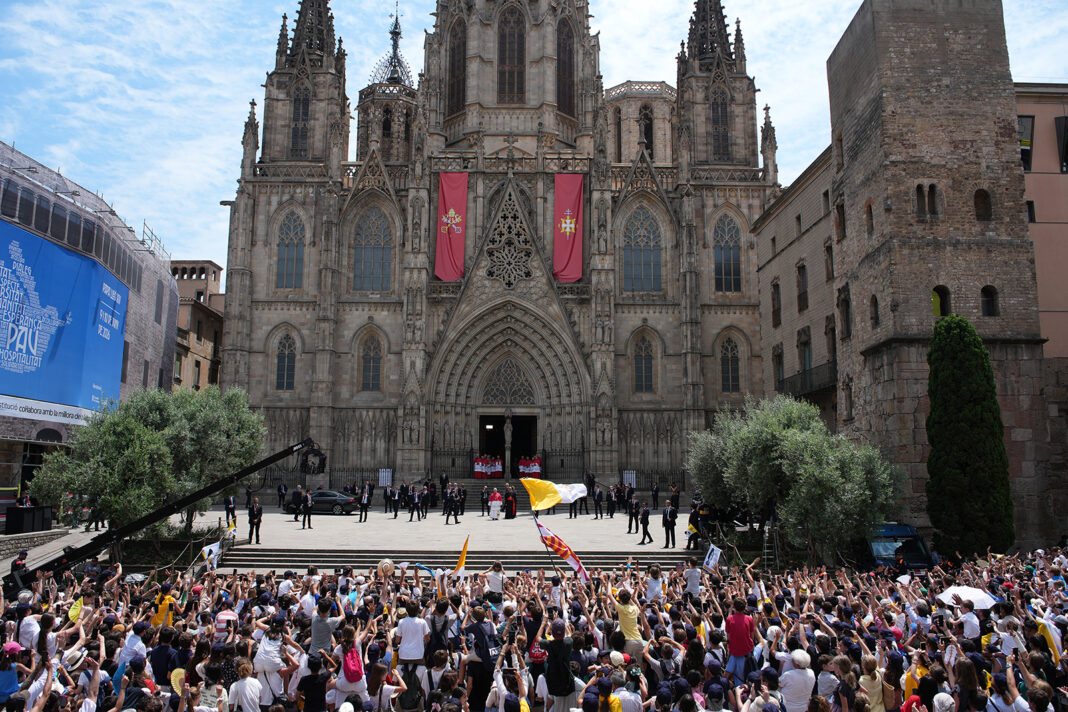
BARCELONA (RNS) — Pope Leo XIV urged healthcare systems Tuesday (June 9) to prioritize mental health as he reflected on how society often silences pain and vulnerability, which especially harms the psychological well-being of young people.
The pope made the remarks while answering questions by Spanish youth during a prayer vigil at the Lluís Companys Olympic Stadium in Barcelona, where he also addressed the “dramatic reality” of violence against women. It marked the end of his first day in Barcelona, the second leg of his weeklong trip that has already led him to Madrid and will end in the Canary Islands.
Mental health is often threatened in societies that are considered advanced, he said, calling this a “sign that there is something deeply wrong” in how people are subjected to “pressures, expectations and tensions” in the name of progress.
“For this reason, we need a healthcare system that prioritizes this invisible and widespread malaise, which also affects young people,” the pope said.
Leo answered a question by a young person who attempted suicide before finding faith and who struggles with mental health. “Certain cultural norms demand that we always be victorious and perfect, and so our limitations, fragility and pain must be eliminated, confined to the deafening silence of loneliness or even shame,” he said.
About 40% of Generation Z members worldwide say they need support for their mental health, according to a 2025 survey by the Global Coalition for Youth Mental Health, a UNICEF initiative funded by private-sector partners. A 2025 World Health Organization report found that suicide was the third leading cause of death among 15- to 29-year-olds.
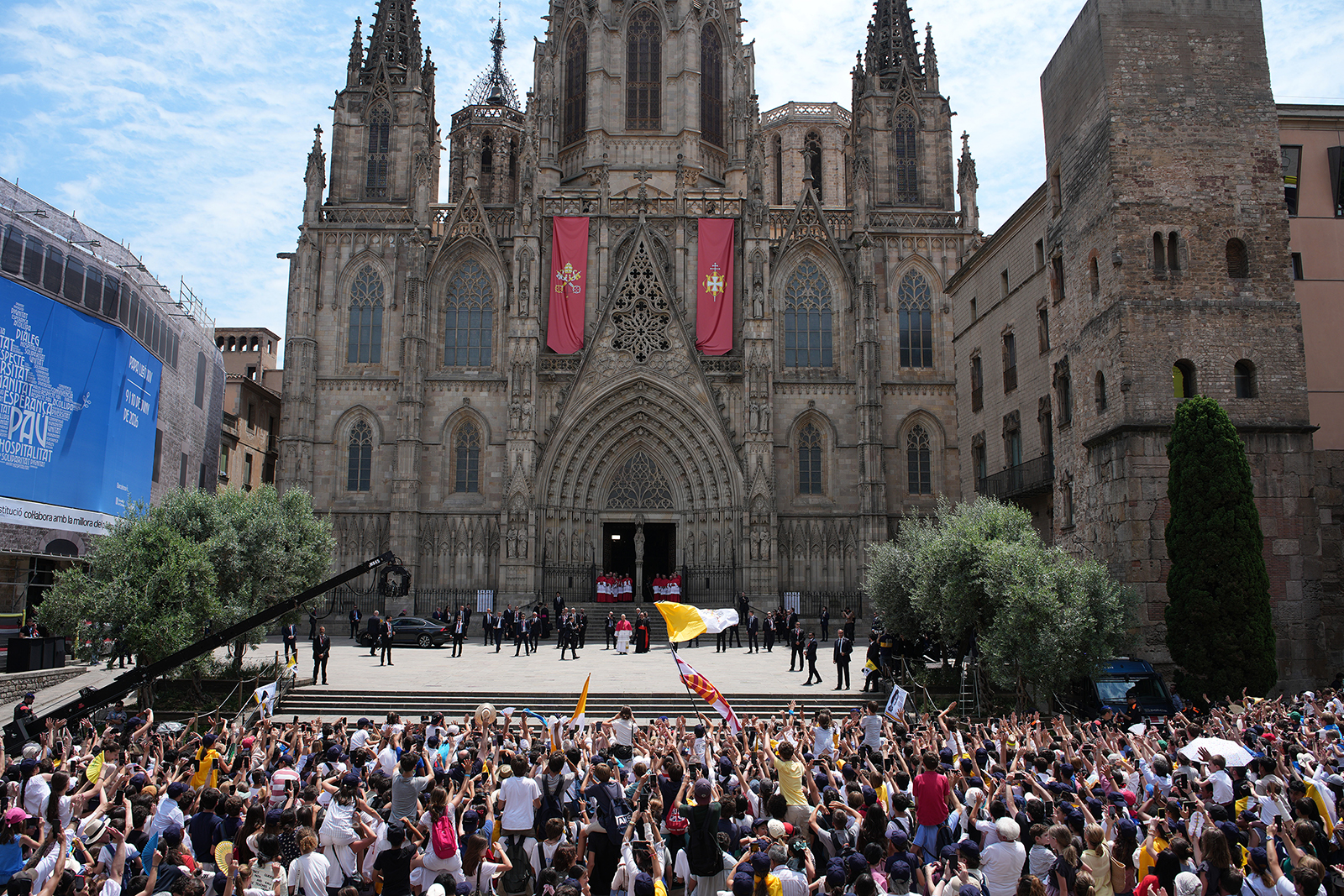
Pope Leo XIV looks at the cheering crowd upon arriving to attend a midday prayer at the Cathedral of the Holy Cross and Saint Eulalia in Barcelona, Spain, Tuesday, June 9, 2026. (AP Photo/Emilio Morenatti)
In the U.S., suicide was the second leading cause of death in 2023 for people ages 10-34, a National Institute of Mental Health report found. While suicide rates rose sharply from 2007 to 2023, numbers have declined in recent years, according to the U.S. Centers for Disease Control and Prevention.
The pope urged people struggling with mental health to speak to God, “even crying out to him, even protesting like Job, confident that in some way he is present and near even when he appears to be silent.” But he also said that people must not handle the situation alone. “In times of pain, at least as much as possible, we must open ourselves to someone” who can offer a prayer, nonjudgmental support and discretion, he said.
“These experiences also offer a message to us believers, to the whole church: We must not spiritualize pain, superficially attributing it to ‘God’s will’ or to some mysterious plan of his, because this risks minimizing that suffering, silencing it and hurting people,” Leo said.
“God does not want suffering. He carries it with us and invites us to trust in him with perseverance,” he added.
Answering another question, the pope weighed in on “the idolatry of profit and performance” in our societies, marked by “the drive to always produce and win, as well as the cult of self-image.” These, he said, “are nothing more than anesthetics designed to numb our conscience and mold it to a certain vision of society.”
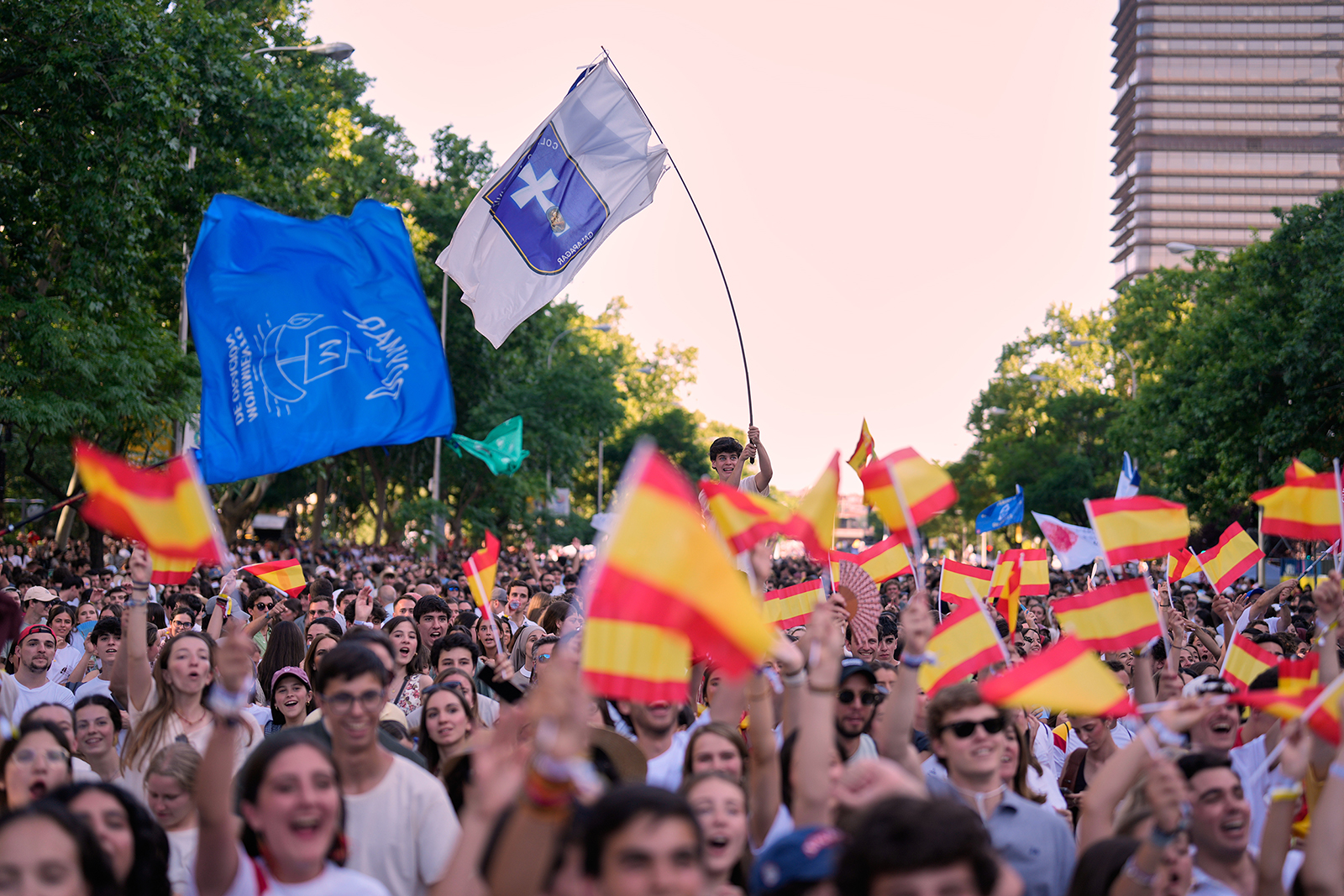
People wait for the arrival of Pope Leo XIV during a prayer vigil with young people at Plaza de Lima in Madrid, Spain, Saturday, June 6, 2026, on the first day of his seven-day apostolic visit to mainland Spain and the Canary Islands. (AP Photo/Bernat Armangue)
Leo urged young people to “look within,” through moments of silence and prayer, and “develop a critical perspective on a social system that does not put people first and creates situations of injustice and existential poverty.”
This will lead to a “restlessness,” he continued, that allows people not to be overwhelmed by the pace of life and external temptations.
Listening to the traumatic witness of a young person who experienced abuse in the family when her father tried to kill her mother, Leo reflected on the dynamics in society leading to violence and hatred, especially against women.
“So many crime reports, even today, reflect a toxic climate in family relationships marked by abuse and oppression and, in particular, by violence against women,” he said, which “often leads to femicide.”
One in 3 women have experienced some form of violence in their lifetime, according to the latest estimates by the World Health Organization. In 2025, the same report found that 316 million women were victims of violence by an intimate partner.
“We are all called to address this dramatic reality, both personally and as a society, because we are responsible for confronting it in all its dimensions,” Leo said.
But the pope also warned that it’s not God’s responsibility to prevent evil from happening. “If violence exists, if selfishness prevails, if even love among family members turns into hatred, we must question the dynamics of our society, the culture of individualism and the temptation of violence — but not God,” he said.
Finally, the pope reflected on forgiveness, not as a destination but “as part of a process and a journey,” which must start with forgiving oneself and recognizing the limitations of others.