








(RNS) — Pope Leo was on an airplane headed for Algeria to begin a two-week tour in Africa when he was asked to respond to Trump’s attacks.
Leo’s position was clear: Enough of war. God rejects the prayers of leaders who wage violence. The path forward must be negotiation, ceasefire and dialogue.
His focus has remained on the human cost — lives lost, families displaced and communities destroyed. Without papal processes, authorizations, approvals or official editing, Leo answered Trump’s attacks saying:
“I have no fear of either the Trump administration, or speaking out loudly of the message of the Gospel … ‘Blessed are the peacemakers’ is a message that the world needs to hear today.”
In the 1930s, German theologian Dietrich Bonhoeffer once described confronting the tyranny of Hitler as standing in the path of a speeding car driven by a madman and said the church needed to find ways to stand in front of the madman’s car. Pope Leo’s airplane comments now serve as a model for faith leaders and communities to respond when facing dangerous political rhetoric.
In a recent podcast with Kim Daniels, director of Georgetown’s Initiative on Catholic Social Thought and Public Life, and Christopher Smith, associate director of the initiative and a biographer of Pope Leo, both pointed out that popes have always spoken out against “the presumption of war” and called people back to the work of peace. Leo stands firmly in that tradition, and as an American, his voice is drawing particular attention, offering a clear contrast in tone and moral focus to that of Trump.


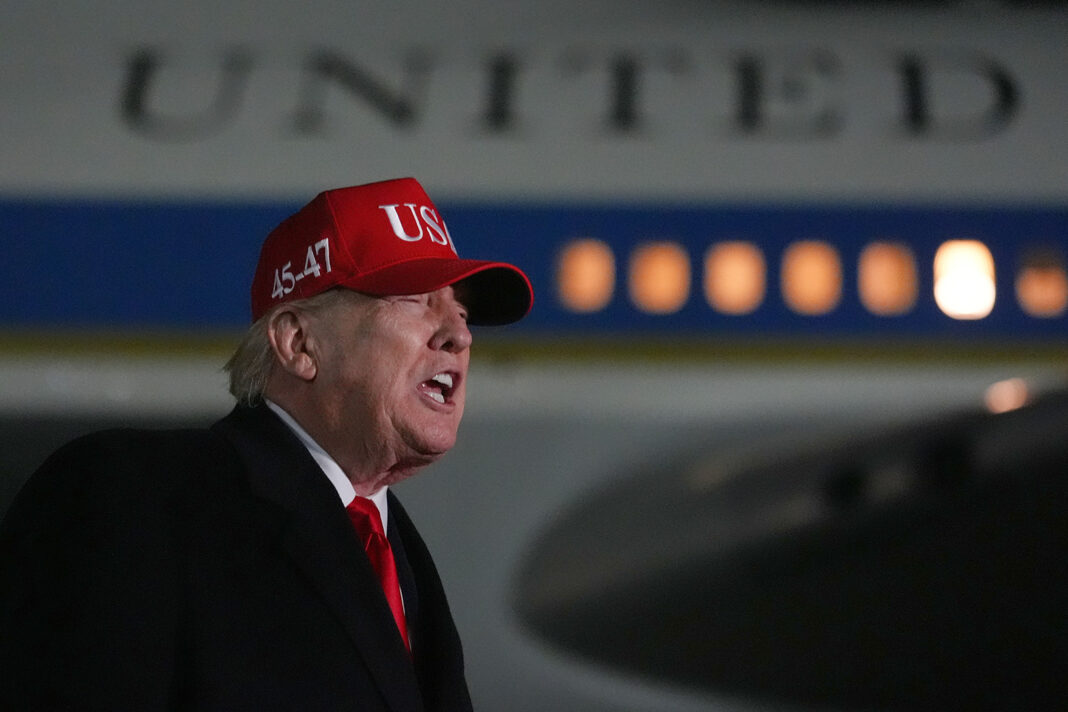
President Donald Trump speaks with reporters at Joint Base Andrews, Md., Sunday, April 12, 2026, after he returned from Miami. (AP Photo/Julia Demaree Nikhinson)
That contrast has become more visible in recent days. We saw Trump’s blasphemous posts including the AI generated image of himself depicted as Jesus Christ, robed and glowing, with warplanes overhead. The reactions and discussion following the posts have been astonishing. A CNN commentator made his word of the week “blasphemy.” Trump deleted the blasphemous post. But that was not the end; Trump just kept going.
Donald Trump has long exhibited a messianic complex. That raises serious concerns about the judgment of a commander in chief overseeing the most powerful military in the world. Religious language is being used to frame military action in ways that risk turning a geopolitical conflict into something resembling a holy war. Pete Hegseth, the self-titled secretary of war, regularly talks about U.S. military successes and then adds, “But to God be the glory.” This should give pause to anyone concerned with the integrity of faith and public leadership.
The moral voice of faith leaders is essential. At the Center on Faith and Justice at Georgetown, we are encouraging and supporting faith leaders and clergy around the country to find ways to speak out to their own constituencies and congregations, because religious communities have both the reach and the responsibility to speak clearly for peace. This is a moment to use that influence before the ceasefire ends and in the uncertain days that follow.
Since the U.S. and Israel started the war in Iran earlier this year, thousands of people have been killed, many more injured and millions displaced.
As people of faith, we must stand on the authority of our sacred Scriptures and speak with moral clarity. We must unequivocally oppose the war in Iran and condemn all false religious statements and claims made to justify violence and war by false prophets, who choose power and warmongering over the gospel. This moment requires us to confront the sin of Christian nationalism and any distortion of our faith that seeks to sanctify war. Instead, we must lift up the teaching of Jesus at this critical moment. “Blessed are the peacemakers, for they shall be called the children of God.” This is a gospel calling to resist violence, seek reconciliation and stand firmly on the side and process of peace. Our call to peacemaking compels us to confront the human and moral cost of this war.

Pope Leo XIV speaks to journalists aboard his flight bound for Algiers on April 13, 2026. (Alberto Pizzoli/Pool Photo via AP)
The financial burden of this war, which most people in the U.S. are opposed to, is estimated at over $1 billion per day and will likely come at the expense of essential social programs. Proposed cuts to Medicaid, food assistance, housing and other essential supports are being considered and mean that the “least of these” will bear an even greater burden. This reality stands in direct tension with Jesus’ teaching in Matthew 25, which calls us to care for those most in need.
As Martin Luther King Jr. warned in his 1967 speech about Vietnam, “A nation that continues year after year to spend more money on military defense than on programs of social uplift is approaching spiritual death.”
Religious leaders across traditions are beginning to speak out, calling for diplomacy, restraint and accountability. Cardinal Robert McElroy of Washington, D.C., has made a very strong statement against the war in Iran. Even the more conservative military archbishop of the Catholic Conference, Timothy Broglio, has also now called this war unjust. Pope Leo has called for Catholics in America to write their members of Congress asking them to reject violence, oppose the war and push for peace. Our voices must continue to grow. Advocacy, public witness and direct engagement with elected officials are all necessary.
If Trump decides to escalate further, difficult moral choices may arise, including for those asked to carry out orders. In such moments, the broader faith community must be prepared to support conscience and uphold ethical responsibility. This is a test of truth and courage and a refusal to allow faith to be used in service of violence or power.
(The Rev. Jim Wallis is Archbishop Desmond Tutu Chair and director of Georgetown University’s Center on Faith and Justice and is the author, most recently, of “The False White Gospel: Rejecting Christian Nationalism, Reclaiming True Faith, and Refounding Democracy.” A version of this commentary appeared on the Substack God’s Politics with Jim Wallis. The views expressed here do not necessarily reflect those of RNS.)