



(RNS) — Though majorities in both groups support abortion being legal, a new survey by the Public Religion Research Institute found that both white Catholics and white mainline/nonevangelical Protestants have demonstrated a small swing toward an anti-abortion position since 2024.
In a survey conducted throughout much of 2025 and released Thursday (April 23), 57% of white Catholics said abortion should be legal in all or most cases, down from 62% in 2024. Similarly, 65% of white mainline/nonevangelical Protestants said abortion should be legal in all or most cases, down from 69% in 2024. Both changes were statistically significant; however, PRRI-affiliated scholars say it’s too early to tell if the shift is an enduring trend.
Kristin Kobes Du Mez, a PRRI senior democracy fellow and history professor at Calvin University in Grand Rapids, Michigan, said several theories could explain the shift.
“One theory would be consistent with the argument that changing legislation can change values,” Kobes Du Mez said, as the shift is driven by Republicans, and Republican states have seen abortion laws change post-Roe. But she added, “I see abortion come up over and over again as the justification for why it was still the right choice to reelect (President Donald) Trump,” even as some Republicans might not like his other policies.
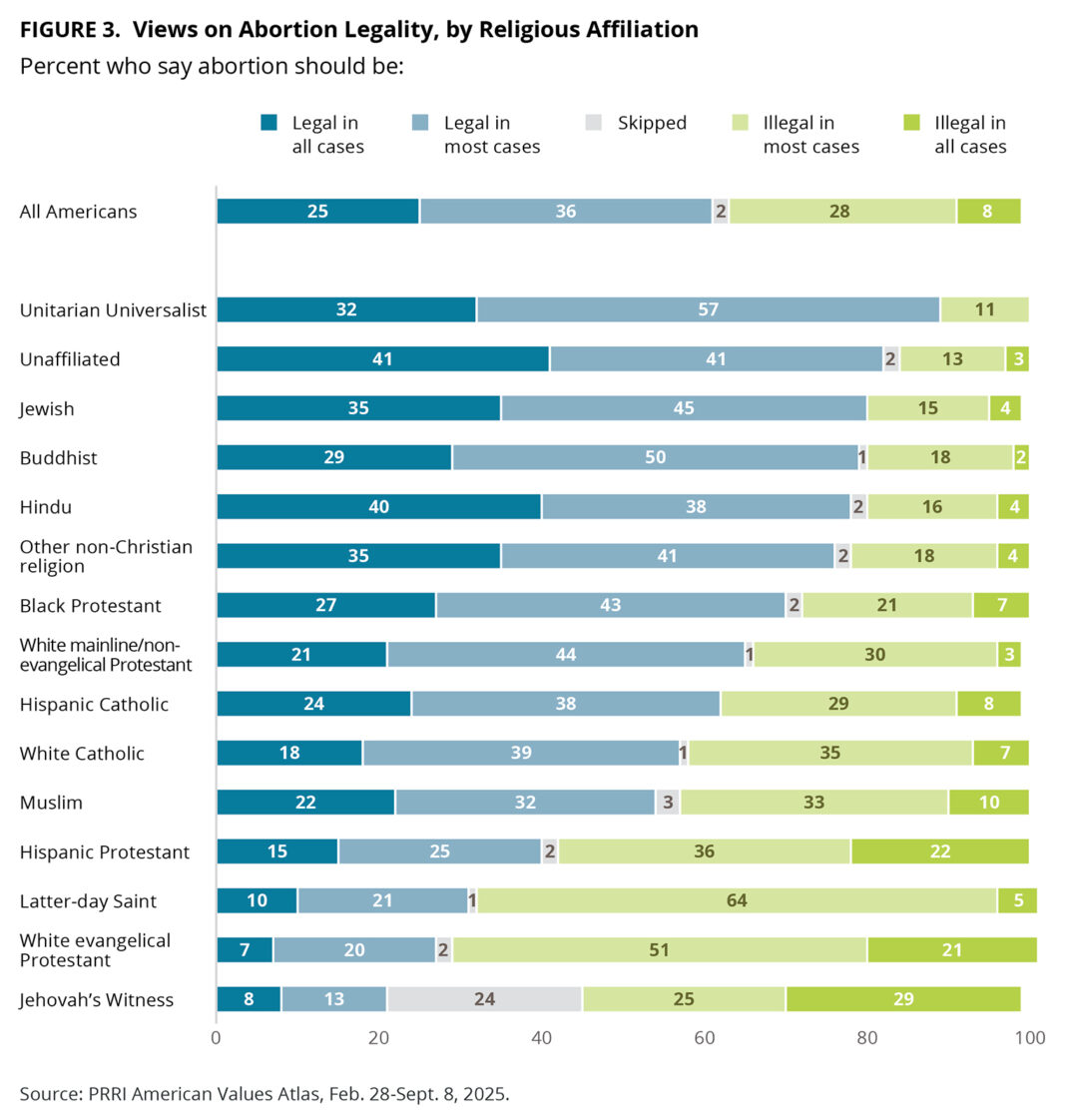
Three groups that indicated abortion should be illegal in all or most cases — white evangelical Protestants (72%), Latter-day saints (69%) and Hispanic Protestants (58%) — all supported Trump in 2024. Only one other group, Jehovah’s Witnesses, had a majority say abortion should be illegal in all or most cases.
All other surveyed religious groups reported majority support for legal abortion: Unitarian Universalists (89%), religiously unaffiliated people (82%), Jews (80%), Buddhists (79%), Hindus (78%), Black Protestants (70%), white mainline/nonevangelical Protestants (65%), Hispanic Catholics (62%), white Catholics (57%) and Muslims (54%).

“Views on Abortion Legality, by Religious Affiliation” (Graphic courtesy of PRRI)
For both white Catholics and white mainline/nonevangelical Protestants, the shift against abortion reflected a movement toward an anti-abortion position among Republicans in those faiths. White Catholics who identified as Republicans decreased in support for abortion legality from 43% to 38% since 2024, while Republican white mainline/nonevangelical Protestants decreased in support from 53% to 47%. Among white Catholics, the shift for independents was also statistically significant, from 69% support for abortion access to 64%.
“Abortion has served as a kind of moral linchpin for the broader Republican agenda, and this is particularly important for conservative Christians, and I think it is still functioning in that way,” Kobes Du Mez said.
White Christians were a crucial part of Trump’s winning coalition in 2024, and he has touted his appointments to the Supreme Court and their subsequent overturning of Roe v. Wade to appeal to his Republican base. However, in the last several years, many national Republican politicians have moved away from focusing on abortion, even dropping support for federal abortion limits from their 2024 party platform.
Religiously unaffiliated Americans and Black Protestants have seen significant increases in support for legal abortion since 2010. Black Protestant support increased 14 points from 56% in 2010, and support among the religiously unaffiliated increased 6 points from 76%.
Altogether, 6 in 10 Americans said abortion should be legal in most or all cases, while 36% said abortion should be illegal in most or all cases. Eight percent indicated abortion should be illegal in all cases.
However, support for legal abortion is significantly lower among U.S. adults who attend religious services more frequently. Only 32% of U.S. adults who attend religious services weekly or more say that abortion should be legal in all or most cases, but 61% of those who attend monthly or a few times a year and 76% of those who seldom or never attend support abortion legality.
When white Catholics and white mainline/nonevangelical Protestants — the two groups that saw a decrease in abortion legality support from 2024 to 2025 — were broken down by church attendance, white Catholics of all attendance frequencies saw a statistically significant decrease in support for abortion legality. Weekly Catholic church attendees saw the largest decrease in support, from 37% to 29%. Only white mainline/nonevangelical Protestants who attend monthly or a few times a year saw a statistically significant drop in support.
Other subgroups that drove the change for white Catholics were women, who decreased from 67% to 61% in support, and those 65 and older, who saw a decrease from 61% to 52% in support for abortion access. For white mainline/nonevangelical Protestants, it was men who saw a statistically significant decrease in support (65% to 59%).
Anne Whitesell, a PRRI public fellow and associate professor of political science at Miami University in Oxford, Ohio, said that in the aftermath of the Dobbs decision, the data implies the anti-abortion movement may have had effective messaging. For example, people in states that made abortion illegal and haven’t experienced any changes personally after fearing serious consequences may have adjusted their position, she suggested.
Still, any steam gathered by the anti-abortion movement post-Dobbs is specific to states. At the national level, abortion is falling behind the cost of living and war in Iran among politicians’ priorities, Whitesell said. “There’s just not a lot of attention paid to (abortion) because there are so many other things. It feels like everything’s on fire,” she said.

Anti-abortion demonstrators walk to the Supreme Court during the annual March for Life, Jan. 23, 2026, in Washington. (AP Photo/Julia Demaree Nikhinson)
And, according to the study, people who said abortion should be illegal were more likely than the general population of U.S. adults to agree that “society as a whole has become too soft and feminine,” favor policies that encourage Americans to have more children, say that young men are struggling more than young women to find their place and agree that “the gains that women have made in recent years have come at the expense of men.”
These survey results, Kobes Du Mez said, signal that abortion “really is linked to broader views of gender and power and to a broader cultural identity.” She also said those links have existed historically as people question women’s roles. “Abortion is seen to sever a woman from her God-ordained role of being a mother,” she said of some religious people’s views.
PRRI surveyed 222,111 adults from Feb. 28 to Dec. 8, 2025. The margin of error was +/- 0.87 percentage points.