










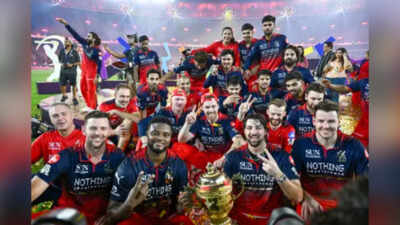
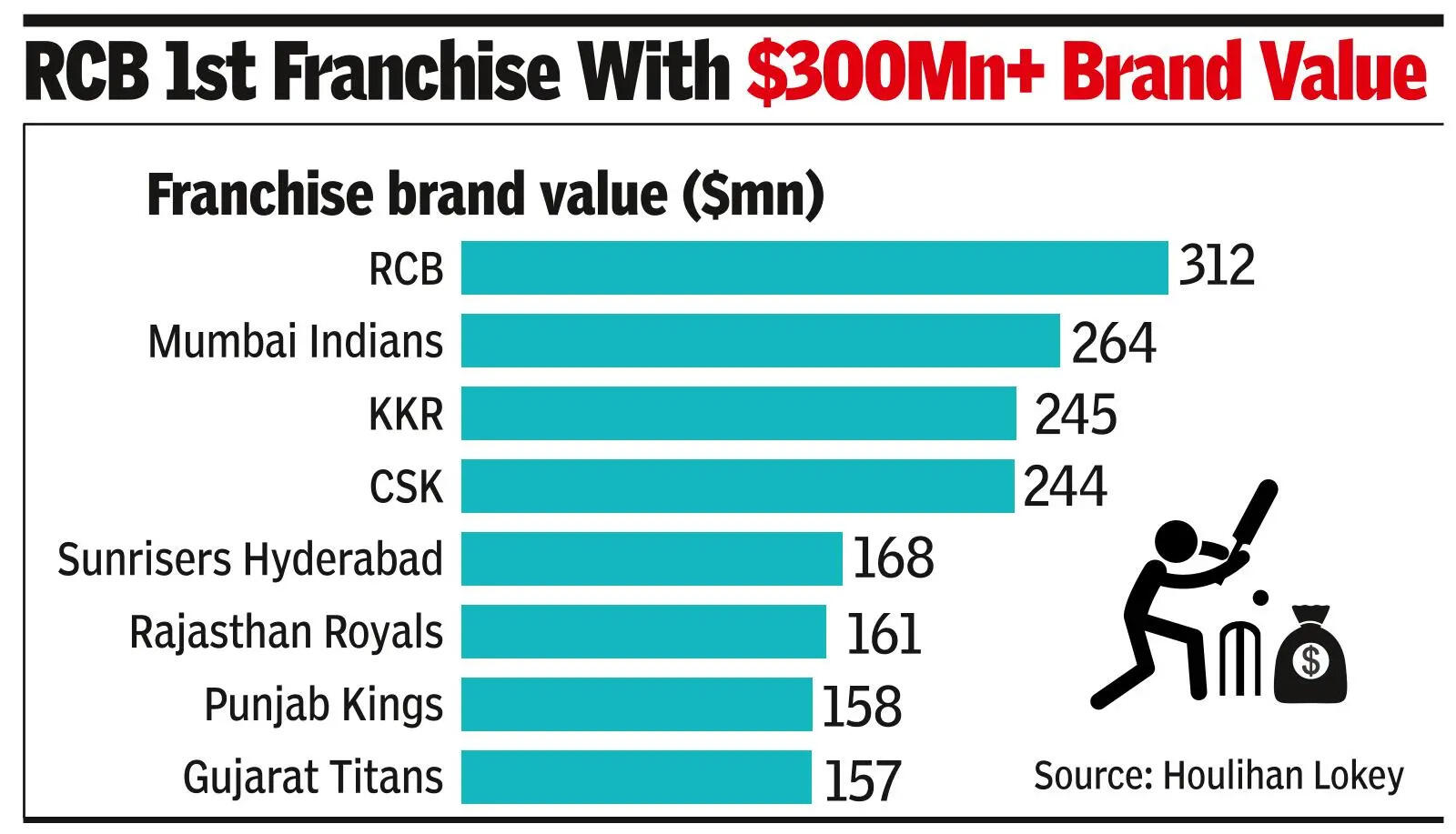
BENGALURU: Indian Premier League‘s business value rose 11.4% from a year earlier to $20.6 billion in 2026, helped by growing revenues, digital viewership and record franchise transactions, according to a study by investment bank Houlihan Lokey.It also pegged Royal Challengers Bengaluru’s brand value at $312 million, 16% higher than the previous year and making it the first franchise to cross the $300 million mark. Despite finishing ninth in the last season, Mumbai Indians saw its brand value rising 9% to $264 million and was ranked second. This is the second consecutive year in which the league has recorded double-digit growth in business value. Its standalone brand value increased 10.3% to $4.3 billion, adding more than $1.1 billion since 2023. Total league revenues crossed $1.8 billion during the year.Based on media-rights value per match, IPL ranks second globally, behind only US National Football League, the report said.

The year also saw two of the league’s biggest ownership transactions. RCB was acquired by a consortium of Blackstone, Bolt Ventures, Aditya Birla Group and The Times of India at a reported valuation of just under $1.8 billion. Houlihan Lokey described it as the most expensive transaction involving a single IPL franchise.Rajasthan Royals was acquired by the Mittal family and Adar Poonawalla at a reported valuation of a little less than $1.7 billion. “We were actively engaged in the processes for both RCB and Rajasthan Royals, and both are great assets. Across the league, however, RCB’s fanbase intensity and connection are unparalleled, which made this a special opportunity,” said Satyan Gajwani, vice-chairman of RCB and chairman Times Internet.The IPL already commands attention comparable to NFL but earns far less from it. As incomes in India rise and connected television reaches more households, its revenues are expected to catch up with its audience scale, Gajwani added.“What the market confirmed this year, through landmark franchise transactions, is the extent to which the league can attract precisely the calibre of global, institutional, and strategic capital it was built to draw.“Franchise valuations have reached new highs, private capital participation has accelerated, and the league’s commercial ecosystem continues to diversify,” Harsh Talikoti, director at Houlihan Lokey, said in a statement.“Centralised media rights, revenue sharing and financial discipline have created a model that’s stable and sustainable. That gives owners the confidence to invest for the long term rather than simply think about the next season,” said Ness Wadia, co-owner of Punjab Kings.


