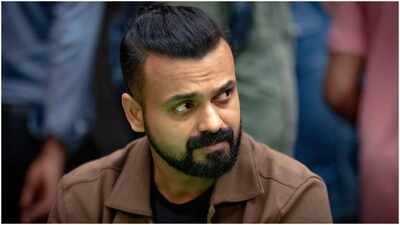









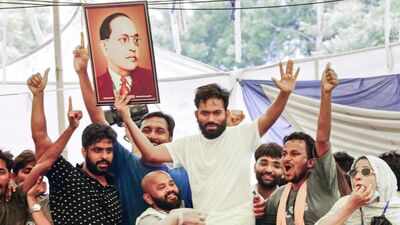
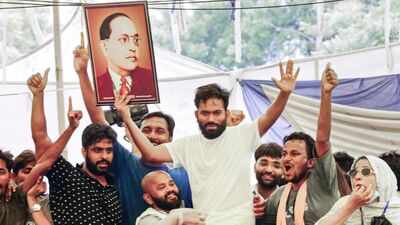
NEW DELHI: Cockroach Janta Party (CJP) founder Abhijit Dipke on Saturday thanked Chief Justice of India Surya Kant, saying his “cockroaches” remark about unemployed youth had sparked the movement that culminated in Union Education Minister Dharmendra Pradhan’s resignation.“If you had not called us ‘cockroaches’, I would not have returned to India. If you had not called us ‘cockroaches’, the youth of the country would not have come out on the streets. If you had not called us ‘cockroaches’, Dharmendra Pradhan’s resignation would not have happened,” Dipke said. The movement traces its origins to May 15 this year, when Chief Justice of India Surya Kant, during a court hearing, reportedly remarked that some unemployed youngsters become journalists, RTI activists or social media users and “start attacking everyone”.
CJP Jantar Mantar Protest Updates
He later clarified that his comments had been taken out of context and were not intended as a criticism of unemployed youth in general. The CJI said he was referring only to individuals entering professions with fake or bogus degrees and described reports claiming he had demeaned young people as “totally baseless”.Dipke’s remarks came hours after the CJP called off its 36-day agitation following Pradhan’s resignation on Saturday and the government’s acceptance of its remaining demands. The youth-led movement had mobilised lakhs of people over alleged irregularities in competitive examinations and the NEET paper leak.In a statement announcing his resignation, Pradhan said the developments of the past 10 days had “saddened” him deeply and that the issue was “not a matter of personal prestige”.He said he did not want “anti-national forces” to exploit the situation and wanted to ensure that “the unity of the nation remains intact”, “the future of even a single student should not become entangled in legal complications” and that students could focus on their studies and careers.“Keeping all these considerations in mind, I have sent my resignation to the Hon’ble Prime Minister,” he said.Soon after the announcement, the CJP declared that it was ending its agitation after the government agreed to its remaining demands, including compensation for the families of students who allegedly died by suicide following the NEET paper leak and the withdrawal of FIRs registered against protesters.The decision followed the third round of talks at the Constitution Club of India, where Union ministers J P Nadda and Jitendra Singh met CJP representatives Saurav Das and Ashutosh Ranka.Addressing a joint press conference with the CJP leadership, Nadda said the government would provide “honourable compensation” within the rules to the families of students who committed suicide after the NEET examination controversy and ensure the withdrawal of all FIRs registered against protesters.“As the government accepted all our demands, we call off our protests with immediate effect. We appeal everyone to go back home peacefully,” Das said.Celebrations broke out at Jantar Mantar after Pradhan’s resignation, with protesters chanting “Hum Jeet Gaye” (We have won). As the protest site was cleared, authorities urged demonstrators to disperse peacefully, while the Delhi Metro Rail Corporation reopened all entry and exit gates at nearby stations.Pradhan’s resignation marked a significant political setback for the Narendra Modi government, which had initially dismissed the agitation before opening talks with the protesters.He is only the second Union minister to resign during Narendra Modi’s tenure as prime minister following sustained public controversy. The first was M J Akbar, who stepped down as minister of state for external affairs in 2018 after sexual harassment allegations emerged during the #MeToo movement.The resignation is also among the few instances since 2014 in which the Modi government has reversed course under sustained public or political pressure, alongside shelving proposed amendments to the land acquisition law in 2015 and repealing the three farm laws in 2021.