










LAS PALMAS, Spain (RNS) — Pope Leo XIV delivered a heartfelt speech addressing migrants on Thursday (June 11), reminding them of their worth and dignity even as they suffer at the hands of traffickers and mafias. He also spoke directly to the church and states — especially in Europe — underlining their duty to promote and protect migrants.
Leo said those who exploit migrants are “monsters” — as are people who are indifferent to their suffering. He called for a “conversion,” allowing people to see migrants beyond mere statistics.
“Only then can we understand that that little girl could be our daughter, and that those faces could be part of our family. Then, our conscience is left with no excuses,” he said. “Human dignity has no passport and does not lose its value when crossing a border.”
He made his remarks at the port of Arguineguín, in Las Palmas in Gran Canary Island, where he listened to the stories of migrants and people who help them. Leo is visiting the Canary Islands for the last leg of his weeklong visit to Spain.
While the Canaries, eight islands roughly 60 miles from the African coast, may be considered a vacation spot for wealthy Europeans, the reality on the ground tells a deadlier tale, where tens of thousands of migrants arrive each year stranded on its rocky shores and thousands more die in its surrounding waters.
Arguineguín became known as the port of shame in 2020, when more than 3,000 migrants crammed into a space meant for 500. Photos of exhausted migrants, who had traveled the deadly Atlantic route from West Africa, sleeping on concrete exposed an inability to manage the crisis.

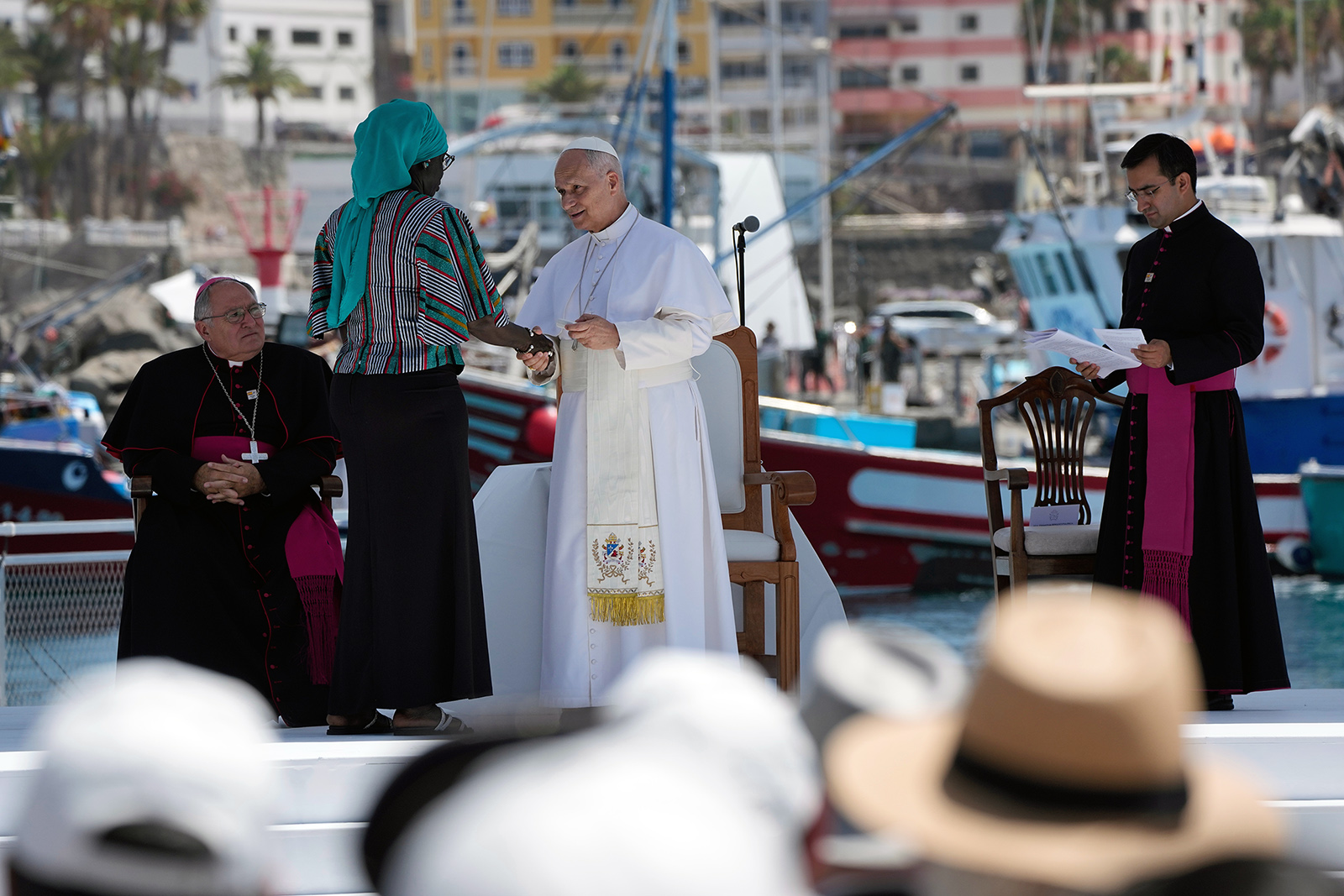
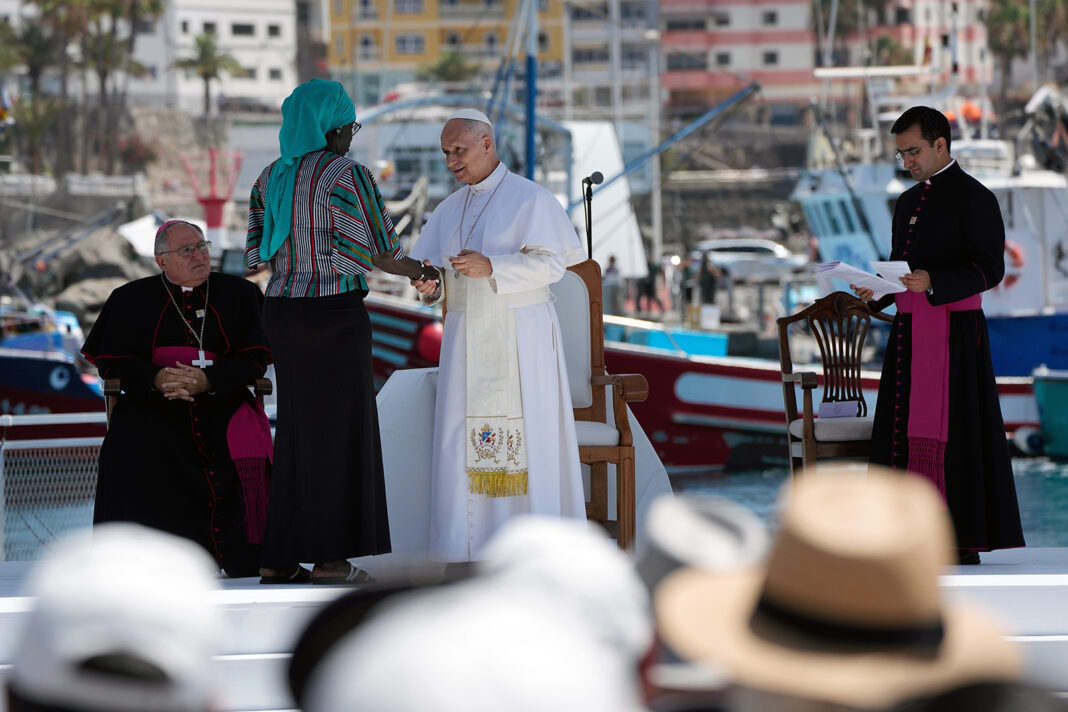
A volunteer meets Pope Leo XIV during a meeting with organizations working with migrants in Arguineguín at the Canary Islands, Spain, Thursday, June 11, 2026. (AP Photo/Alessandra Tarantino)
Today, Arguineguín wants to rebrand itself as a “port of hope” as volunteers and Catholic charities work to help the migrants and refugees, who arrive in the islands aboard makeshift boats called “cayucos” and “pateras.”
Tito Villarmea, captain of the salvage boat Guardamar Urania, has reportedly saved more than 20,000 people as he patrols the ocean near the islands. Addressing the pope at the pier, he recalled saving a woman who cried desperately over the body of her teenage daughter, who had died on the journey.
“I wish we didn’t have to save anyone again,” he said. “Let’s work as a society to reduce this tragedy and build a more just world.”
In 2024, the Canaries received a record 46,843 migrants. Arrivals have declined in recent years after Spain and the European Union struck deals with Mauritania, Senegal and Morocco to intercept departures and increase patrols. The crossing has also grown proportionally deadlier, with a greater number of those attempting the journey perishing; last year, nearly 3,090 people died trying to reach Spain, through the Canary Islands or the Balearic route, and 1,300 have already died in the first six months of 2026, according to the Spanish nongovernmental organization Caminando Fronteras.
Just over 3,000 migrants have arrived to the islands this year, most from Senegal, Mali, Mauritania, Gambia and other regions of sub-Saharian Africa. Other immigrants arrive via air from Latin America, especially Venezuela and Cuba.
In his address, Leo called migrant deaths and exploitation a tragedy and said they “must serve as an appeal to the conscience of the nations of origin,” which have an obligation to provide the conditions for human flourishing. He also urged transit nations to protect the vulnerable from criminal networks and said the international community should promote cooperation.
The pope made an “appeal to the conscience of Europe, which cannot claim to uphold human dignity while growing accustomed to the Mediterranean and the Atlantic becoming unmarked graves.”
The EU Pact on Migration and Asylum, a new legal framework for how European countries manage immigration, takes effect Friday. Human-rights organizations warn that the pact, a set of 10 pieces of legislation adopted in 2024, opens the door for large deportation efforts to migrant camps in Africa. “We are worried because European politics is restrictive, it’s not aimed at building bridges but at building walls,” said the Rev. Fernando Redondo, who oversees the migration office of the Spanish bishops’ conference.
Critics have likened the policy to U.S. President Donald Trump’s recent limitation on green card applications, which must now be filed from outside the U.S.
Ahead of the implementation of the EU Pact on Migration and Asylum, Spain granted one year of legal status to immigrants lacking authorization, benefiting potentially 500,000 migrants living in the country. In January, when the initiative was announced, Spanish Minister of Migration Elma Saiz told journalists the government is ”dignifying and recognizing people who are already in our country.”
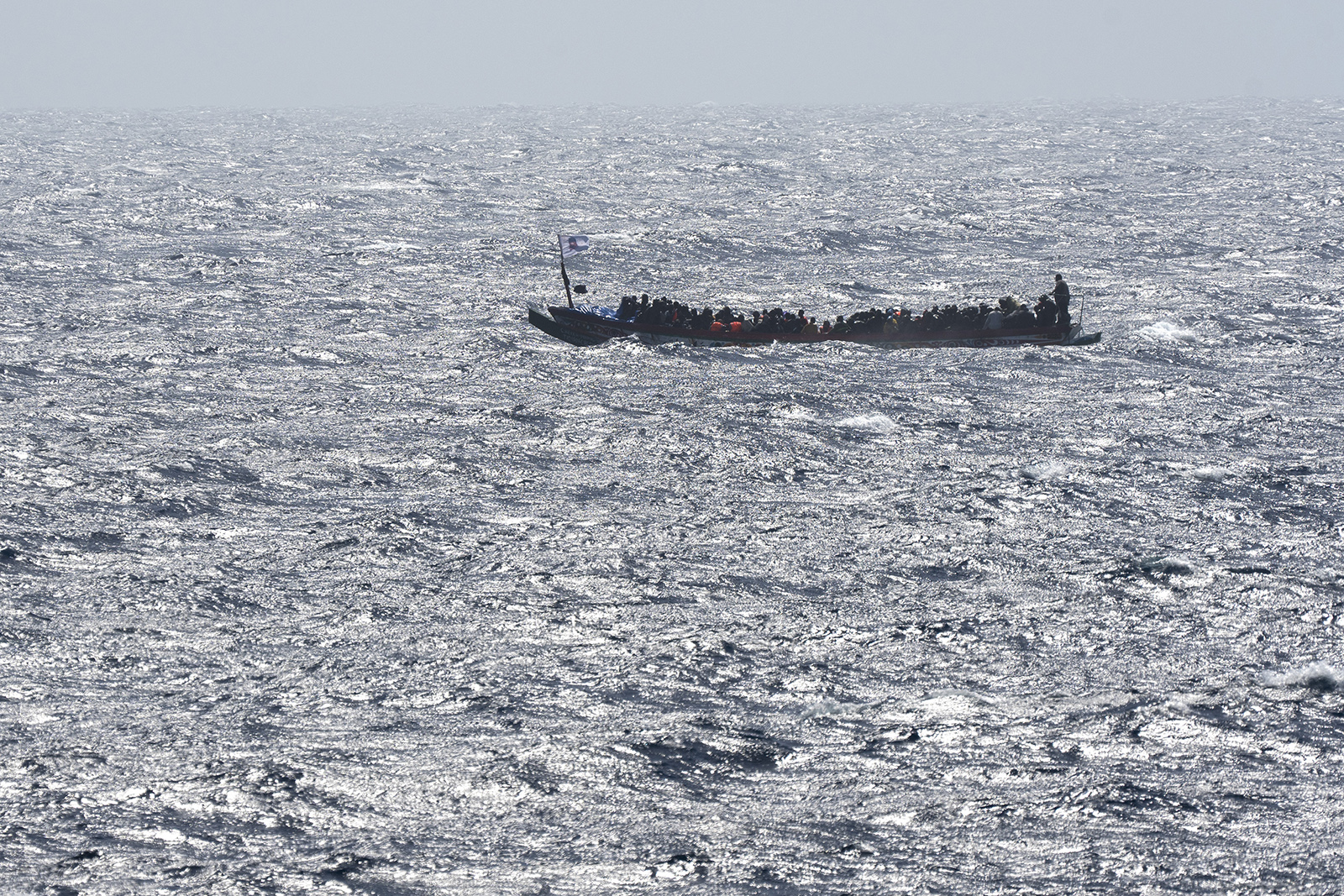
Migrants crowd a wooden boat as they sail to the port in La Restinga on the Canary island of El Hierro, Spain, Sunday, Aug. 18, 2024. The migrants sailed for seven days from the coast of Senegal. (AP Photo/Maria Ximena)
At the event, Leo addressed immigrants directly. “I want to bow before your dignity,” he said. “You are not just numbers or files. You are people who have left behind families and homes. You have dreams that no one has the right to despise.”
He told migrants they “have a right to be protected” and to not fall for the “siren songs” of those who want to exploit them. “They are industries of death,” he said.
The pope heard the testimony of Blessing, a victim of sexual trafficking, which was read by another woman to protect her identity. Born in Nigeria, Blessing sought to leave the abject conditions of her life. She said the mafia performed a “juju” ritual on her, commonly used in West Africa to bind and “curse” people into submission. After, they told her she had a 25,000 euro debt.
“So, my captivity began,” the testimony said, recounting years of abuse, violence and rape. She told of her journey to the Canaries, when one of her captors got her pregnant, later taking her child away and forced her into prostitution. She thanked the Catholic charities for freeing her from the cycle of violence she endured and for reuniting her with her son.
Catholic charities assist over 220,000 migrants in the Canaries, including more than 2,000 minors, according to the secretary-general of the local Caritas charity network. The local church also signed an agreement in 2023 of “Atlantic hospitality” to work together with African countries to help migrants.
Leo said that even though some put a price on the body of migrants, trap them in their past or treat them like objects, God sees their intrinsic humanity.
“Your life does not belong to those who harmed you; your body does not belong to those who took advantage of you; your days do not belong to those who wanted to chain you to fear,” he said. “Your life belongs to God, who has given you a dignity that cannot be taken from you. We want to walk with you until that truth feels stronger than the pain.”
Between 2024 and 2025, Spanish police uncovered a network responsible for trafficking minors in the Canary Islands, to bring them to France. And in 2021, more than 150 boat drivers were arrested in Gran Canary for smuggling, even though they are often migrants themselves and victims of human trafficking rings.
“Even today, monsters lurk in these seas: mafias that profit from despair, traffickers who enslave women and children, and those whose indifference allows the poor to be swallowed up by exploitation or forgetfulness,” Leo said. Repeatedly, the pope stated that the church and believers “cannot remain silent” before the suffering of immigrants and refugees.
“Every boat that arrives brings a question along with the migrants: What kind of world have we built, if so many brothers and sisters must risk death to seek life?” he said.
The pope questioned how people today will be judged by history for becoming accustomed to migrant suffering and death, an echo of his recent encyclical, “Magnifica Humanitas” (Magnificent Humanity), where he stated that the treatment of migrants is a “litmus test” for democracies.
“Today, here by the sea, every individual that arrives asks us what remains of our humanity. Sooner or later, it will be known whether we protected life or whether we yielded to indifference,” he said.
Leo concluded the ceremony by throwing a wreath into the water to honor migrant deaths, followed by a moment of silent reflection.