



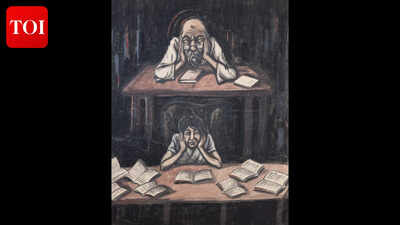
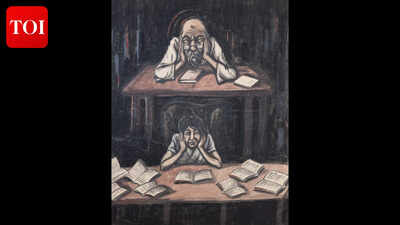
The first sensation of Stranger Forms: The Forgotten Art of G C Chakravarty at the Birla Academy of Art and Culture did not unfold gently; it confronted the viewer. Walls lined with works that seem to speak to one another across decades—drawings, paintings, and illustrations that collectively construct a charged inner world shaped by doubt, belief, rupture, and reflection. Rather than presenting a linear artistic evolution, the exhibition functions as an immersive field of ideas, where meaning accumulates through proximity and repetition.The artworks range widely in tone and form. Delicate line drawings sit beside brooding, heavily worked compositions, while painterly surfaces alternately between restraint and turbulence. Figures recur, but rarely settle into clarity. Religious, mythic references, and everyday human gestures coexist uneasily, suggesting not reverence but interrogation. The works repeatedly circle questions of faith, education, authority, and social conditioning, exposing their tensions rather than offering resolution. Across the gallery, the grotesque is not sensationalized; instead, it operates as a visual strategy – an insistence on discomfort as a way of seeing more clearly.Illustrations form a crucial part of this visual landscape. Graphic, narrative-driven, and sharply observant, they blur the boundary between fine art and mass visual culture. These works carry a distinct immediacy, compressing psychological unease and social critique into compact, striking images. Together with the paintings and drawings, they reveal an artist deeply invested in storytelling – one that unfolds through distortion, repetition, and symbolic density rather than linear narration.The event itself unfolded as an extension of this visual experience. Mit Vyas of Dwija Gallery opened the evening by welcoming the audience and introducing the exhibition catalogue, a carefully assembled publication of G C Chakravarty’s works. His remarks were brief, allowing the artworks to remain central, before the catalogue was shared with attendees.A guided walk-through led by scholar Ankan Kazi followed, offering contextual entry points into the works without closing them off to interpretation. Kazi’s readings emphasised how the artworks resist singular meanings, encouraging viewers to engage with them intuitively as well as critically.The evening concluded with a discussion between Kazi and art historian Sampurna Chakraborty, situating the works within the shifting environment of the Government College of Art and Craft during the 1920s—a period of institutional uncertainty and ideological transition. Their conversation touched on changing pedagogical models, the role of conscious versus subconscious processes in art-making, and how such conditions shaped practices that later slipped out of dominant art historical narratives. An open floor discussion followed, with audience members contributing reflections that echoed the exhibition’s larger questions about visibility, memory, and interpretation.Ultimately, Stranger Forms is less an event than an encounter. On view from June 16 to 28, the exhibition foregrounds the artworks as living propositions—images that continue to question belief systems, social norms, and artistic hierarchies long after the opening evening’s conversations have ended.