










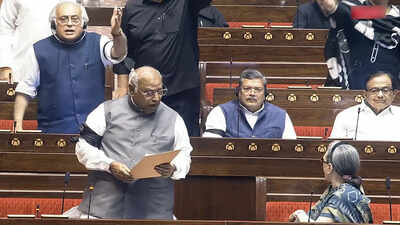
NEW DELHI: The opposition on Wednesday submitted a notice under Rule 267, seeking the suspension of the House’s listed business to facilitate an immediate discussion on the alleged police action against student protesters, the detention of opposition leaders, and the NEET controversy.Raising the issue in the Rajya Sabha, leader of the opposition and Congress president Mallikarjun Kharge said, “We want a discussion on NEET under Rule 267. The education minister (Dharmendra Pradhan) should resign.”Responding to the demand, Deputy Chairman Harivansh said that Rule 267 has been invoked only on the “rarest of rare” occasions.The opposition is demanding an immediate discussion on:
- The alleged use of excessive force by Delhi Police against student protesters during their march to Parliament on July 20.
- The removal of Congress MP Rahul Gandhi and other opposition leaders from outside Prime Minister Narendra Modi’s residence, where they were protesting the police action against students.
- The silence of PM Modi and Union home minister Amit Shah on the issue.
- Union education minister Dharmendra Pradhan’s refusal to resign over the alleged NEET (UG) paper leak in May, which remains the protesters’ primary demand.
- The “growing frustration” and “sense of hopelessness” among young people over the country’s education and examination system.
What is Rule 267 of Rajya SabhaRule 267 of the Rajya Sabha Rules of Procedure allows for the suspension of specific rules governing the House’s listed business.However, in December last year, Vice President and Rajya Sabha Chairperson CP Radhakrishnan clarified that discussions under Rule 267 can only be held on matters already included in the day’s listed business.“Any notice concerning an issue outside the listed business is invalid,” he said, noting that members had been submitting Rule 267 notices “almost daily” to seek discussions on issues of their choosing by suspending the scheduled business.He added that such use was not the purpose of the rule.Radhakrishnan also stressed that Rule 267 in the Rajya Sabha is not equivalent to an adjournment motion in the Lok Sabha, which is provided for under Article 75(3) of the Constitution.He noted that the present form of Rule 267 was adopted by the House in 2000 following the recommendations of a committee. The committee had observed that the provision was increasingly being invoked to seek discussions on matters that were neither listed in the day’s business nor formally admitted. It therefore recommended that the rule’s application be confined strictly to subjects connected with the listed business.