









(RNS) — In a historic breakthrough, three women were allowed to sit for the Israeli rabbinate’s competency exams earlier this week.
The tests, which drill on a variety of topics in Halacha — traditional Jewish law — were previously only available to men seeking rabbinic ordination. But Israel’s Supreme Court ruled last year that the rabbinate must open up exams to women.
The exam didn’t go off without complications. The women were brought to a separate venue far from the male test takers and waited nearly five hours on Monday (April 27) until an emergency court order forced the rabbinate to administer the exam.
“We were really exhausted, angry and hurt,” Yaara Vidman Samuel, one of the women who sat for the test, told RNS. “The feeling was that we were being looked down upon as human beings, mostly for the sake of politics.”
Passing the tests will not grant the women the title of rabbi; Israel’s strictly Orthodox-controlled rabbinate does not ordain or acknowledge women as rabbis. But it was a win that comes with benefits beyond just symbolism.
While female rabbis have long been commonplace in the Reform and Conservative Jewish movements in North America and elsewhere, that’s not the case in Orthodox Judaism, and non-Orthodox movements are still very uncommon in Israel.
For much of Jewish history, the study of Jewish religious law was largely reserved for men. When women did have the opportunity, it was often more informal and in translation.


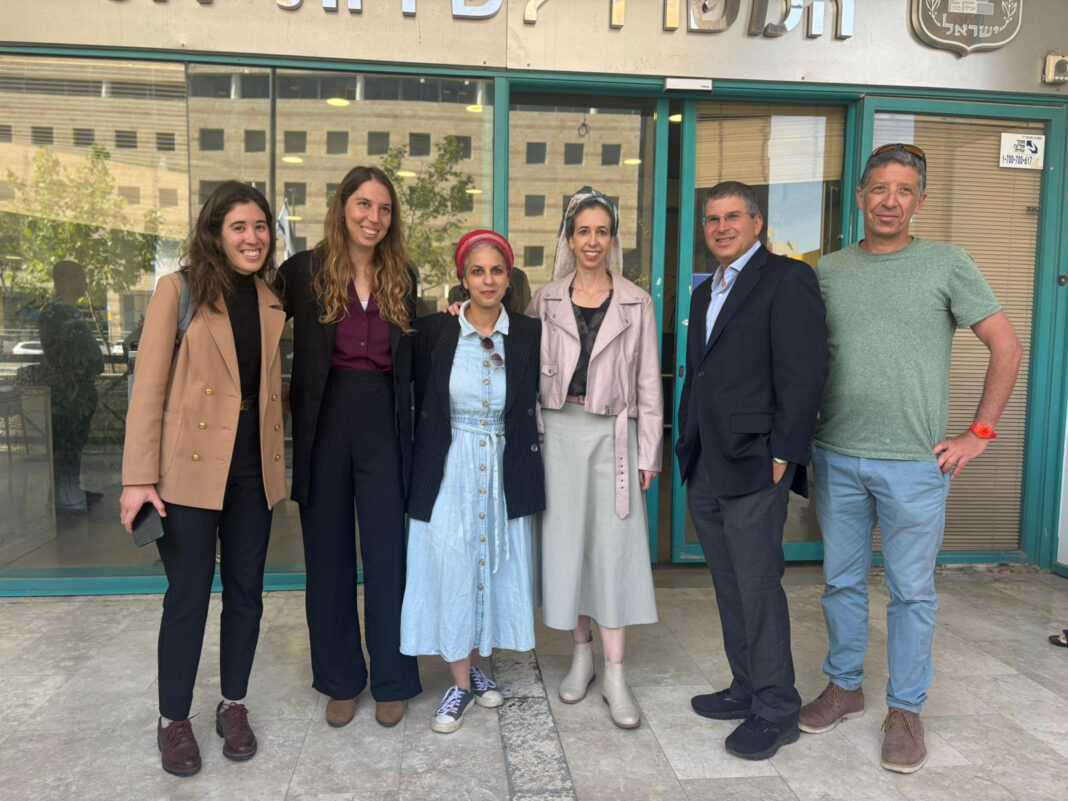
From left to right: Timna Gotel of ITIM’s legal department; Ofra Sitesmar, head of ITIM’s legal department; Ruth Agiv from the Matan Hasharon beit midrash (study hall); Rabbanit Yaara Vidman Samuel from Midreshet Ein Hanatziv; ITIM director Rabbi Seth Farber; and ITIM CEO Asi Kaniel, outside the Religious Services Ministry where Agiv and Vidman Samuel took a rabbinical test administered by the Chief Rabbinate on April 27, 2026. (Photo by Netanel Hirsch)
RELATED: Israeli Supreme Court says rabbinate must offer tests to women
Nonetheless, Orthodox Jewish tradition records a number of learned female leaders across its history, from the biblical prophet Deborah, through Talmudic era scholar Bruriah, to many more from the Middle Ages through the present.
The Orthodox Jewish stream has been slowly adapting to women’s rabbinic leadership. In 1917, Sarah Schenirer founded the first Bais Yaakov girls school in Poland, which remains the blueprint for girls schools in the Orthodox world. In 1937, Rabbi Joseph B. Soloveitchik, the foremost leader of modern Orthodox Judaism in the United States, opened the Maimonides School in Boston and demanded it offer equal Talmudic education to both boys and girls.
Still, it’s been a long road for truly equal educational opportunities for women in the Orthodox Jewish world.
“I grew up in a very conservative community, which educated me to love Torah and fear God,” Vidman Samuel said. “They showed me that Torah can guide, help and elevate life. So when I fell in love with Torah and started studying it, I didn’t see it as a rebellion but as a realization of the values I grew up with — I just missed the fact that they were only intended for boys, not girls.”
Among the new institutions devoted to providing women religious educational opportunities is Hadran, an Israeli organization that encourages Talmud study among Orthodox women across the world. In New York, there is also Yeshivat Maharat, the first Orthodox Jewish institution in the U.S. to ordain women scholars.
ITIM, the Israeli nonprofit that petitioned the court for the right of women to sit for the exam, argued there were tangible financial benefits to doing so. In 2018, Shas, Israel’s Sephardic Haredi party, successfully lobbied to have the rabbinic exams be considered the equivalent of a bachelor’s degree for the public-sector jobs for which the Israeli government requires a higher education degree.
That opened the door for ITIM to argue that if men could achieve those positions and pay scales on the basis of their religious education, women should have the same right.
It took nearly seven years, but the Israeli Supreme Court agreed last summer.
“Discrimination between women and men regarding eligibility to take the Chief Rabbinate exams is unacceptable, just as discrimination between women and men regarding eligibility to enjoy any other service provided by a public authority in the State of Israel is unacceptable,” Justice Ofer Grosskopf wrote in the court’s decision.
Rabbi Seth Farber, the director of ITIM, said now that the exams were finally given, his organization will be closely monitoring their grading and the accessibility of future tests.
“The reason I say it’s just a beginning, not an end, is because the real measure of success for me is if in five years or 10 years,” Farber said, “when there’s 200 or 300 women taking the exams, not three, and everybody forgets that there was even a revolution at all. It just becomes part of normal life here.”
For Vidman Samuel, the real value in her ability to take the test was to show her daughter — and other girls growing up in Israel — it was possible.
“When they want to enter the world of Halachic law in the state of Israel,” she said, “it will be obvious that they too can do it the same way everyone does it in the state of Israel — through the Chief Rabbinate.”
RELATED: Citing Wexner’s Epstein ties, Jewish leaders direct money to survivors