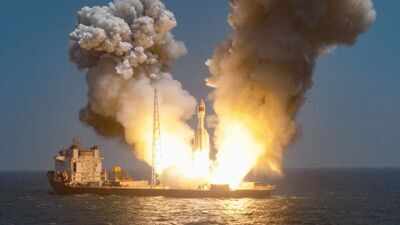
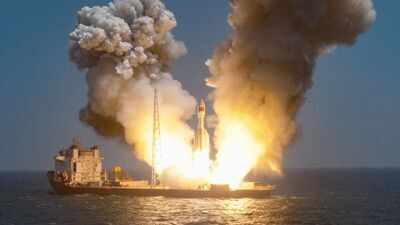
China on Wednesday successfully launched its Gravity-1 commercial rocket from the East China Sea, placing nine satellites into their designated orbits and carrying out one payload experiment. The mission marked the first far-sea launch by a privately developed commercial rocket, demonstrating China’s growing capability in long-range maritime launch operations.Developed by ORIENSPACE, the 30-metre, 405-tonne Gravity-1 lifted off at 10:54 am from a launch vessel operated by the Oriental Aerospace Port in Shandong province. The launch was conducted under the direction of the Taiyuan Satellite Launch Center. Officials said the mission successfully validated the rocket’s ability to operate under complex offshore conditions, remain launch-ready for extended periods at sea, and support cross-sea launch operations.Nine satellites to support Earth observation, AI and disaster managementThe payload included nine satellites—Dongpo-13, Dongpo-14, Dongpo-17 to Dongpo-20, Xiguang-2 01, Tianyi-49 and Lilac-3. The six Dongpo-series satellites, comprising optical and synthetic aperture radar (SAR) payloads, will join an existing constellation to improve remote-sensing coverage for applications such as land mapping, disaster response, agriculture, forestry and water management.Meanwhile, Xiguang-2 01 and Tianyi-49 are designed for AI-powered Earth observation, offering services in mineral exploration, environmental monitoring, urban planning and agriculture. Lilac-3 will test next-generation satellite platform and attitude-control technologies through in-orbit demonstrations.Gravity-1 is the world’s first medium-lift launch vehicle with all-solid-propellant strap-on boosters, capable of carrying 6.5 tonnes to low-Earth orbit and 4.2 tonnes to a 500-km sun-synchronous orbit. Chinese officials said the mission also marked another step in expanding the country’s coordinated sea-launch network and improving operational flexibility for future commercial space missions.