






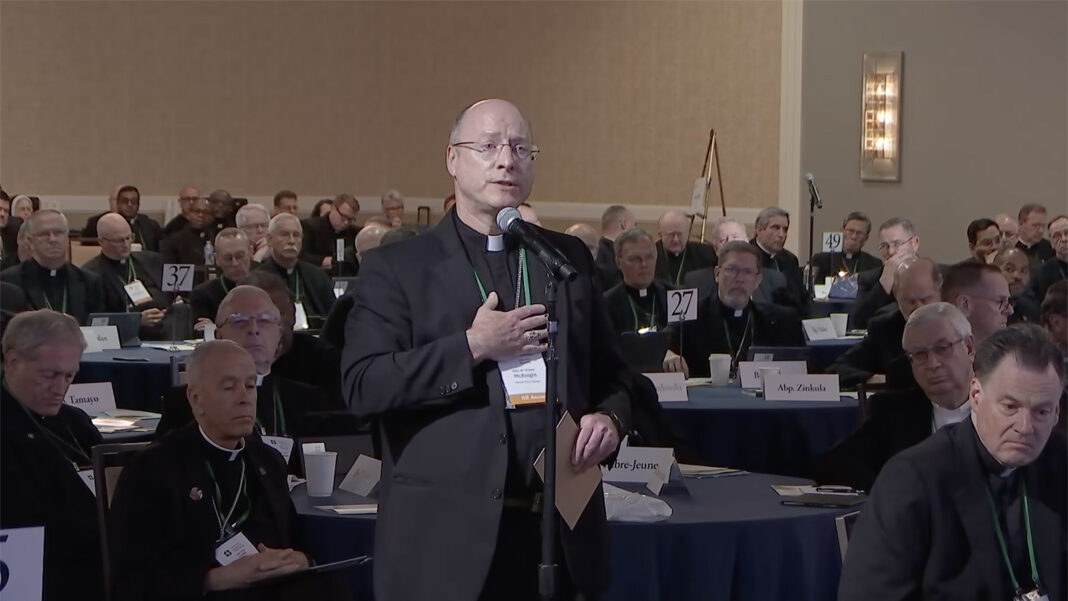
(RNS) — United States Catholic bishops approved a new version of their signature document on child sexual abuse on Thursday (June 11), adding language on the “presumption of innocence” for accused priests, despite a push for broader discussion and changes.
Shawn McKnight, archbishop of Kansas City, Kansas, had led an effort to include more expansive changes to the bishops’ Charter for the Protection of Children and Young People, commonly known as the Dallas Charter. Advocates for survivors and sexual abuse reform had also called for broader changes to the U.S. Conference of Catholic Bishops’ policy commitments, including expanding the document to address the sexual abuse of adults.
After McKnight motioned for the vote to be postponed to the next meeting to allow bishops to consult people in their dioceses about changes, 73 bishops, representing more than a third (36%) of those voting, voted with him.
Though McKnight was unsuccessful in advocating that the Dallas Charter expand to address the sexual abuse of adults, he successfully added an amendment that commits the bishops to ensuring their priests learn to provide trauma-informed pastoral care.
Several bishops at the meeting in Orlando, Florida, rose to back McKnight’s efforts to postpone the vote, including Columbus, Ohio, Bishop Earl Fernandes; Seattle Archbishop Paul Etienne; and San José, California, Bishop Oscar Cantú.
On Wednesday, McKnight had expressed reservations with the current document. “I am worried how the language presently in the draft will impact our known victims as well as our unknown victims. I’m also concerned about how our priests are going to respond,” he said.
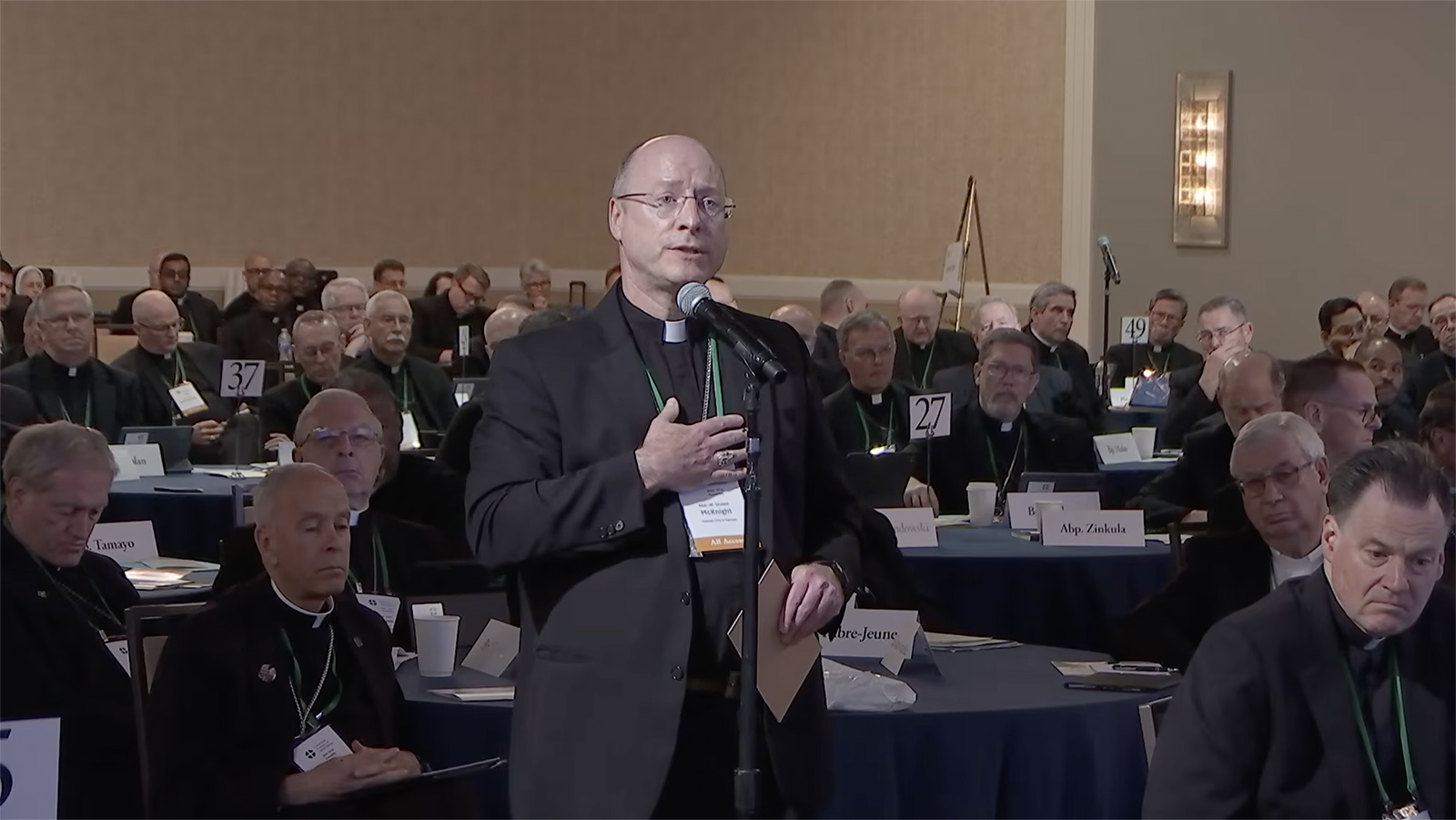
Archbishop Shawn McKnight of Kansas City, Kan., asks questions about a document addressing the sexual abuse of minors, during a meeting of the U.S. Conference of Catholic Bishops, Wednesday, June 10, 2026, in Orlando, Fla. (Video screen grab)
But when it came time for the vote on approving the charter — which required a two-thirds supermajority and could have served as a second opportunity to force a postponement — the bishops shifted toward immediate approval. Over 85% of the voters, or 176 bishops, backed the approval.
Catholic advocates for survivors did not raise objections to the “presumption of innocence” language but instead objected that the bishops had made that language their focus in the revisions instead of aspects of sexual abuse that they believed have been insufficiently addressed.
Bishop Robert Barron of Winona-Rochester, Minnesota, who has a significant social media platform through his Word on Fire ministry, sought reassurance during the public discussion portion about whether the document sufficiently defended the rights of accused priests, especially against false accusations. But no other bishops rose to make similar objections, and Barron seemed to indicate he had gotten some reassurance on the topic.
Sara Larson, the executive director of Awake, a survivor support and advocacy organization, had called for addressing the sexual abuse of adults ahead of the vote. Richmond, Virginia, Bishop Barry Knestout, chair of the committee on the protection of children and young people, said Wednesday that the committee holds the position that sexual abuse of adults is “outside of the scope of the charter.”
In a statement after the vote, she urged diocesan bishops to push forward on strengthening support for survivors, even without major changes in national policy.
“Every diocesan bishop has significant authority to strengthen protections, improve responses to survivors, and foster a culture of accountability within his own diocese,” Larson wrote. “Many of the changes survivors hope to see do not require national votes or new Church legislation. They require leadership, commitment, and a willingness to learn.”
Awake’s statement urged bishops to expand safeguarding efforts to protect adults, particularly in vulnerable situations like confession or for those in vowed religious life and employment. It also pushed them to implement trauma-informed practices and prioritize listening to survivors and incorporating them in decision-making.
BishopAccountability.org, an abuse watchdog group, called the vote “a major missed opportunity” to create more robust guidance and further consultation. But Terence McKiernan, BishopAccountability’s founder, told RNS he hopes the 73 bishops who had voted for further consultation will proceed with conversations in their own dioceses about the document and “the important concerns it neglects or mishandles.”
Ahead of the vote, a statement by BishopAccountability said “the authors of these revisions seem to have slept through most of the important developments of recent years,” citing “ubiquitous” spiritual abuse, abuse of adults, the importance of protecting whistleblowers, bishops’ accountability, religious sisters’ role in experiencing and perpetuating abuse, racial minorities’ experiences and questions about defining “credible and substantiated” allegations.
Bishops’ political guidance, polarization
In another presentation at the bishops’ meeting on Thursday, Louisville, Kentucky, Archbishop Shelton Fabre, chair of the committee on domestic justice and human development, announced that the bishops would not edit their political guidance document, which places stopping abortion as the “preeminent priority” in their guidelines to voters, ahead of the 2026 midterm elections.
The bishops met in “fraternal dialogues” to discuss political guidance last November, Fabre said, describing the talks as “robust.” He said the discussions led to 26 pages of detailed notes.
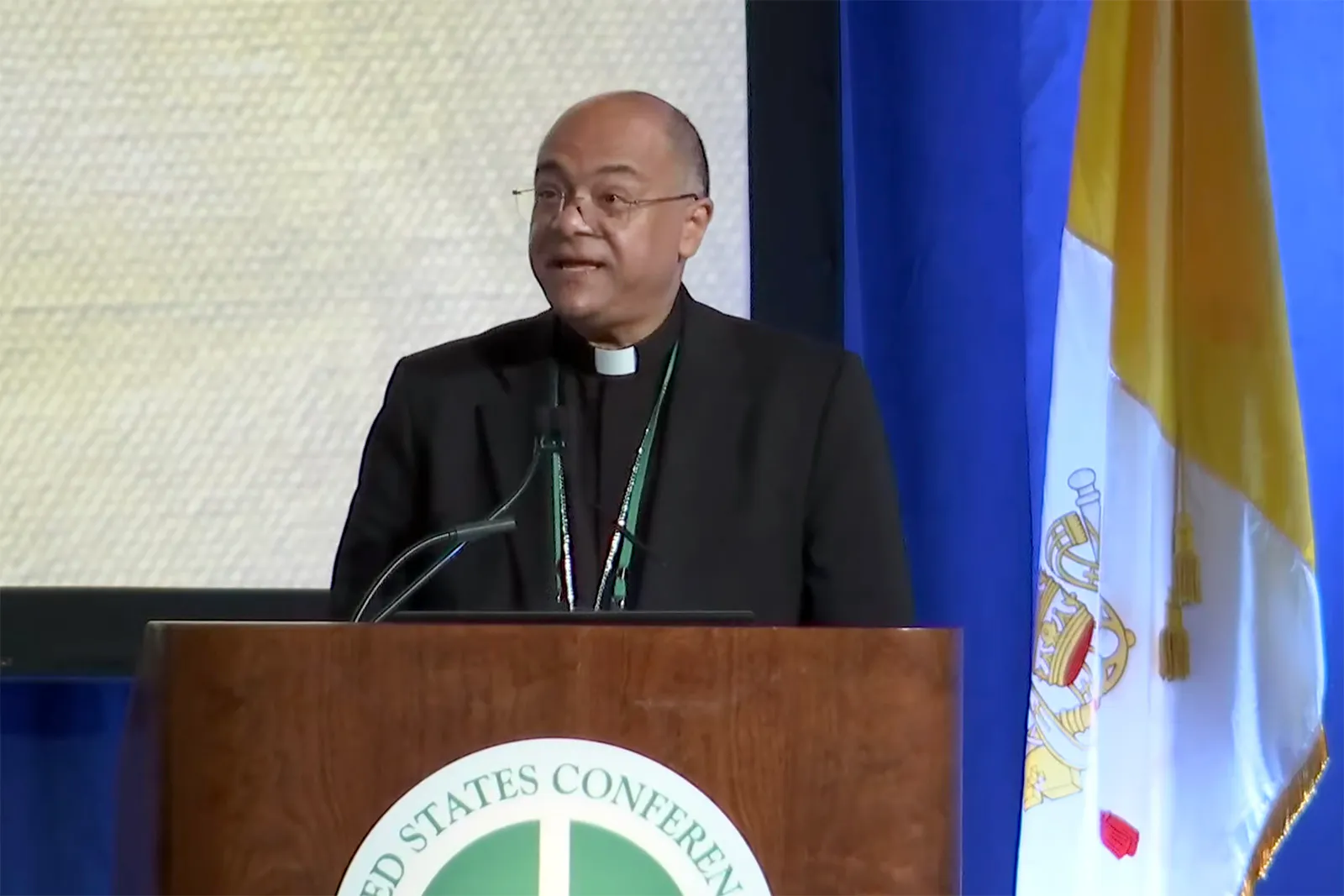
Louisville, Ky., Archbishop Shelton Fabre addresses the U.S. Conference of Catholic Bishops’ spring meeting on Thursday, June 11, 2026, in Orlando, Fla. (Video screen grab)
“ An important topic during our discussions was the concern that the faithful can often first be guided by their political affiliation and only second by their faith,” Fabre said. “ We must help Catholics to better understand that the Church is not aligned with any political party or ideology.”
The faith-before-politics language in Fabre’s presentation echoed statements in Oklahoma City Archbishop Paul Coakley’s presidential address on Wednesday, and both men also highlighted polarization as a serious problem facing the church and the world.
Fabre also said that the bishops had discussed the importance of using alternative formats to reach Catholics, particularly younger ones, including videos, social media and one-page documents. The archbishop announced that the conference will create materials that can be adapted locally, including to use with priests and deacons, as well as help dioceses with lower capacities to create videos.
The materials will focus on faith before politics, the church’s role in society and the question “ who is my neighbor as a gospel-inspired lens for how we see, encounter, care for the other and for all who are vulnerable,” Fabre said.
And on Thursday afternoon, the bishops consecrated the United States to the Sacred Heart of Jesus, as part of their commemoration of the nation’s 250th anniversary. During the morning’s meeting, Archbishops Fabre, Bernard Hebda of St. Paul and Minneapolis, and Alexander Sample of Portland, Oregon, gave reflections on the Sacred Heart.
In his remarks, Fabre addressed the bishops on their relationships with each other. “Division among the bishops deeply harms the church’s witness and calls us to feel the gravity of our unity’s fragility,” Fabre said, calling them to an examination of their own hearts, their speech, their social media posts and conversations.
In the past year, one of the most visible signs of division among the U.S. bishops was open opposition by several bishops to Chicago Cardinal Blase Cupich’s decision to nominate Democratic Sen. Dick Durbin, who has supported abortion access, for an archdiocesan award. Cupich has remained influential at the Vatican under Pope Leo XIV.
While Fabre did not clarify what kinds of division the bishops should address, he told them, “If we are to always be continually striving to love one another authentically as brothers, we must resist the temptation to reduce one another to labels or conventions.”