












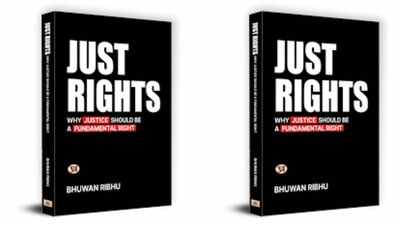
There are books that inform, and there are books that challenge the way we think. Just Rights by Bhuwan Ribhu belongs firmly in the second category. It is not just a book about law or policy; it is a compelling call to rethink how justice is understood and delivered in India. With clarity, conviction, and a deep sense of purpose, Ribhu argues that justice should not remain an abstract constitutional promise but should be recognized as a fundamental right accessible to every citizen especially the most vulnerable.What makes Just Rights stand out is its ability to translate complex legal and constitutional ideas into language that is accessible to ordinary readers. Rather than relying on dense legal jargon, the author explains why delayed justice, unequal access to legal remedies, and systemic failures continue to deny millions of Indians their basic rights. The book encourages readers to see justice not merely as the outcome of court proceedings but as the foundation upon which every other right rests.Bhuwan Ribhu writes not as a distant academic but as someone who has spent years working at the intersection of law, child rights, and social justice. That lived experience gives the book both credibility and emotional depth. His arguments are strengthened by real-world examples, policy insights, and constitutional reasoning, making the book equally relevant for legal professionals, policymakers, students, and socially conscious citizens.One of the book’s greatest strengths is its optimistic tone. While it does not shy away from exposing systemic shortcomings, it never becomes cynical. Instead, it presents a constructive vision of reform one where institutions, governments, civil society, and citizens collectively work towards building a justice system that is timely, accessible, and equitable. The emphasis on accountability and constitutional values gives the book a sense of urgency without becoming confrontational.The writing is crisp, engaging, and thoughtfully structured. Each chapter builds naturally upon the previous one, making it easy for readers with little legal background to follow the central argument. At the same time, the depth of research ensures that legal scholars and practitioners will also find substantial material for reflection and discussion.Perhaps the most significant contribution of Just Rights is that it broadens the conversation around justice. It reminds readers that justice is not only about courtrooms but about dignity, equality, protection, and the ability of every individual to enjoy the rights guaranteed by the Constitution. In doing so, the book elevates an important national conversation that deserves wider public attention.Just Rights is ultimately a book of ideas, but it is also a book of hope. It invites readers to imagine an India where justice is not delayed, denied, or reserved for a privileged few, but is treated as a basic constitutional guarantee. Whether one agrees with every argument or not, the questions it raises are difficult to ignore and deeply relevant in today’s social and legal landscape.Thought-provoking, timely, and accessible, Just Rights is an important contribution to contemporary discussions on constitutional rights and judicial reform. It is a recommended read for anyone interested in understanding why justice should be viewed not merely as a legal process, but as the foundation of a truly democratic society.


