






(RNS) — On a humid evening in late March, Victor Glover huddled with his fellow Artemis II astronauts to have what the spacefarers called their “ultimate dinner.” It was their last full meal before embarking on their historic journey around the Moon — the first human-crewed visit to Earth’s silver satellite since 1972.
After Glover finished his spread of lamb chops, spinach and sweet potatoes, the cook returned with something else: Communion elements. The cook, a Christian himself, then sat next to Glover and Canadian astronaut Jeremy Hansen as the men paused to pray before observing the Christian sacrament together.
“I prayed and I pleaded that God accepts that I do this for the mission,” Glover, who worships with Churches of Christ congregations in Texas, told Religion News Service in a recent video interview.
It was a quiet moment of religious ritual shortly before a rocket launch so explosively loud that, even a mile away, the boom rivaled the sound of standing near a screaming jet engine. The Space Launch System that carried the Orion spacecraft then catapulted Glover, the pilot for the mission, and his fellow Artemis II crew members into space, where they soared around the Moon and back in a gaping 252,756 mile arc that took them farther away from the Earth than any human beings in history.
But as millions back home marveled at the nine-day mission’s breathtaking photographs and technical accomplishments, Glover said the journey was also steeped in spiritual significance, from blastoff to splashdown.
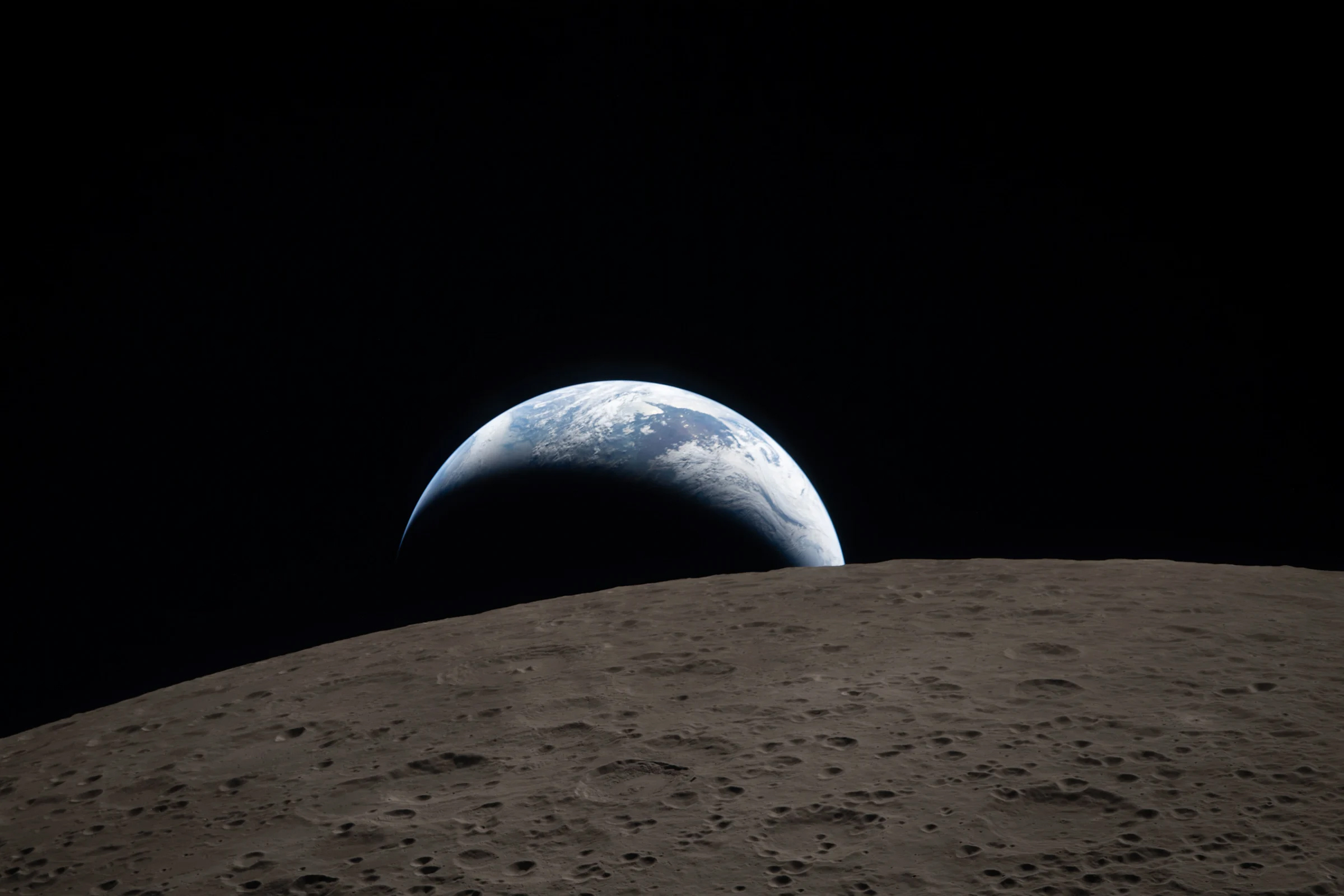
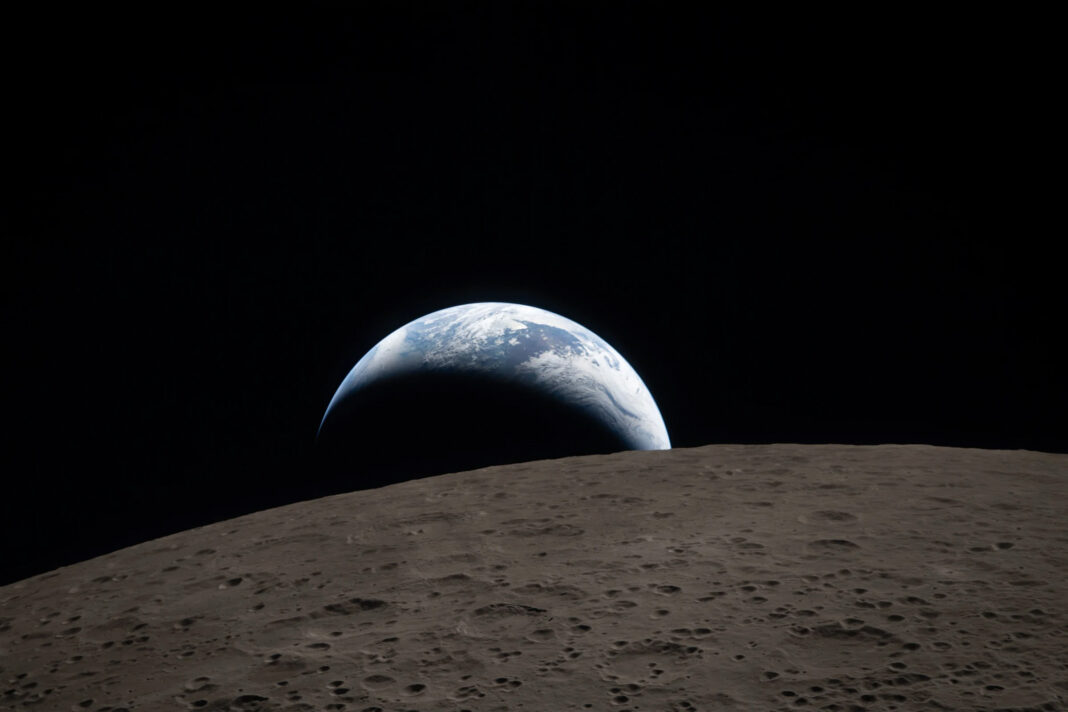
The Artemis II crew captured this view of an Earthset on April 6, 2026, as they flew around the Moon. (Photo courtesy of NASA) TOP PHOTO: NASA astronaut and Artemis II Pilot Victor Glover peers out the window of the Orion spacecraft during the Artemis II lunar flyby on April 6, 2026. (Photo courtesy of NASA)
“At the end of it, when we were just responding totally instinctually, we talked a lot about God,” he said, referring to the crew. “We talked a lot about creation and the beauty of the universe and the cosmos.”
Glover, 50, said just talking about the mission — even among the Artemis II crew members in their brief reunions between press junkets — has been a challenge. Multiple times in his interview with RNS, Glover admitted to struggling to articulate his thoughts on aspects of the flight, which included witnessing a spectacular solar eclipse rarely seen from space that spurred mission commander Reid Wiseman to quip to Glover, “I don’t think humanity has evolved to the point of being able to comprehend what we are looking at right now.”
“At the end of it, when we were just responding totally instinctually, we talked a lot about God … We talked a lot about creation and the beauty of the universe and the cosmos.”
Victor Glover
While he feels his faith has “definitely grown” through the journey, Glover said the inability to find the right words is something he has come to embrace as a kind of spiritual posture.
“I don’t have to be quick to put words on it and label the moments in the mission,” he said, later adding: “I’m actually getting comfortable not having to answer things. You have questions? Let’s talk about the question.”
A faith that dwells among the stars
The clear impact of the mission on Glover is striking given his already ample experience as an astronaut. In 2020, he was among the first astronauts to fly aboard the Dragon Capsule, a commercial spacecraft created by Space X, to the International Space Station, where he and three other astronauts lived, suspended above the Earth, for 167 days. In an interview with the Christian Chronicle before the mission, he said he planned to bring Communion cups aboard the ISS, hoping to continue worshipping virtually with his faith community.
It’s hardly the first time an astronaut has engaged in religious ritual while in space (Buzz Aldrin, a Presbyterian, took Communion shortly before stepping out on the lunar surface during Apollo 11), and Glover said he counts himself among those who do not see science and religion as incompatible.
“If God could create the universe, God could create a thing to evolve,” Glover said, noting he once challenged a preacher’s claim that the Earth was 3,000 to 7,000 years old.
“I’m actually getting comfortable not having to answer things. You have questions? Let’s talk about the question.”
Victor Glover
And when the remake of the television series Cosmos aired in 2014, Glover said he had his four daughters lie down on their living room floor, close their eyes and listen as each read from the show’s description of the beginning of the universe. He asked them to build a picture in their mind of what they heard, which included descriptions of the Big Bang.
Glover encouraged his daughters to think about how someone who lived “2,000 years ago, 3,000 years ago” would describe the birth of the universe, and they noted how it echoed the Bible’s description of creation in Genesis.
“I saw my kids’ eyes light up,” Glover said. He added: “I work in science. I work in church. I don’t see them as conflicting.”
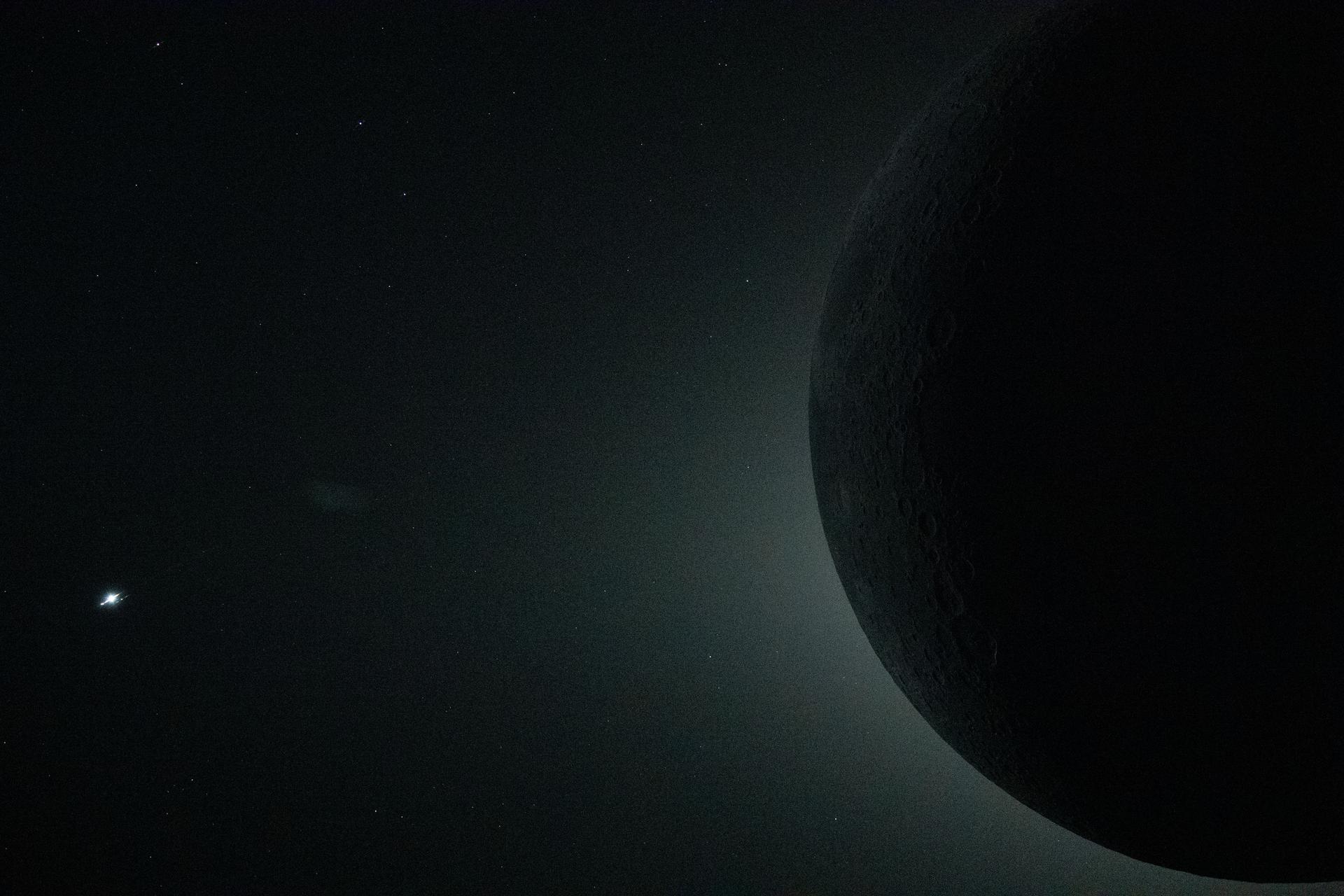
A close-up view from the Orion spacecraft during the Artemis II crew’s lunar flyby on April 6, 2026, captures a total solar eclipse, with only part of the Moon visible in the frame as it fully obscures the Sun. Venus is a bright spot on the left of the frame. (Photo courtesy of NASA)
Articulating a ‘gentle faith’
NASA also sought religious perspectives while prepping for the Artemis II mission. In a recent interview Wiseman conducted with The New Yorker, the mission commander said the agency hired “spiritual and cultural leaders” to come speak to the team “about the significance of the Moon around the world.”

NASA astronaut Victor Glover conducts leak checks on his spacesuit in the Neil A. Armstrong Operations and Checkout Building at the agency’s Kennedy Space Center on Wednesday, April 1, 2026, in Florida. (Photo courtesy of NASA/Kim Shiflett)
“We wanted to know how everyone sees the Moon,” Wiseman said.
During the mission itself, which coincided with the Christian Easter holiday and the Jewish celebration of Passover, Glover made reference to the Bible and his faith in his public statements at least twice: once during a televised interview with CBS as they hurtled away from Earth, and a second time during a broadcast just before the crew vanished behind the Moon and entered a 40-minute period of radio silence.
“As we continue to unlock the mysteries of the cosmos, I would like to remind you of one of the most important mysteries there on Earth — and that’s love,” Glover said, referencing the Gospel of Matthew during the broadcast. “Christ said, in response to what was the greatest command, that it was to love God with all that you are. And he also, being a great teacher, said this: ‘I give you equal to it, and that is to love your neighbor as yourself.’”
He added: “And so, as we prepare to go out of radio communication, we’re still able to feel your love from Earth and to all of you down there on Earth, and around the Earth, we love you from the Moon.”
It’s a kind of public-facing religious rhetoric that has proven controversial in the past. After Apollo 8 astronauts read from the book of Genesis while circling the Moon in 1968, an atheist activist filed a lawsuit. The legal challenge was thrown out, but it left NASA skittish about religious rhetoric taking center stage during missions.
But public reception of Glover’s remarks seemed generally positive, with many lauding what one commentator called the astronaut’s “gentle faith.”
“I work in science. I work in church. I don’t see them as conflicting.”
Victor Glover
“I tried to speak something that was true for me personally, but also true universally, no matter what you follow, whatever faith — or lack of faith — you have,” Glover said, musing that the warm reception may have been because “people’s hearts needed something,” at a time when “there’s a lot of negativity flying around.”
“You can understand how important it is to love something bigger than yourself, and how you should love your neighbor. If we could figure that out, all of us would be better today,” he said.
A religious return
According to Glover, his crewmates were frequently at a loss for words as they gazed back at an Earth that grew ever smaller throughout their journey. He often heard them exclaiming reverently to each other, “Oh my God.”
“We Christians are often, too often, quick to say, ‘do not use the Lord’s name in vain,’” he said. “I will tell you, I never felt it was in vain: I thought that is the appropriate utterance for this moment. It’s truly a God moment.”
Glover stopped short of suggesting his fellow astronauts were using the same spiritual lens he does. Neither Hansen nor Christina Koch, both mission specialists, appear to have publicly discussed their faith — if they claim one — before or after the mission, and Captain Wiseman has described himself as “not really a religious person.”
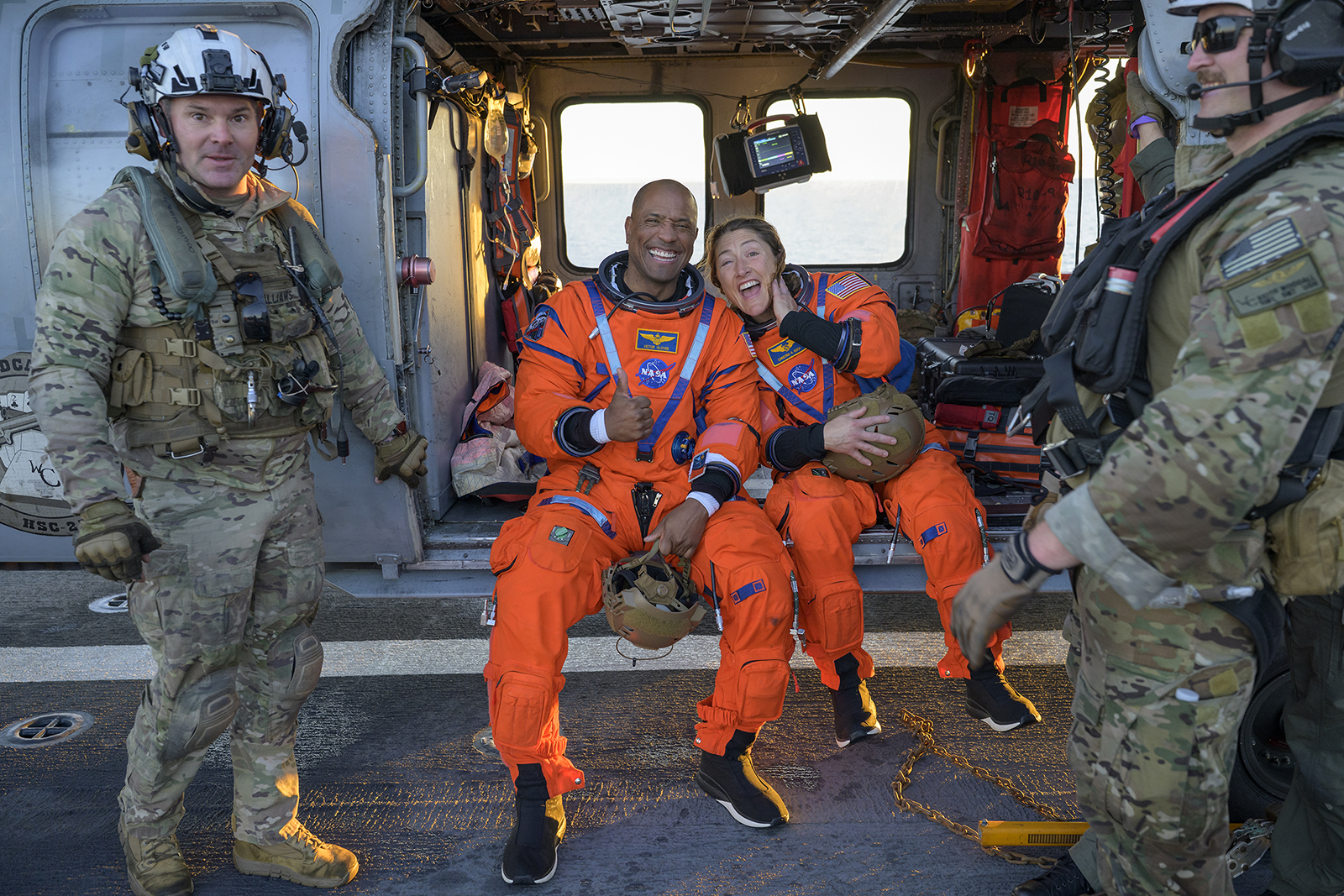
NASA Artemis II astronauts Victor Glover, center left, and NASA astronaut Christina Koch, center right, are sit on a Navy MH-60 Seahawk on the flight deck of USS John P. Murtha after they were extracted from their Orion spacecraft after splashdown, Friday, April 10, 2026, in the Pacific Ocean off the coast of California. (Photo courtesy of NASA/Bill Ingalls)
Even so, one of the first calls Wiseman made after splashing down in the Pacific Ocean on April 11 was to a chaplain. In a recent public appearance, Wiseman said that as the crew waited together in a medical bay, he felt the astronauts had “no other avenue” to “explain” what they saw during their time in space.
The Navy chaplain on duty that day was Lt. Eliseo Morales Jr., who is affiliated with the Presbyterian Church (USA). In an email to RNS, Morales said that around the same time, an officer called him and said, “Chaps, your presence is requested at medical.”
When Morales entered the room, Wiseman embraced him. The mission commander, who has discussed the encounter publicly and gave Glover permission to mention it, then broke down into tears.
“I’ve told (Wiseman) this since: That was one of the most spiritual moments of my life,” Glover said.
Morales said that he, too, left the experience moved, saying it felt “like a dream.”
“Praying for and meeting actual astronauts who we just recovered from a capsule in the middle of the ocean is a sentence I never thought I would write in my entire life,” he said in the email. “Yet God placed me on this ship for that reason.”
The impulse to call a chaplain speaks to the power religion can have in tense moments, said Glover, including when it comes to articulating the seemingly intangible.
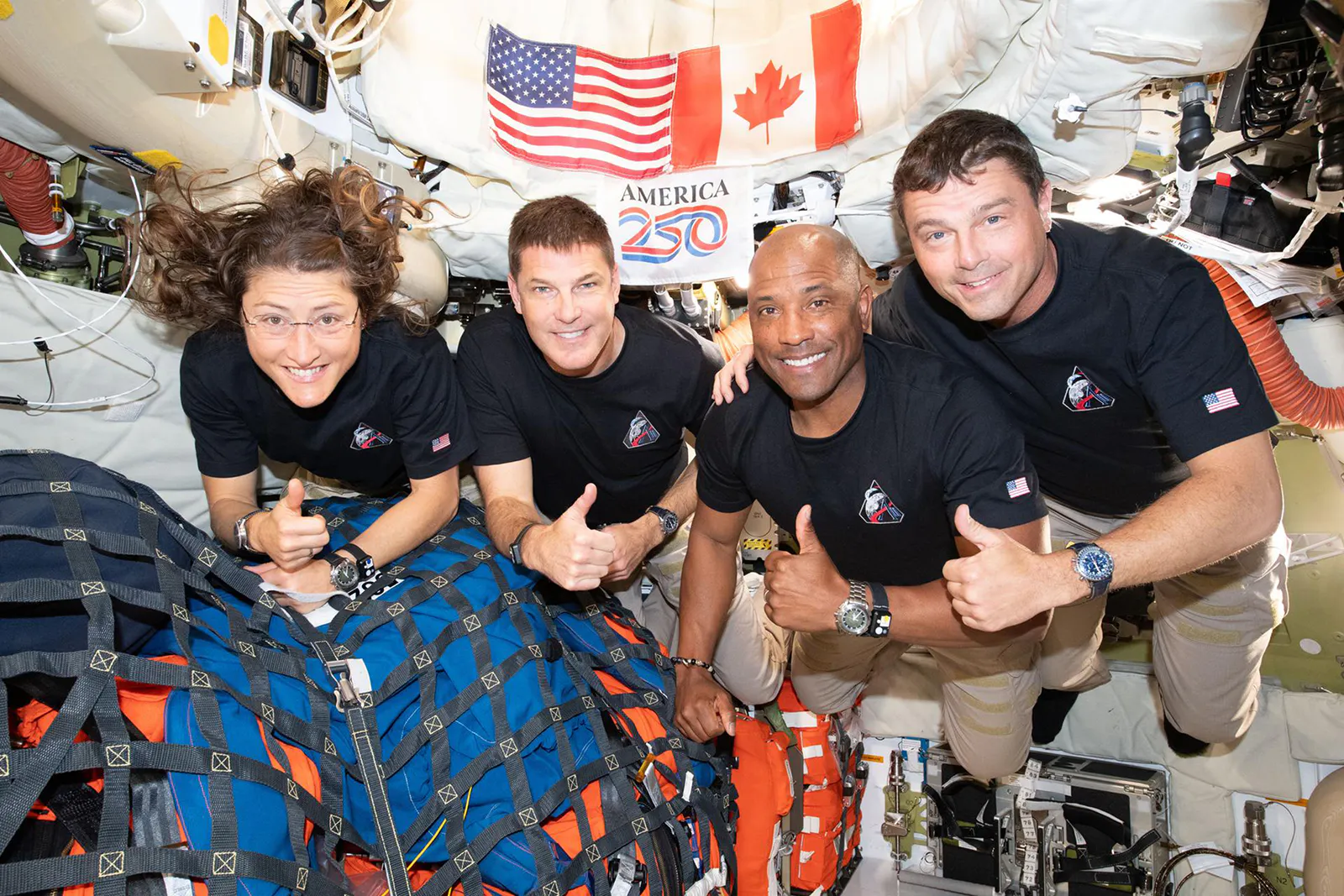
The Artemis II crew, from left, Mission Specialist Christina Koch, Mission Specialist Jeremy Hansen, Pilot Victor Glover, and Commander Reid Wiseman pause for a group photo inside the Orion spacecraft on their return to Earth, on April 7, 2026. (Photo courtesy of NASA)
“(Wiseman’s) brain and emotion and development and maturity thought to bring a person in who could understand,” Glover said. “When you think about it, that’s what church is supposed to be anyway: When people have need, you want them to reach for that.”
Morales felt similarly. He noted that, while his meeting with Wiseman and the other astronauts was a “once-in-a-lifetime moment,” it was “no more sacred than the time I was speaking to a young Sailor in my office … who was going through overwhelming challenges in his life.”
Wiseman, in his New Yorker interview, said he and Glover discussed the divine while carving out a few hours together in the Montreal airport during a media tour in April.
“I told him, ‘I think we slipped through the hands of God during that mission,’” Wiseman said, referring to Glover. “That just stopped him in his tracks. He completely agreed. There’s just ways that we see the world right now that are totally different.”
And while a trip to the Moon and back may have left him spiritually reeling, Glover gave no indication that it fractured his faith itself. He said he initially wanted to return to church a day after returning home, and although his family shot down appearing in person, they worshipped virtually together that Sunday.
And while the Communion he shared at his “ultimate meal” was certainly uniquely timed, it was hardly his last.
“I got right back to it when I got back to Earth,” he said.
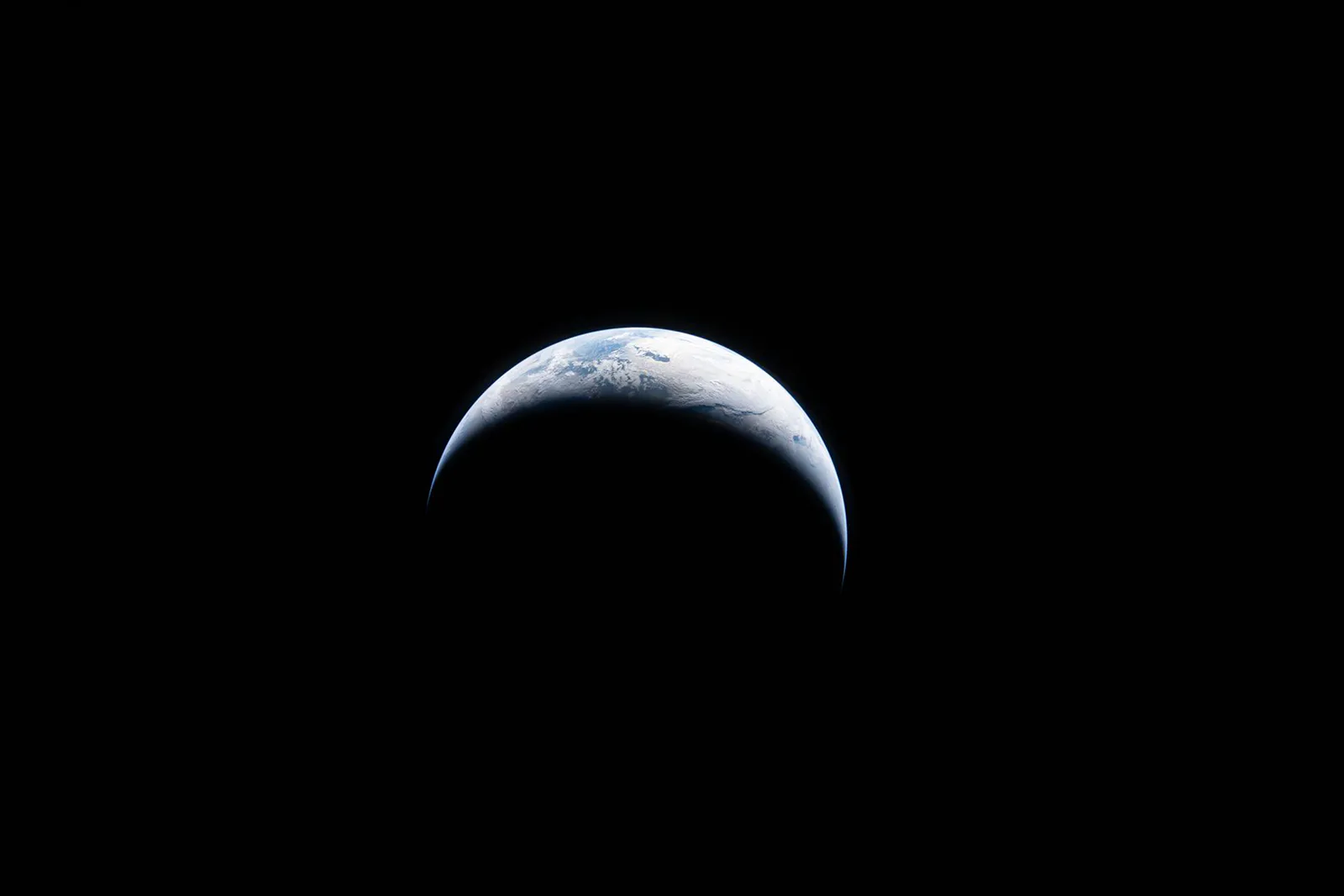
Earth is illuminated against the blackness of space in this photo taken by an Artemis II crew member through an Orion spacecraft window. (Photo courtesy of NASA)