



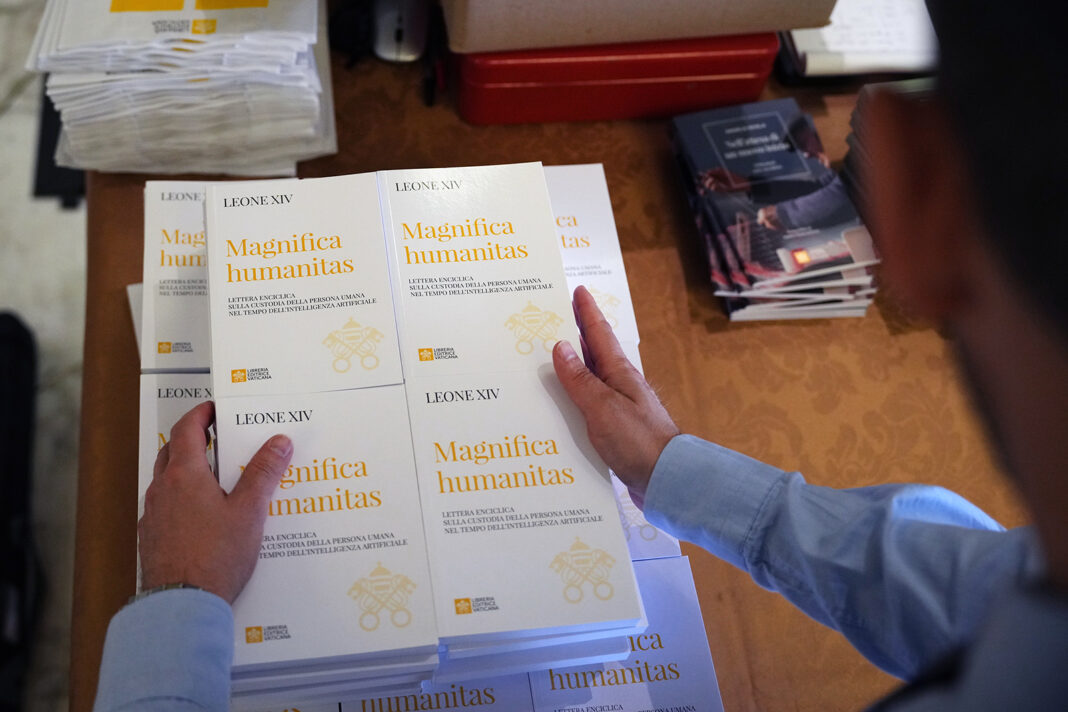
(RNS) — I wish I could better recall every person I met at Our Lady of Peace Church and Shrine this past June 6. It’s a vibrant and growing parish (packed Sunday Masses, every two hours, from 6:30 a.m. through 8 p.m.) in the heart of Silicon Valley, and Bishop Oscar Cantu of San Jose decided it would be an ideal place to have an event on Pope Leo XIV’s encyclical, “Magnifica Humanitas,” just days after its release.
I met people from Anthropic, Google DeepMind, Meta, PayPal and Microsoft, among other places. Well over 300 folks showed up for two public panels on a papal encyclical at 9 a.m. on a Saturday. Several who identified as religious felt deep apprehension about what was happening within their companies. Others were secular but expressed gratitude that the pope was stepping up at this key moment in our history. Both the numbers of the people who came, and the kinds of stories they told, demonstrated the profound need for the leadership of Pope Leo and an interest in “Magnifica Humanitas.”
I’m a Catholic moral theologian, but prominent secular outlets like NPR, The New York Times, the BBC, The Atlantic and The Washington Post all reached out to me to help cover the encyclical. I recently helped the U.S. Conference of Catholic Bishops brief congressional staffers on the encyclical. The House dining room we reserved was packed, and the exchange, robust.
We engaged topics such as lethal autonomous weapons, the geopolitical pressure put into the system by China and the differences between using brain-implanted devices for therapies versus using them for enhancement. And, of course, in the back of everyone’s mind was the race that artificial intelligence and tech companies are having in the U.S. and around the world.
Many of these companies find themselves in something akin to a prisoner’s dilemma, where they believe that if they don’t “win,” then other companies (including those working for foreign adversaries) will do things like ignore safety standards and expose the steps for making chemical or biological weapons — or even risk the “escape” of autonomous large-language models that could wreak havoc and perhaps put human civilization itself up for grabs.
From my own formal and informal conversations with folks working in frontier AI labs, it is clear not everyone agrees about the nature of these risks or how far into the future they might become existential concerns. Some believe we have about 18 months to act before the exponentially increasing power of AI becomes unstoppable, while others think that there is almost no chance of this happening. Others take something like a middle position. Unfortunately, more than one person from these labs has said there is basically no neutral forum available where these competing claims are welcomed and publicly tested.

The U.S. government, paralyzed by a combination of fear and massive amounts of tech bro money, seems unlikely to step in with solutions. This despite the fact that Anthropic, OpenAI and the CEO of Google DeepMind have called for a pause in the breakneck pace of frontier AI development.
Of this situation, the Center for Strategic and International Studies said, “It takes a profound failure of political imagination for the United States government to be outflanked on the most pressing technological issue of the twenty-first century by a two-millennia-old religious institution.” The Catholic Church, they claim, “has accomplished exactly what U.S. politicians have failed to do.”
Brian Green, director of technology ethics at the Markkula Center for Applied Ethics at Santa Clara University, wrote, “The Church might be the only institution in the world that can actually lead this moral discussion on AI.”
Vice President JD Vance agrees. “The American government is not equipped to provide moral leadership, at least full-scale moral leadership, in the wake of all the changes that are going to come along with AI,” he said. “I think the Church is. This is the sort of thing the Church is very good at.”
Choosing this topic for his first encyclical, and being the first pope to appear at the press conference for its release, reveals Leo’s sense of urgency — as do his actual words in “Magnifica Humanitas.” He notes the need to move quickly, “given the frequent imbalance between the speed of technological growth and the slower development of awareness, norms, safeguards and institutions capable of governing its effects.” He calls for “more active political involvement that is capable of slowing things down when everything is accelerating,” and especially the need to “disarm” AI.
With all this in mind, Pope Leo should make a special and urgent visit to Silicon Valley.
I predict such a visit would mirror the dramatic results of St. John Paul II’s visit to Poland in 1979: an earthquake with aftershocks that led to the Solidarity movement. One could draw a historical line from this to the fall of communism in Poland to the fall of the Iron Curtain itself.
Pope Leo XIV took his name as a way of signaling his intention to respond to our current moment in ways that mirror what Leo XIII did in promulgating “Rerum Novarum” in 1891. Many different kinds of responses to the Industrial Revolution — including the labor union movement, minimum wage laws, child labor protections, the 40-hour workweek, worker safety protections and more — can be traced back to the influence of Leo XIII and the development of Catholic social teaching.
Today, despite taking controversial positions on everything from immigration to abortion, Pope Leo XIV remains incredibly popular. Christianity more broadly in the United States is experiencing a recovery and, with certain significant pockets of young people, something akin to a revival. Evidence of this came through loud and clear in a deeply reported article by The San Francisco Standard titled “Silicon Valley Found AI and Started Looking for God.” Apparently, our experience at Our Lady of Peace was not unique. A “shift” is being described by younger people in the area where religion has a “fading stigma” and questions coming from today’s tech revolution lend themselves to theological answers.
These are the people Leo would find if he came to Silicon Valley.
He would also find many leaders working in frontier AI labs, desperate for solutions, who would join events at his invitation. These would include local folks but also, crucially, international players — including those working for DeepSeek and other Chinese companies. (For many different reasons, the Vatican diplomatic corps has lots of experience working with the Chinese.)
Modeling some of what we did in Santa Clara, the Holy Father could hold listening sessions, discuss his proposals in “Magnifica Humanitas,” invite other religious leaders to lend their wisdom and draw global attention to the AI issues like no other event has in human history. Like we did, the Holy Father will find people who are thirsting, not only for his humble leadership, but for someone with the convening power to name the moment we are in and spur the major players to discussion and action.
He could also use the visit as a way of calling the formidable global resources of the Catholic Church — ecclesial, educational, healthcare and more — to address this particular moment. In the past, religious orders such as the Jesuits, Dominicans, Franciscans and Benedictines have moved at the direction of the pope to use their particular gifts to meet the signs of their times. The Augustinians, who count Leo himself as a member, have a particular role to play, especially with their charism focused on what sorts of ideas and practices can address the “restless hearts” so many have today.
I also hope the Holy Father’s visit would kick off plans to start something like a “Magnifica Humanitas Institute for Technology and Catholic Social Teaching.” The already substantial institutional resources of the church could be organized for both continuing the dialogue and debate in a forum not influenced by profit margins or campus politics, and also for organizing and activating to help affect consensus changes.
Happily, the issues surrounding AI have not yet been politically or ideologically coded in ways that lead to deadlocked polarization. Everyone from Sen. Bernie Sanders to Vance is floating dramatic responses to meet the needs of this moment. There is a perhaps unique amount of ideological room for big, creative, evidence-based proposals.
Here’s what’s missing: the urgent energy, breakthrough levels of attention and global institutions necessary to help bring such proposals to the fore and get them implemented. Twice in the last 135 years, the actions of a pope sparked massive global changes that met the cultural moment.
Pope Leo XIV, the world needs you to help pull this off again.