



NEW DELHI: In late 2020, during a pandemic-induced gap period before starting their freshman year at Stanford, Aadit Palicha and Kaivalya Vohra incorporated Kiranakart Technologies in Mumbai. After a pivot from a traditional grocery aggregator model to a hyper-local dark store network in mid-2021, they chose to officially drop out of their deferred university seats to scale what eventually became Zepto.They bet their entrepreneurial zeal on a single proposition: that India’s grocery buyer would pay for a ten-minute delivery promise. Within five years, they had built a platform processing over 640 million orders a year, drawn capital from Y Combinator, Nexus, Glade Brook and the Kaiser healthcare group, and filed draft papers with SEBI.Zepto’s draft red herring prospectus (DRHP) has set the stage for what could become one of India’s most closely watched startup listings, offering public investors their first detailed look into the economics of a company that helped popularise 10-minute grocery delivery across urban India.
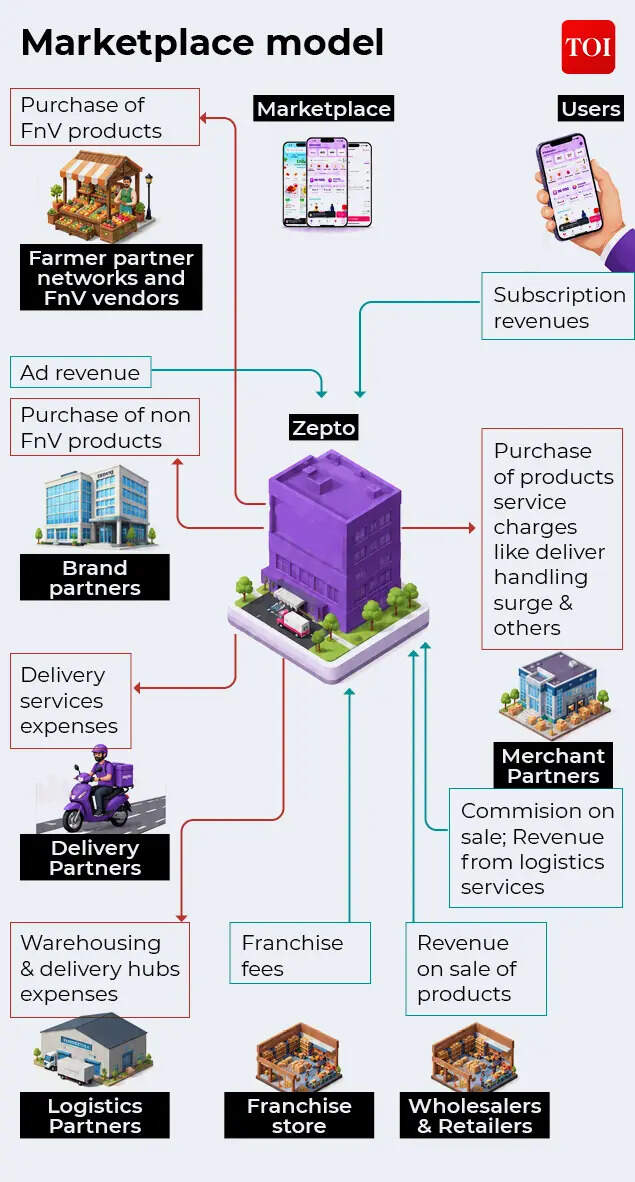
Zepto has emerged as one of the largest quick-commerce platforms in the country, operating 1,139 dark stores and 75 warehouses while serving 47.97 million annual transacting users as of March 2026. The company has filed updated draft papers for an IPO comprising a fresh issue of shares worth up to Rs 80,100 million and an offer for sale by existing investors. The issue is being managed by Axis Capital, Morgan Stanley India, Goldman Sachs India Securities, Motilal Oswal Investment Advisors, HSBC Securities and Capital Markets India, JM Financial and IIFL Capital Services.Use of fresh issue proceeds
Source: Zepto UDRHP-I, June 8, 2026. Inorganic/GCP amounts to be finalised on price band determination.The IPO comes at a time when quick commerce has evolved from a pandemic-era convenience service into one of India’s fastest-growing consumer internet segments. Yet while investors broadly agree on the size of the opportunity, debate continues over whether the sector’s leading players can eventually generate sustainable profits.That question sits at the centre of Zepto’s public-market story.
Growth story
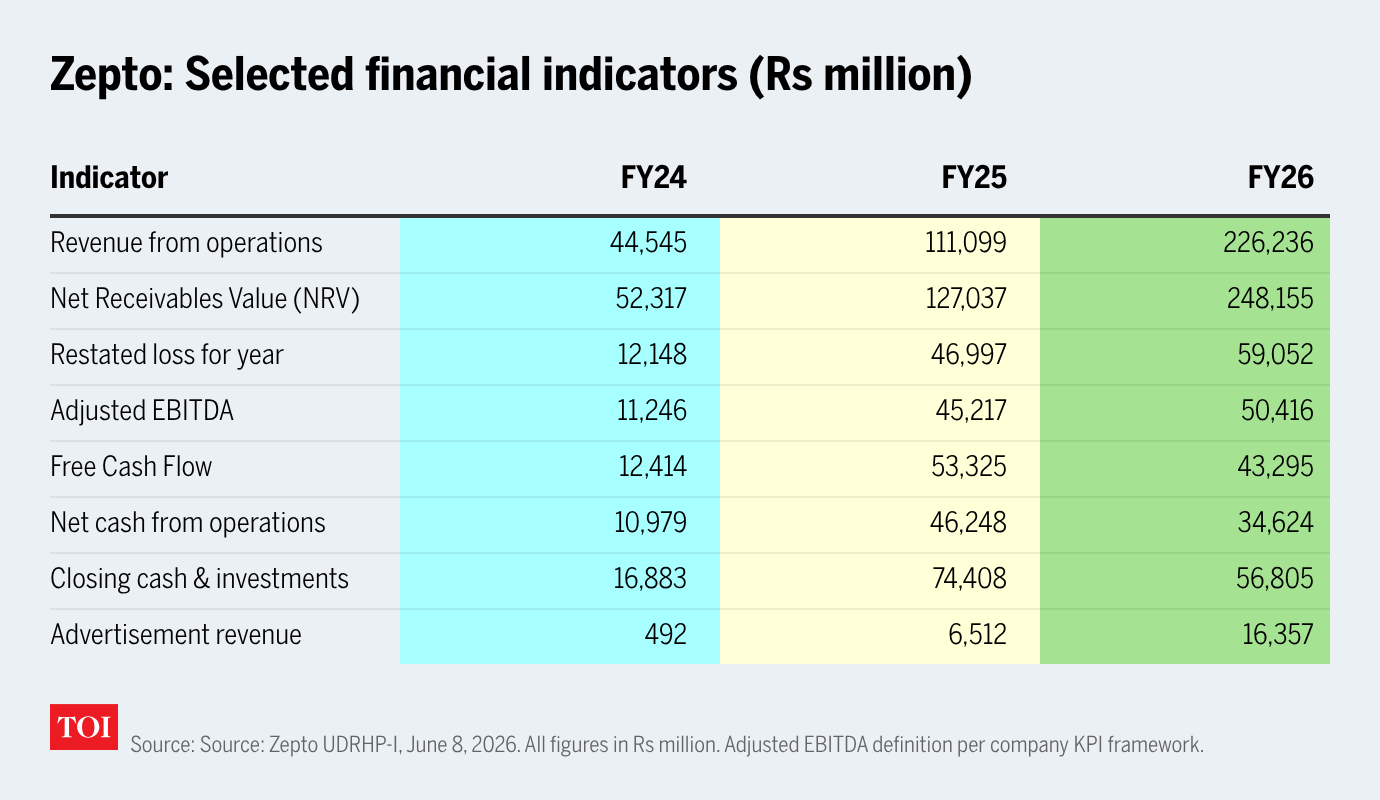
Revenue from operations more than doubled to Rs 22,623 crore in FY26 from Rs 11,109 crore in FY25, while annual transacting users rose to 47.97 million from 38.38 million a year earlier. Orders processed during the year crossed 640 million as the company expanded its footprint across cities and categories.
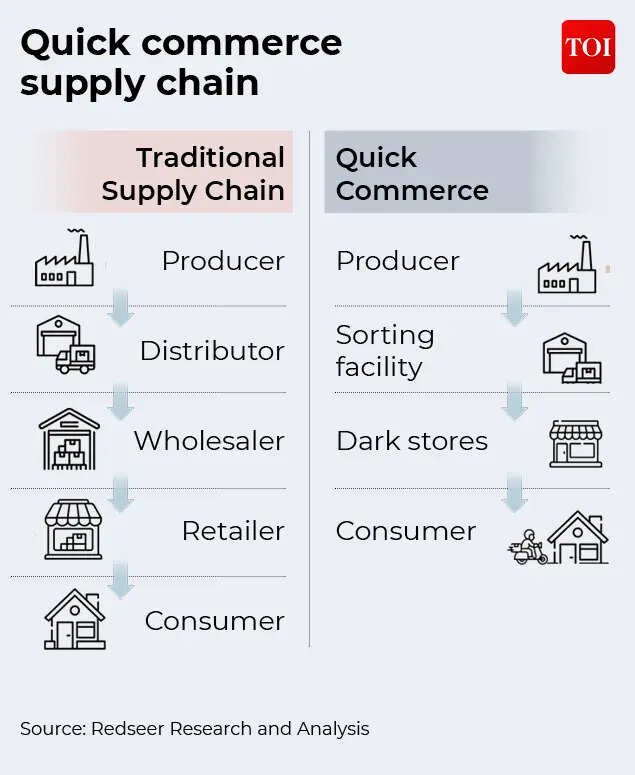
The broader market opportunity remains compelling.According to industry estimates cited in the DRHP, India’s quick-commerce market has grown from about $1.6 billion in 2022 to roughly $11.3 billion in 2025 and is projected to reach between $60 billion and $83 billion by 2030. That would imply a five-to-seven-fold expansion over the next five years.The size of that opportunity explains why investors continue to back the sector despite heavy spending and fierce competition.
The operating metric that stands out
Among the dozens of figures disclosed in the filing, one metric has drawn particular attention from analysts: order density.In quick commerce, profitability depends heavily on how many orders each dark store processes daily. Higher order density allows fixed costs such as rent, manpower and utilities to be spread across more transactions.
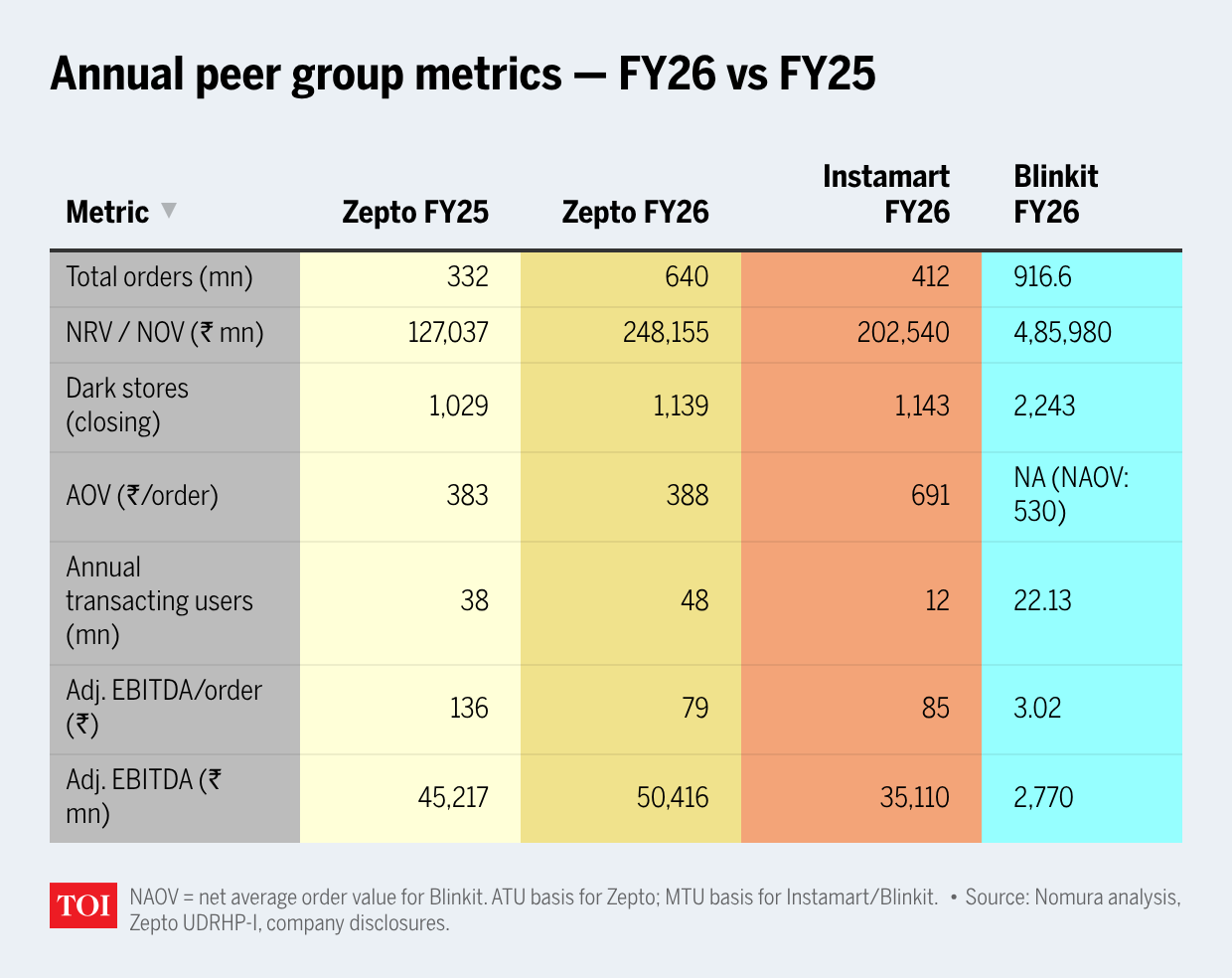
A Nomura analysis based on Zepto’s DRHP disclosures suggests the company currently leads peers on that parameter.“Zepto’s order per day per dark store (OPD/store) at ~2,140 was ~60% higher than Blinkit and ~100% higher than Instamart in 4QFY26,” the brokerage noted.Nomura also highlighted that Zepto’s dark-store network of 1,139 locations was roughly similar to Instamart’s but only around half of Blinkit’s 2,243 stores.The implication is that Zepto is generating more orders from a comparatively smaller network, a factor that could support profitability if the model scales efficiently.The brokerage, however, pointed to a less favourable trend as well. Zepto’s average order value (AOV) stood at around Rs 387 and has remained largely flat over the past 12 quarters. In contrast, Blinkit and Instamart have recorded stronger growth in basket sizes over the same period.
Profitability remains the biggest challenge
Strong operating metrics have not yet translated into earnings.Nomura estimates show Zepto reported an adjusted EBITDA loss of about Rs 12.5 billion in the March quarter of FY26, compared with a loss of Rs 8.6 billion for Instamart, while Blinkit posted positive adjusted EBITDA of Rs 3.7 billion.
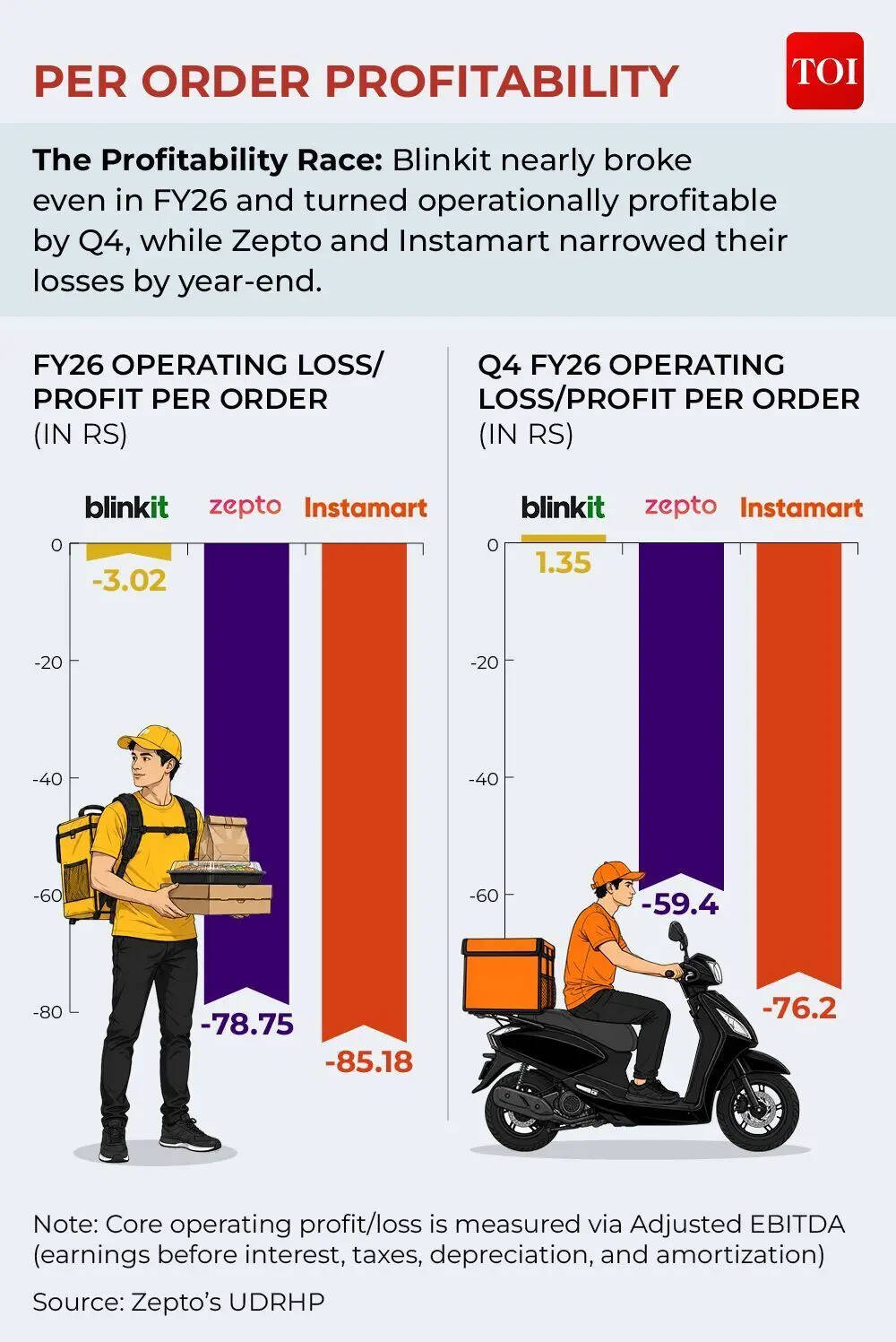
For the full year, Zepto’s adjusted EBITDA loss stood at around Rs 50.4 billion, compared with Rs 35 billion for Instamart and Rs 2.77 billion for Blinkit.“We have incurred losses and have had negative cash flows from operating activities since our inception. Specifically, we had restated loss for the year of Rs 59,051.92 million, Rs 46,997.14 million and Rs 12,147.94 million in Fiscals 2026, 2025 and 2024, respectively. If we are unable to generate sufficient revenue growth, we may continue to incur losses. Further, we may not be able to sustain our historical growth rates, and our historical performance may not be indicative of our future growth or financial results.” Zepto’s DRHP-I noted.Those numbers explain why profitability is likely to dominate conversations during investor roadshows.Siddhant Singh, Partner at Contriance Legal Solutions, said investors are effectively betting on future execution rather than present earnings. “The valuation being discussed ahead of the IPO is based largely on expectations of future performance rather than current profitability.”
"Investors are effectively assuming that Zepto can continue growing at a rapid pace, maintain a leadership position in India’s quick-commerce market and eventually convert scale into sustainable profitability despite operating in one of the most competitive segments of the digital economy."
Siddhant Singh, Partner at Contriance Legal Solutions
According to Singh, the biggest risk remains whether scale can eventually overcome high customer-acquisition costs, logistics expenses, dark-store investments and aggressive competition. “Public markets have repeatedly demonstrated that growth alone is insufficient if profitability remains distant.”The challenge is particularly relevant because listed-market investors have become more demanding after the first wave of internet IPOs. The experiences of Paytm, Nykaa, Zomato, Swiggy and Ola Electric have reinforced the importance of profitability, governance standards and cash-flow visibility.
Advertising may become the hidden earnings lever
One area investors are expected to watch closely is advertising.As brands increasingly spend to gain visibility on quick-commerce platforms, advertising is emerging as a higher-margin revenue stream compared with core grocery deliveries.Nomura noted that advertising revenue accounted for about 7.88% of Zepto’s net receivable value in FY26.For analysts, that is significant because advertising typically carries substantially higher margins than commerce operations.Singh believes this could become an important driver of future profitability. “Particular attention should be paid to Zepto’s efforts to build higher-margin revenue streams such as advertising.” he said adding “Zepto’s ability to successfully monetise advertising inventory and brand partnerships may play an important role in determining whether it can achieve sustainable earnings.”
Multiple players are still in expansion mode
Kotak Institutional Equities said in a June 9 report that available metrics for the three largest quick-commerce players suggest they ended FY26 with around 4,525 stores and a combined net merchandise value (NMV) of Rs 277 billion in the March quarter.The brokerage noted that combined NMV for the three platforms increased 81% year-on-year during FY26, underscoring the rapid growth of the industry.
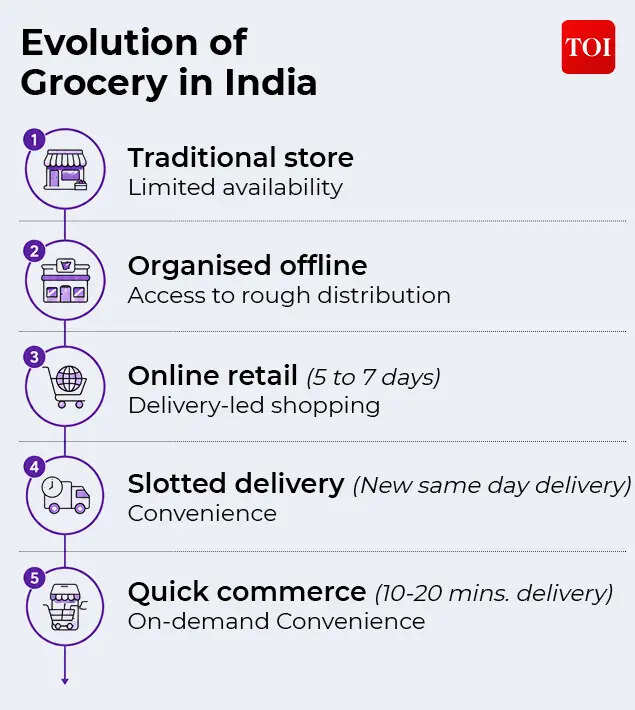
“Price competition remains high, with new entrants offering discounts and cash backs; incumbents such as Blinkit seem to be more disciplined,” Kotak said.The report added that multiple players remain in expansion mode despite the increasingly competitive landscape.Amazon and Flipkart are among the latest entrants accelerating investments.According to Kotak, Amazon has already rolled out about 500 dark stores and aims to expand the number to around 1,000. Flipkart Minutes is targeting roughly 1,600 dark stores by the end of 2026.
Meanwhile, Zepto itself plans to add 1,904 dark stores between FY27 and FY30, according to disclosures highlighted by Nomura.The expansion plans illustrate how aggressively companies are positioning themselves for what could become one of India’s largest consumer internet opportunities.On being asked about investors sentiment, Siddhant Singh Partner at Contriance Legal Solutions told TOI “Investors will be looking for evidence that increasing order density, operational efficiencies, advertising revenue and scale advantages can translate into improved margins, reduced cash burn and eventual free-cash-flow generation. Public markets are likely to focus less on gross merchandise value and customer growth and more on profitability metrics, capital discipline and cash-flow visibility.”
Governance and regulatory disclosures
Beyond operating performance, investors are also expected to scrutinise governance and regulatory disclosures.The DRHP contains disclosures relating to FEMA-related summons issued by the Enforcement Directorate to the founders.Singh noted that while a summons does not amount to a finding of wrongdoing, public-market investors tend to place significant emphasis on governance standards and regulatory certainty. “Public markets tend to be far less forgiving of compliance issues than private investors.”He also pointed to the company’s Foreign-Owned and Controlled Company (FOCC) structure, which operates under India’s marketplace e-commerce regulations.According to Singh, this distinction may have implications for margins, supply-chain control and long-term operating economics.
The new-age startup IPOs
The new-age startup IPO class has delivered a mixed experience for investors. Of the nine significant news age internet based IPOs listings given below in the table, five trade below their issue prices as of June 15, 2026. Eternal, the parent of Zomato and Blinkit, is the standout outperformer, having risen approximately 232% from its IPO price of Rs 76 as its food-delivery margins expanded and Blinkit turned adjusted EBITDA-positive.Ather Energy, which listed in May 2025 at Rs 321, has more than tripled to around Rs 1,000, driven by a sharp re-rating of its position in India’s electric two-wheeler market. Mamaearth and Nykaa trade modestly above their adjusted issue prices. Against those gains sit five cautionary cases: Paytm is still nearly 48% below its Rs 2,150 issue price despite a recent profitability recovery; Swiggy has lost a third of its value since its November 2024 listing; Ola Electric trades at Rs 44, nearly 42% below its issue price; and FiRs tCry and Delhivery remain in negative territory.
* Nykaa original IPO price was ₹1,125 per share. The company issued a 5:1 bonus in November 2022, making the adjusted issue price ₹187.50 (₹1,125 ÷ 6). Return shown is calculated on the bonus-adjusted basis. On the original unadjusted issue price the stock trades approximately 75.7% below its 2021 IPO price.
The real public-market test of Zepto’s
The investment debate surrounding Zepto ultimately comes down to a straightforward question. Can quick commerce become sustainably profitable at scale?The company has already demonstrated that Indian consumers are willing to pay for convenience and speed. It has built one of the country’s largest quick-commerce platforms in less than five years and operates in a market expected to expand dramatically over the next decade.What remains unresolved is whether those advantages can eventually translate into durable earnings.As Singh put it: “Ultimately, the real public-market test for Zepto is not whether it can deliver groceries in ten minutes. It is whether it can build a profitable, compliant and scalable business that justifies a valuation based largely on expectations of future earnings rather than present financial performance.”That is the question Dalal Street will now be asked to answer.(Disclaimer: Recommendations and views on the stock market, other asset classes or personal finance management tips given by experts are their own. These opinions do not represent the views of The Times of India)