











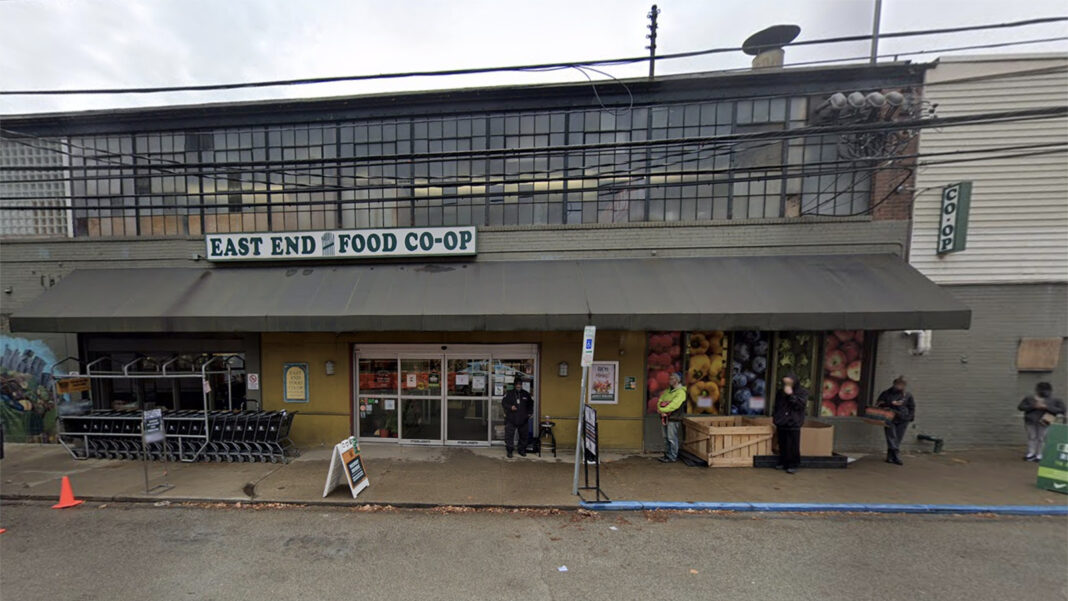
(RNS) — I don’t like seeing good intentions go awry — especially of those who shop for food intentionally at farmers markets or co-ops. These types of organizations were started and have flourished by giving workers and farmers more control over the quality and pricing of the food they produce and consume.
My local co-op, the East End Food Co-op in Pittsburgh, began as a “buying club,” as group purchases made food cheaper to help those in poorer areas of the city, according to its website. Its first funder was the Catholic Church.
During the first Trump administration, I wrote about why I like going to the co-op. It was a way to stand out and served as an important tool of resistance, as historian Timothy Snyder explained at the time. I wrote how I felt comfortable standing out as a Jew and did not think the co-op was a place that would feel inhospitable to me or anyone else who wants to stand out in any way. As a child of the 1970s and who had parents who shopped at the Philadelphia co-op Weavers Way, I have been associated with these kinds of establishments for more than 50 years.
But like other co-ops around the country, mine recently did something that made me uncomfortable when its board voted to advance a policy to boycott Israeli products. On Monday evening (June 15), there will be an open meeting before the board decides whether to approve the boycott. Out of thousands of items, the store carries fewer than 10 products sourced from Israel.
To be clear, I am opposed to the Netanyahu government and have been for some time. I am a longtime proponent of a two-state solution and was a member of the religious peace movement Oz ve’Shalom when I lived in Israel. I’m not unsympathetic to the point of view of the boycott campaigners or their goals — a peaceful Israel for both peoples. But fostering a climate of hate, intolerance and inhumanity is no way to reach those laudable goals.
The first reason such a boycott makes me uncomfortable is that it uniquely demonizes Israel. There are many other places in the world — and companies in the U.S. — to be concerned about that do not treat their workers humanely. Why focus on Israel specifically unless to target the majority of its citizens who are Jews? As scholar and activist Shai Davidai has written recently, the ideology surrounding boycotts of Israel “portrays Jews as uniquely powerful oppressors, Israel as uniquely illegitimate among nations, and violence against Israelis as morally justified, or at the very least morally explainable, so long as it is committed in the name of ‘liberation.’”
Second, these boycotts hurt those they are intended to help. In reporting on the well-publicized vote to boycott Israeli products at the Park Slope Food Coop in Brooklyn, the New York Post found that some items removed from the shelves — the Equal Exchange olive oil and the Al Arz tahini brand — are made by Arab-Israeli-run companies.
These kinds of boycott, divestment and sanctions campaigns certainly did not help Palestinians who had good jobs with SodaStream, which they could no longer hold once it relocated after pressure to move out of the West Bank. As NPR reported, when the plant moved out of the Palestinian territory about 10 years ago, some 500 Palestinians lost their jobs at the company.
As Bassem Eid, a Palestinian-Israeli columnist for The Times of Israel, wrote recently:
“BDS does not build Palestinian hospitals. It does not fund Palestinian universities. It does not support the civil society organizations, the professional associations, or the municipal institutions that would need to exist in order for Palestinian self-governance to function. It offers symbols: the moral comfort of removing Bamba from a Brooklyn shelf while Palestinian workers grow poorer and Palestinian institutions grow weaker.”
I agree with him and wish those spending time and effort on co-op boycott votes would instead direct their energies in ways that will lead to actual constructive outcomes for the people they are ostensibly interested in helping. I also wish they would take the time to find out how the products they are removing from the shelves are made, who is making them and how their economic engine might be doing good for co-existence and shared economic goals.
But I fear that by using slogans like “vote yes for humanity” — which is what East End boycott supporters are saying to urge co-op shoppers to support the campaign in the days before the vote — they are merely creating hate for Jews. If you are clearly positioning one people as having more humanity than another, you are causing harm. And the history of Jews being depicted as sub-human or as animals has a long and dark history (writers and scholars like Deborah Lipstadt and Pamela Nadell catalogue it carefully if you’d like to read more about it).
And notably, this issue is being forced in the same city that saw the deadliest attack on Jews in American history. I yelled to one woman at the boycott organizing table in front of the store, “This is a place where less than eight years ago, 11 Jews were killed just for being Jews! How dare you say, ‘vote yes for humanity.’” I told her that to imply Jews are not part of humanity or not important to her humanity foments antisemitism. And it does not help Palestinians or anyone else. Her reaction? “I’m Jewish.”
I once asked my parents what drew them to take part in a grocery co-op, and my mother said it was her desire to feed her family healthy food. And when I look at the history of my Pittsburgh co-op, I see so many of my family’s values reflected in the others shopping there — using recyclable bags, getting food from local growers, supporting vegetarianism, volunteering and prioritizing sustainability.
I hope the East End Food Co-op can do better than Park Slope. I very much hope the board will decide not to pass the boycott for that same humanity the boycott supporters cited — including the humanity of the Jews of Pittsburgh and elsewhere, and that of the Palestinians whose economic life is put in turmoil by such measures. And I wish co–op members who support the boycott can instead spend time on causes that will help all the residents of Israel and territories that may one day become a Palestinian state rather than wreak harm on them.
(Beth Kissileff is co-editor of “Bound in the Bond of Life: Pittsburgh Writers Reflect on the Tree of Life Tragedy.” The views expressed in this commentary do not necessarily reflect those of RNS.)