






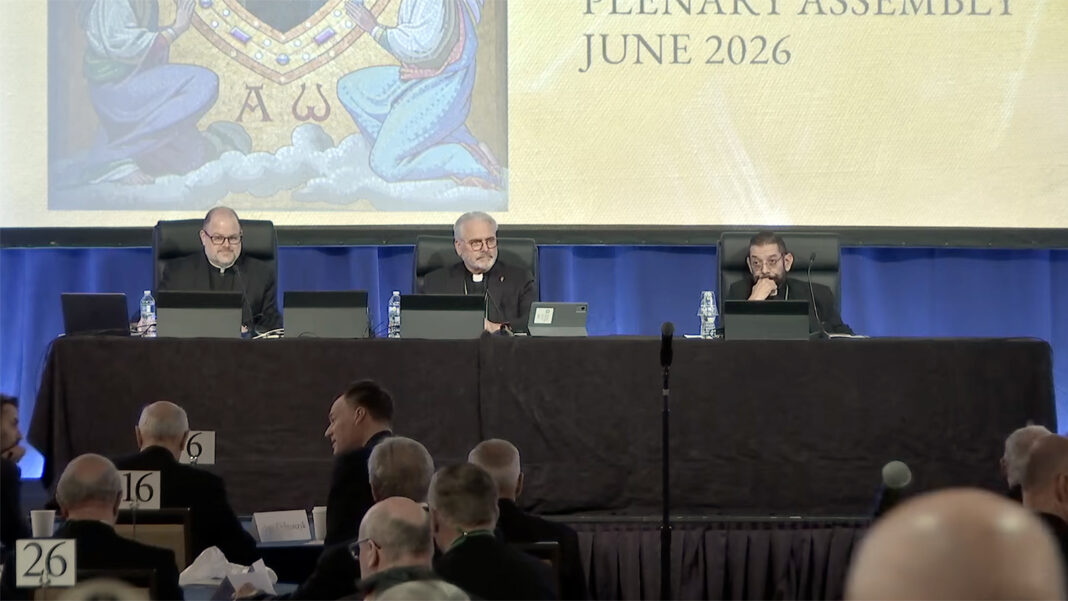
(RNS) — In agenda-setting speeches for the beginning of their terms as leaders of the U.S. Catholic Church on Wednesday (June 10), Oklahoma City Archbishop Paul Coakley, the new president of the U.S. Conference of Catholic Bishops, and Archbishop Gabriele Giordano Caccia, Pope Leo XIV’s new diplomatic representative in the U.S., emphasized their unity with the pope and each other as they tackled some of the church’s most pressing problems.
During Pope Francis’ pontificate, the conference did not always appear to prioritize his keystone initiatives, particularly around environmental teaching and dialogue known as synodality. As church observers watched closely to see what kind of posture the new U.S. leaders might take toward Leo’s papacy, Coakley’s repeated citations of the first U.S.-born pope and references to his teachings may be signaling a closer relationship between the Vatican and U.S. church, though the meeting’s public agenda does not include any sessions dedicated to artificial intelligence or Leo’s first encyclical, “Magnifica Humanitas.”
“ Today, in an age of constant flux, of forced migration, polarization, disruptions, climatic and economic upheavals, artificial intelligence, and wars,” Coakley said during his presidential address to the conference, “to restore hope in such a time as this, the truth of Christ must be proclaimed all the more confidently.”
In a January meeting with President Donald Trump, Coakley, the ecclesiastical adviser for the Napa Institute, a powerful group of conservative Catholics, was the first president of the bishops’ conference to meet with a U.S. president in over a decade. Coakley mentioned that “cordial visit” in his address but acknowledged that U.S. bishops “recognize the need for further progress” when it comes to Trump and his administration. “Nevertheless, we must stay in the conversation,” he added.
Though some commentators had worried Coakley’s election would lead to a more accommodating stance to the Trump administration, Coakley told his fellow bishops the goal for the conference should be to place “faith before politics.”
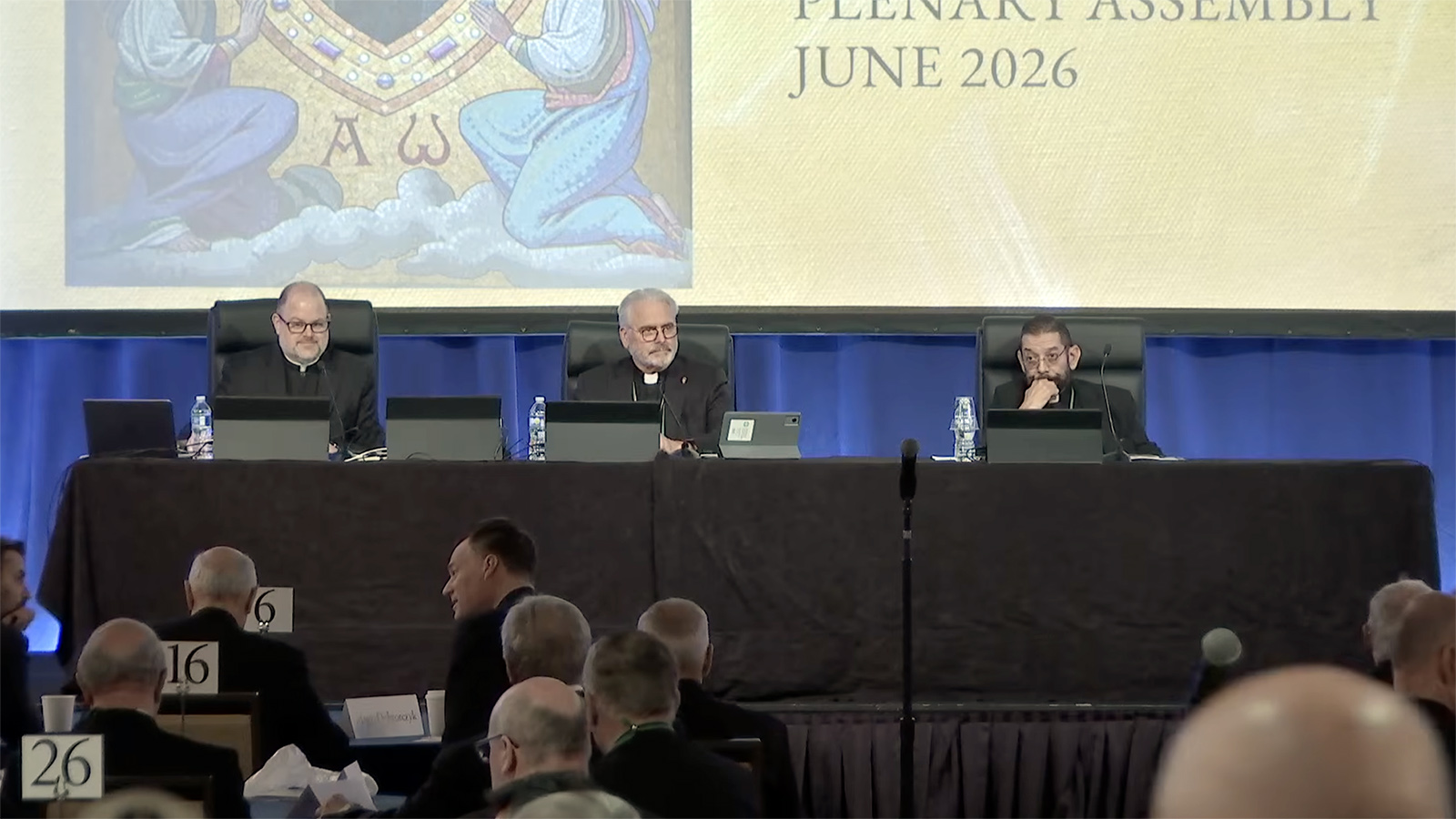
Archbishop Paul Coakley, center, president of the U.S. Conference of Catholic Bishops, presides over a USCCB meeting Wednesday, June 10, 2026, in Orlando, Fla. (Video screen grab)
“ We are working on ways to promote faithful citizenship through dialogue, a deeper realization of who is our neighbor by placing faith before politics, a faith that inspires hope, respect and the pursuit of the common good,” he said. “This is not always easy.”
Among the political goals Coakley named in his speech were reduced polarization, meaningful immigration reform and the defense of human dignity.
In the face of “threats to the unborn, to the elderly, to the sick, and to the suffering through the violence of wars and injustice,” Coakley urged his fellow bishops to preach that “ human life can never be adequately valued based on its being useful or useless” and that “life is a gift from God.”
“ Human dignity is also threatened by the scourge of racism, by abuse, by disdain and contempt, especially toward the poor, the stranger, the condemned and the outcast,” he said.
Coakley also emphasized the importance of the bishops’ November statement opposing indiscriminate mass deportations. “The concern — the grief over how people are being treated — expressed in our message remains as relevant now, six months later, as it did last November,” he said.
Before that statement, which involved a last-minute amendment to strengthen its language, was released, Leo had encouraged the U.S. bishops to speak more forcefully on immigration.
Coakley said that “we must never give up on those who are different or see things differently.” He called polarization “a scandal” and said it could be overcome through “ the cultivation of interpersonal relationships and conversations between those who may disagree.”
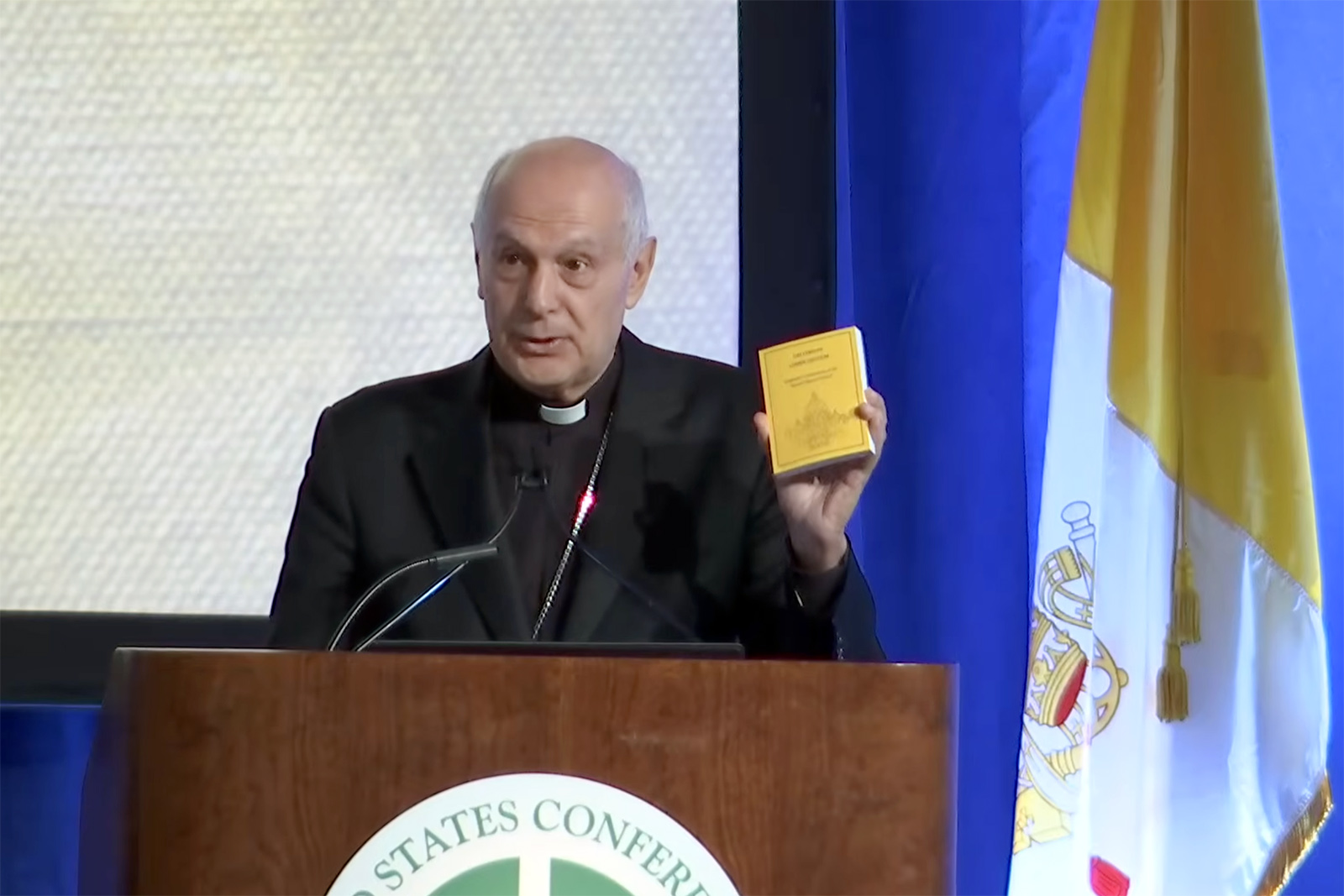
Archbishop Gabriele Giordano Caccia, the Vatican’s new diplomatic representative in the U.S., speaks to the U.S. Conference of Catholic Bishops, Wednesday, June 10, 2026, in Orlando, Fla. (Video screen grab)
The meeting’s public agenda includes discussion and voting on guidance related to sexual abuse, new lectionary and liturgy of the hours materials, votes on new sainthood causes and updates on synod implementation, the bishops’ political guidance, prison ministry, 2027’s World Youth Day in South Korea and the intercontinental Guadalupana novena, which kicks off preparations for the 500th anniversary celebration of Our Lady of Guadalupe’s apparition in 2031. Caccia, who previously served as the Holy See’s permanent observer to the United Nations in New York, adopted a warm tone in greeting the U.S. bishops as their new apostolic nuncio.
“ I feel that we belong to the same church, we are sharing the same spirit, and we are doing the same work,” he told them. Caccia also expressed a desire to listen and journey with the bishops. “ I know that the ministry of a bishop carries many responsibilities, some of which can feel isolating,” he said.
Caccia emphasized the importance of Leo’s election, saying, “ I see the election of Pope Leo as a gift of the Holy Spirit, especially to this church, encouraging your church in this country, on one hand, to foster what is best in her tradition, and on the other, to continue facing with determination those wounds in her recent history that have caused much suffering, especially through the cases of abuse.”
The conference plans to vote Thursday on revisions to its primary document providing guidance on preventing and addressing the sexual abuse of minors. A presentation on the revisions prompted pushback from Kansas City, Kansas, Archbishop Shawn McKnight, who urged the bishops to wait for broader consultation.
Both Caccia and Coakley also referenced the bishops’ plans to consecrate the United States to the Sacred Heart of Jesus on Thursday.
“ The Sacred Heart is not something separate from the church’s missionary task. From the heart of Christ, the church learns the truth of the human heart, its dignity, its wounds, its desire for God, and its need for communion,” Caccia said.
Coakley also affirmed the importance of evangelism and mission. He celebrated recent news of higher numbers of people entering the Catholic Church but also said “our hearts are saddened” by other Catholics walking away.
“ Our current mission directive to reach out to the disaffiliated and unaffiliated remains a major task helping to restore hope,” he said.