






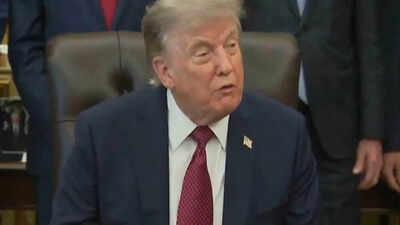
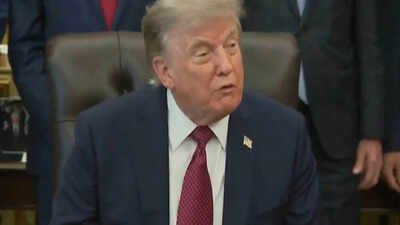
Trump slaps 10% tariff on India, no major impact seen | page 23New Delhi: The US Trade Representative has announced 10% additional tariffs on India and several other countries for allowing import of goods using forced labour.The “permanent” levy after a Section 301 probe, which was on expected lines, will replace the “temporary” 10% import duty from Friday and is unlikely to have a big impact.Although lower than the proposed 12.5% for India, exports from the country face additional threat due to a second probe against over a dozen nations for structural overcapacity. tnnIndian oil basket up 11% in a day to $103 a barrel | page 20New Delhi: Indian basket of crude oil jumped 11% in a day to $103.33 per barrel Thursday, the highest in two months, amid disruptions caused by the closure of Strait of Hormuz and Houthi militia targeting shipping vessels in the Red Sea.Global benchmark Brent crude, which crossed the $100-per-barrel mark on Thursday, eased marginally to $97.08 (at 8.30 pm) Friday.International FOB (free-on-board) prices of petrol and diesel have also surged, raising the possibility of under-recoveries for oil marketing companies if retail pump prices remain unchanged.India’s retail petrol and diesel prices are linked to international product prices because it imports nearly 90% of its crude oil requirement. International FOB prices are generally higher than crude prices as they include refining costs, freight and marketing margins.While the international FOB price of diesel has averaged $129.8 a barrel in July, up $120 June, the corresponding price for petrol has averaged $103.3 this month, though it remains lower than $107.8 in June.Oil marketing companies were making an under-recovery over Rs 1,000 crore a day in May, when the Indian basket of crude oil – a weighted average price representing the actual mix of crude imported by India – averaged more than $110 per barrel.Govt subsequently increased petrol and diesel prices by nearly Rs 7.5 per litre over a few days in May, which partly reduced the under-recoveries.Separately, citing a notice posted on the US treasury department’s website Friday, Reuters reported that the US will allow certain transactions involving Lukoil International GmbH to continue till Aug 22.India had questioned the probe, arguing that a unilateral move was unjustified and India had regulations to check the use of forced labour. But even as the probe was underway, the Directorate General of Foreign Trade revised rules adopting the ILO definition and providing for probe under the Foreign Trade Policy, which USTR has factored in while deciding the tariff.As a result, India, along with Bangladesh, Pakistan, Sri Lanka, the UK, Cambodia, Canada, Indonesia, Malaysia and Mexico are among 17 countries that will face 10% levy, with around 40 at 12.5%. The American agency said the EU, Taiwan, Japan, South Korea and Switzerland will be subject to tariffs of 10% or 12.5%, after adjusting for the MFN rateThere are certain product-specific exemptions, it added. “About 70% of India’s exports to the US will now pay MFN tariffs plus a 10% Section 301 duty, while Section 232 products (auto parts, some metal products) continue to face 25%-50% tariffs,” trade research body GTRI said. Govt has so far not commented on the decision, but officials were expecting the outcome.“The 10% US tariff on Indian exports under the forced-labour investigation lacks a credible factual basis. The US has not produced evidence that India imports goods made with forced labour. In response to US concerns, India has already amended its Foreign Trade Policy to ban the import of goods produced using forced or compulsory labour,” said GTRI founder Ajay Srivastava in a note.“Indian law also prohibits forced labour in domestic production through constitutional guarantees and labour statutes. The tariff therefore appears to serve primarily as a mechanism to preserve the Trump administration’s tariff wall after the expiry of the temporary Section 122 tariffs, rather than as a targeted response to a proven forced-labour problem involving India,” Srivastava said.They are now keeping close tabs on the second investigation focused on structural excess capacity in 16 countries, including India. Analysts and govt officials believe that this will be the starting point of negotiations for a trade agreement with countries to decide on new “reciprocal tariffs” after the previous one imposed by American president Donald Trump was trashed by the US Supreme Court in Feb. At that time, India and the US had settled for 18% additional levy on most Indian exports. While the framework is ready, the agreement can only be finalised once the Trump administration comes up with the revised tariff.“For India, the measure presents both opportunities and challenges. While India remains subject to an additional 10% Section 301 tariff, it is in a relatively more favourable position than several competing Asian manufacturing hubs,” said Manoj Mishra, partner at consulting firm Grant Thornton Bharat.