











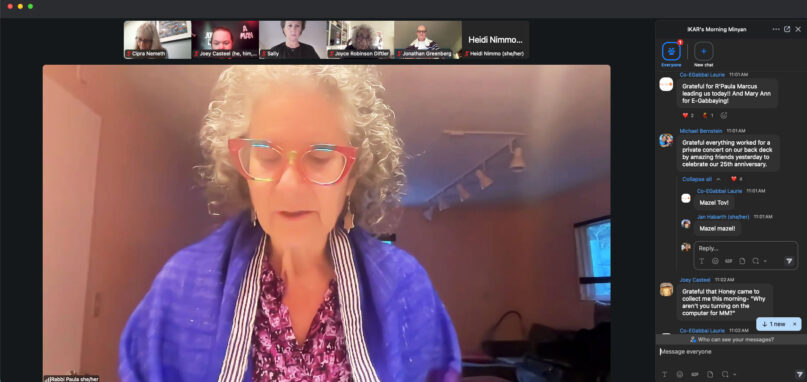
(RNS) — The 8 a.m. service starts with a litany of gratitude, which unfurls in the chat function of the online Zoom:
“Grateful to be awake.”
“Grateful for the last day of school.”
“Grateful for this morning to pray.”
“Grateful for morning minyan.”
On the main screen, the prayer leader, typically a rabbi, begins to chant blessings and psalms from the Jewish morning service. In the gallery, participants sit in front of their laptops, some with prayer shawls draped over their shoulders, others with the video turned off and only a profile picture or a name.
So begins the 30-minute morning service offered through the Los Angeles-based IKAR Synagogue six days a week. For many Jews, in L.A. and beyond, it has become their primary form of community and prayer — as necessary as a morning cup of coffee.
The service offers Jews with varying degrees of observance an opportunity to say the central prayer of Jewish life — the Shema — and for some to recite the kaddish, or mourner’s prayer, which Jews are required to say daily for 11 months after the death of a family member.
Initially a stopgap measure during the first days of the COVID-19 pandemic, the virtual service has turned into a daily source of spiritual sustenance. Many of its most devoted participants have formed not only commitments to their faith but also enduring friendships and ongoing support for their fellow service members.
They describe the experience in spiritual terms.
“There’s a Lou Reed song called ‘Satellite of Love,’ and that’s how I picture it,” said Leah Matsui, 70, who logs on every day from Kumamoto, Japan, alongside her husband. “Here’s the globe, and here’s us. And when we say the Shema, that goes up to the satellite of love, which transmits the sound to L.A. Just at that moment, it might be as close as I get to Hashem (God) in the day.”
In Jewish law, some prayers can only be said communally, in a quorum of 10 Jewish adults, called a minyan. When the COVID lockdown began in March 2020, that posed an immediate problem.
On March 17, 2020, an assistant rabbi at IKAR inaugurated the first morning minyan service on Zoom.
“We were all kind of new to Zoom, and the rabbi started by saying to each person by name, “I see you. Good morning. Good to see you,” said Jody Kussin, 66, a clinical psychologist who became ordained as a rabbi after attending the morning service. “I immediately teared up. It was so nice to be seen.”
That feeling of being seen online was critical. People were isolating and lonely. Some were in mourning and in need of saying the kaddish prayer communally.
From the get-go, the service had no problem attracting a quorum, and soon it grew. On the morning of Oct. 9, 2023, two days after the Hamas attack on Israel, the morning minyan drew 110 people. These days, it draws an average of 40 to 60 people six days a week.
The structure of the service evolved over time. It now features a playlist of uplifting folk and pop songs in English and Hebrew welcoming people in, followed by a few minutes of shared gratitude on the chat. A set of rabbis, a cantor or a lay leader welcomes everyone and then begins chanting the morning prayers from an online prayer book, or siddur, posted via a link in the chat. The service leader typically sets aside a few minutes for a very short talk and announcements.
The highlight for many participants is the kaddish prayer. While participants are muted for most of the service, those mourning the death of a loved one are allowed to unmute for the kaddish prayer and then take turns saying a sentence or two about who they are mourning.
Although only about a third of participants are grieving the loss of a loved one, publicly supporting mourners is an important part of the service.
“We’ve been with people in the most horribly tragic times, including parents who’ve lost children to suicide and addiction,” said Laurie Hall, a Zoom host or gabbai (service facilitator). “It’s really become this incredibly profound sacred space.”
Recently, participants extended a litany of get well wishes for 82-year-old Dick Greenblatt of Toledo, Ohio, a regular, was admitted to the hospital. His name appeared dozens of times in the online chat as part of the “Mi Shebeirach” prayer.

Los Angeles based IKAR synagogue hosts a daily morning minyan, occasionally led Rabbi Paula Marcus, a volunteer service leader. Video screengrab
Minyan participants don’t need much encouragement to Zoom one-on-one with people who are struggling or grieving or just want to talk.
Deep friendships have formed among people who rarely see one another in person.
Hall, the morning minyan Zoom host, lives in San Diego but has become fast friends with Kussin, who lives in the San Fernando Valley, about a two-hour drive away.
“We’ve maybe seen each other a couple of times each year since 2020, but we talk on the phone all the time,” said Hall.
Each morning service concludes with a brief blessing from Barbara Zacky, an ordained rabbi and a a member of the congregation who improvises a one or two sentence sendoff. It typically concludes with, “Don’t forget to hydrate!”
The purpose of the blessing, Zacky said, is “to send people off on their day with a sense that the service is not just cut off. It’s continuing to breathe.”
For Matsui, who participates daily from Japan — even as it means waking up for the service in the wee hours of the morning — it’s the connection with others that makes it worthwhile.
“I would love to just be alone with the prayer book, but to be a Jew means you have to be in community,” said Matsui.
Matsui said she appreciates how the service forces people to put aside their frustrations for 30 minutes and focus on gratitude and caring for others.
“You get to see everybody rowing the boat, everybody wanting to say, ‘I’m so grateful the plumber came.’ Things could be in total collapse, but at least there’s one thing you could put in the chat.”