






(RNS) — Since the war with Iran began, President Donald Trump has directed threats and insults at Iran and its leaders. He warned that he would destroy Iranian civilization and infrastructure and would blockade its ports. He called Iranian leaders “crazy bastards,” “sick people” and “lunatics” on Truth Social. While some of his ultimatums are particularly severe, this rhetoric is familiar.
What is striking to me is the fact that he and other Republican leaders seem to be angered by the fact that Iran — a sovereign country that, according to some legal scholars, was attacked in violation of the U.S. Constitution and the U.N. charter — has retaliated.
While the narrative about the reasons for this war has been inconsistent, one of the justifications for the U.S.-Israeli attack is that it was a preemptive strike to prevent Iran from developing nuclear weapons, following repeated allegations that Iran was rebuilding its nuclear program.
This current moment is unsettlingly evocative of the 2003 Iraq war, which was preceded by the Bush administration’s unproven claims about weapons of mass destruction allegedly stockpiled by Saddam Hussein. A similar sense of urgency leaves little space for doubt today, while allegations about producing nuclear weapons help build the case for war.
Let us not forget that the United States and Israel do possess nuclear weapons; the United States is the only country to ever have used nuclear weapons in war.
Both American and Israeli claims that they are protecting global peace and security are not self-evident.

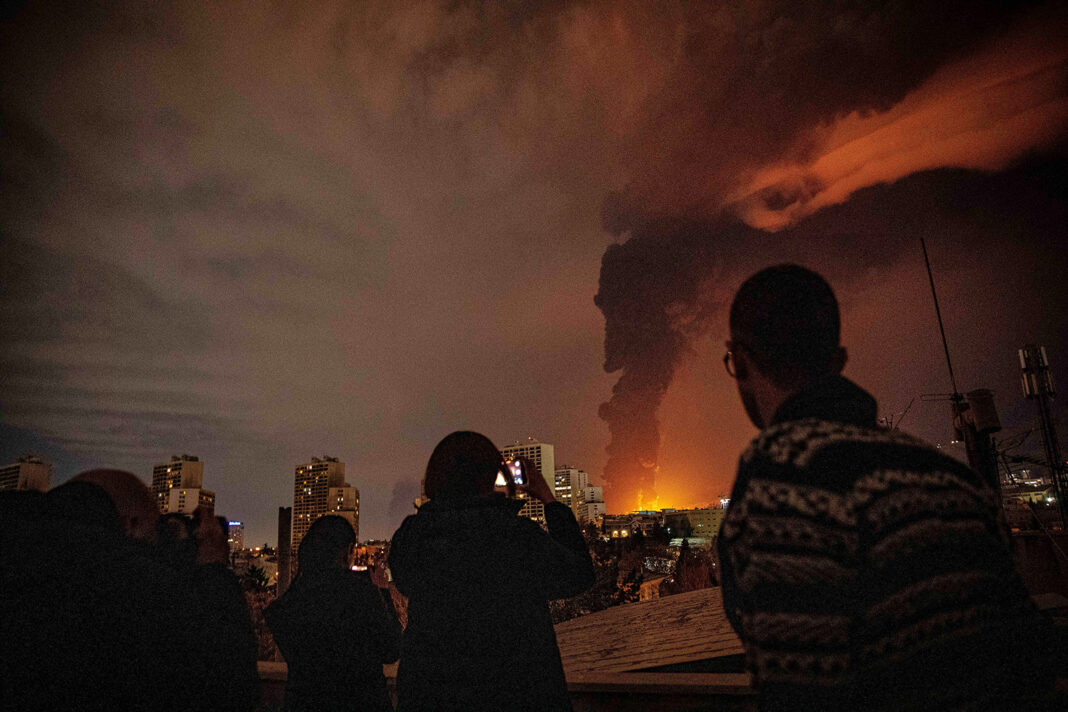
Residents look on and take pictures as flames and smoke rise from an oil storage facility struck as attacks hit the city during the U.S.-Israeli military campaign in Tehran, Iran, March 7, 2026. (Alireza Sotakbar/ISNA via AP)
Alongside threats and insults, the dominant political rhetoric about the war with Iran has adopted Christian imagery. This is a trick from a very old playbook. Christian moral authority has been used to encourage and justify attacks on Muslim lands in the past. It’s disappointing to see how many Christians in the United States still interpret Christian Scripture in a way that gives grounds for attacking other countries and faiths.
Pete Hegseth, the secretary of defense, recently posted that, “crazy regimes, like Iran, hell-bent on prophetic Islamist delusions, cannot have nuclear weapons; it’s common sense” and said that “Islam is not a religion of peace.” Discussions of radicalization and violence without a consideration of structural factors like war, military occupation, economic sanctions and histories of colonial intervention obscure more than they reveal.
This war is just one example of the moral asymmetry of how violence is interpreted. While Western violence against Muslims is often presented as “preemptive wars” — ones ostensibly conducted in the name of global peace and security, thus morally defensible — Muslim violence against the West is portrayed as inherently barbaric and irrational — never defensible. According to this logic, Iran’s response to the U.S. and Israeli attack, described by Iran as justified under Article 51 of the U.N. Charter (which recognizes an inherent right to self-defense if an armed attack occurs against a state), is inevitably interpreted as “escalation.”
Based on this asymmetry, Iran is not granted the moral right to self-defense.
Given the number of casualties and the degree of destruction wreaked on its infrastructure, Iran’s response to the attack has been relatively restrained. It has avoided full-scale war and sent negotiators to talks even as the conflict continued. The blockade of the Strait of Hormuz and Iran’s drone attacks against Israel and U.S. military assets seem to be calibrated pressure.
Throughout the dispute over the nuclear weapons, Iran’s actions and statements in key moments have been diplomatic and collaborative. In fact, since 2018, it is the U.S. whose actions have been belligerent and framed by communications that often include invectives and sweeping threats.
If we are to worry about who threatens the world, the answer cannot ignore the only country that has ever used nuclear weapons in war and, nonetheless, still claims the authority to decide who else may possess them.
(The Rev. Anna Piela is co-founder of Challenging Islamophobia Together Chicagoland and co-associate regional minister of American Baptist Churches Metro Chicago Region. The views expressed in this commentary do not necessarily reflect those of Religion News Service.)