





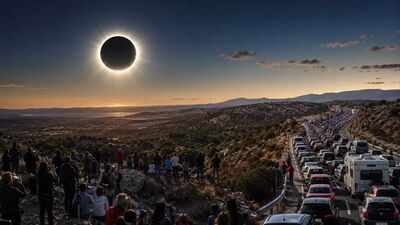
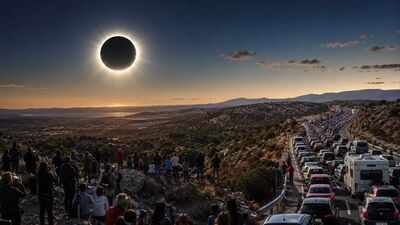
Thousands of people are expected to travel to Spain on 12 August 2026 for one of Europe’s most significant astronomical events in decades. The total solar eclipse will draw amateur astronomers, photographers and tourists from around the world, with many planning their trips years in advance. Yet reaching the path of totality alone may not guarantee the experience they expect. According to Streamline, the eclipse’s unusual timing close to sunset creates a challenge that many visitors may underestimate. As the Sun sits exceptionally low above the horizon, even relatively small obstacles could block the view of totality entirely, making careful site selection just as important as travelling to the right region.
Why Spain’s 12 August 2026 total solar eclipse will be different from most total eclipses
Total solar eclipses often occur with the Sun positioned high enough in the sky to provide a wide choice of viewing locations. Spain’s 2026 event is different because the Moon’s shadow will cross the country late in the day, leaving the Sun close to the western horizon during totality.According to Streamline, the path of totality stretches across northern Spain and the Balearic Islands after beginning in northern Siberia and passing over Greenland and Iceland. As the eclipse progresses across Spain, the Sun gradually sinks lower, leaving observers with increasingly limited viewing angles. In western parts of the country, the eclipsed Sun remains slightly higher, but farther east it approaches the horizon, making clear sightlines essential.
Why being in Spain’s path of totality doesn’t guarantee a clear eclipse view
Being within the eclipse path does not automatically provide an unobstructed view. The position of the surrounding landscape becomes a decisive factor when the Sun is only a few degrees above the horizon.Reportedly, trees, low hills, nearby buildings and other features that would normally have little impact on eclipse viewing could completely block the Sun during totality. This is particularly important in eastern Spain, where the eclipse reaches its final stages just before sunset. A viewing site that appears suitable during the day may prove disappointing once the Sun drops lower.The report suggests that visitors should consider elevation and an open north-western horizon rather than simply choosing a destination inside the path of totality.Balearic Islands face the toughest viewing conditions for Spain’s 2026 total solar eclipseThe Balearic Islands are expected to attract large numbers of eclipse visitors, but they also present some of the most demanding viewing conditions. Totality will occur only moments before the Sun disappears below the horizon, leaving almost no margin for error.As per the Streamline, authorities have introduced an Eclipse Horizon 2026 digital tool to help visitors assess local sightlines using topographical information. Some travellers are also opting for boat-based viewing locations in the Mediterranean to eliminate the risk of land-based obstructions.Weather remains another variable. Even if skies are generally clear, haze near the sea or a narrow layer of cloud close to the horizon could interfere with visibility during the brief period of totality.
Spain’s total solar eclipse in 2026 begins a rare three-year eclipse series
The August 2026 eclipse marks the beginning of an unusually active period for astronomical events in Spain.The country will experience another total solar eclipse on 2 August 2027 before hosting an annular solar eclipse in January 2028.This sequence has increased international interest in Spain as a destination for eclipse tourism while also generating strong demand for accommodation and local services in regions along the eclipse path. Rural communities expected to host large numbers of visitors have been preparing for the influx, with tourism linked to astronomy continuing to grow as a specialised travel sector.