(RNS) — Southern Baptists adopted a resolution on immigration at their annual meeting, affirming “love of neighbor” but also legal immigration enforcement.
The resolution, one of 11 nonbinding statements adopted that gave a sense of viewpoints of those gathered at the Southern Baptist Convention’s meeting in Orlando, Florida, was adopted after the denomination’s public policy arm broke ties with an evangelical immigration advocacy group last September.
“We reject amnesty, understood as forgiveness of legal violations without accountability,” read the denomination’s Wednesday (June 10) statement, which also disavowed “all ideologies or rhetoric that deny the equal worth and dignity of any people group regardless of immigration status.” It also affirmed “that Christian compassion and hospitality do not negate lawful order or excuse indifference to public justice and social peace.”
Before a vote, the statement prompted questions on the floor of the Orange County Convention Center, including from Kyle Stachewicz, lead pastor of a Reedsburg, Wisconsin, church. He said some of its language would convey to young adults carried across the border at a young age and later baptized in a Southern Baptist church “that we see no distinction between them and someone who willfully broke the law as an adult.”
He added: “I fear that not recognizing this will close doors to gospel ministry in immigrant communities at the exact moment that we are asking Southern Baptist churches to strengthen such ministry as this resolution calls us to do.”
In a departure from past resolutions dating back to 2006, the new statement, which was presented by the SBC resolutions committee, does not mention a path to legal status for immigrants.
By Mary Gladstone · June 10, 2026

RELATED: Willy Rice, Florida pastor and abuse crisis skeptic, elected SBC president
“One of the tremendous problems is that the system’s been overwhelmed by just the sheer number of people who have come over,” Hunter Baker, chair of the committee, said at a news conference after the resolutions were considered. “You don’t have an adequate judicial apparatus or regulatory apparatus to give everybody due process.”
As a result, he said, immigrants are left not knowing where they stand.
The slate of resolutions, most of which were adopted on Wednesday, the second day of the two-day meeting, included one that adds to their yearslong discussion of women pastors.
Earlier in the day, messengers, or church delegates to the conference, adopted a measure called the Truth and Unity Amendment in a first step to have the SBC constitution bar churches that have women pastors or permit women to preach on Sunday mornings. The amendment was proposed by Al Mohler, president of the flagship Southern Baptist Theological Seminary in Louisville, Kentucky.
The related resolution, titled “On the Office and Function of Pastor/Elder/Overseer,” states that the Southern Baptist messengers “reaffirm that the office of pastor/elder/overseer is limited to men as qualified by Scripture” and “affirm that the New Testament presents the pastoral office and the function of pastoral oversight of the church as inseparably connected.”
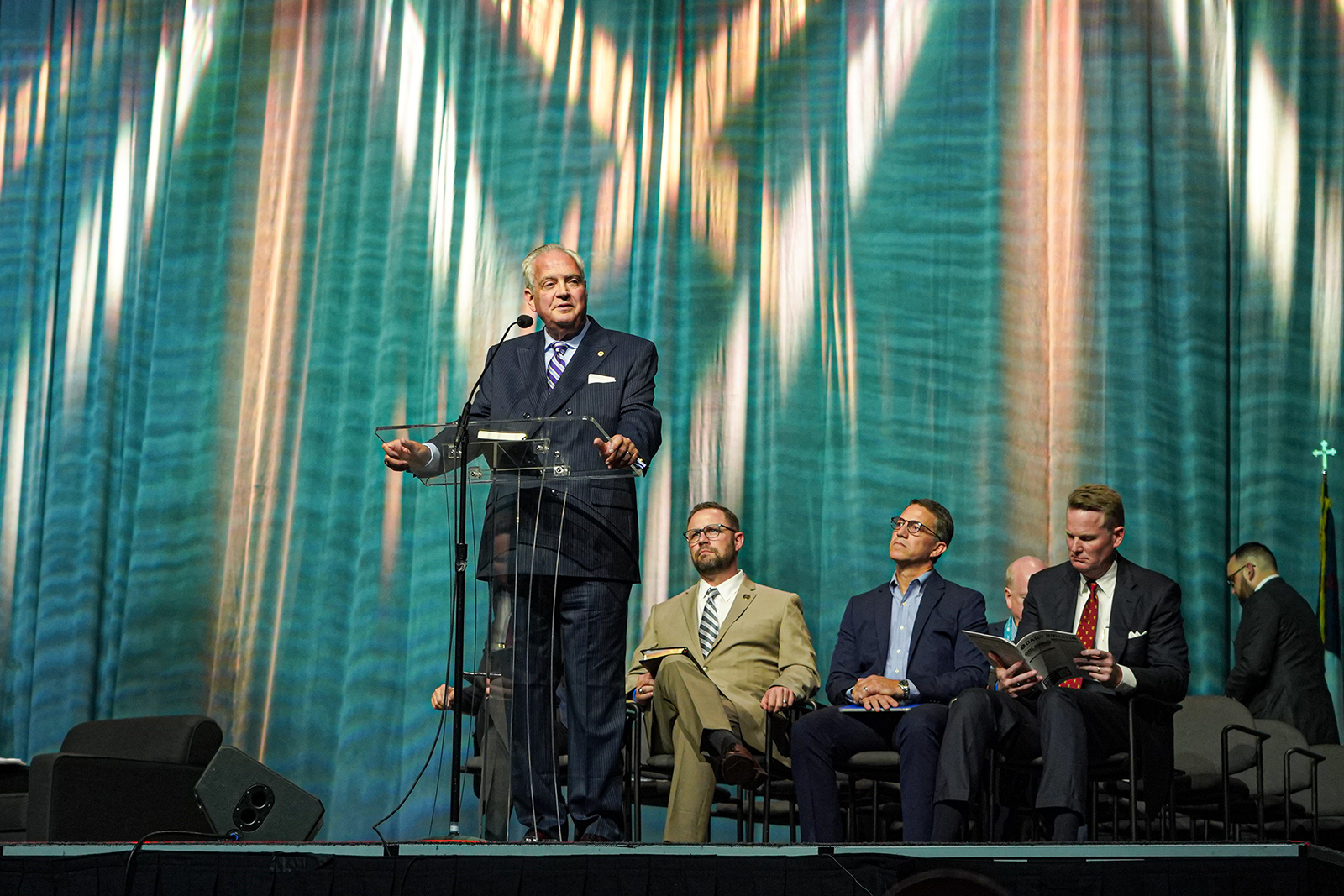
Al Mohler addresses the Southern Baptist Convention annual meeting, Tuesday, June 9, 2026, in Orlando, Fla. (RNS photo/Marty Jean-Louis)
Citing confusion in some SBC congregations, it urged churches to not use the titles “pastor,” “overseer” and “elder” for nonpastoral offices and to “continue affirming and deploying women in biblically faithful ways.” The statement expressed gratitude for the “indispensable service” of women across Southern Baptist life, such as in missions work and evangelism.
The Baptists also condemned political violence, citing recent “assassinations and attempted assassinations of public figures, the harassment and even murder of fellow citizens in houses of worship, vandalism of crisis pregnancy centers, and public mayhem that sows chaos and destruction.”
William Wolfe, a messenger from a Fort Mill, South Carolina, church and executive director of the Center for Baptist Leadership, unsuccessfully sought to add wording to the resolution about Charlie Kirk, the evangelical Christian activist and co-founder of Turning Point USA who was assassinated last September.
“In 2018, the SBC passed a resolution specifically mentioning the assassination of MLK Jr., and if we can name MLK Jr., we can name Charlie Kirk,” said Wolfe, a former Trump administration official, in a reference to the Rev. Martin Luther King Jr.
But the resolutions committee opposed Wolfe’s proposed amendment. During a press conference, committee member Ryan Helfenbein, who said he was a close friend of Kirk’s, said that the whole committee felt the loss of Kirk but wanted to address the bigger issue of political violence.
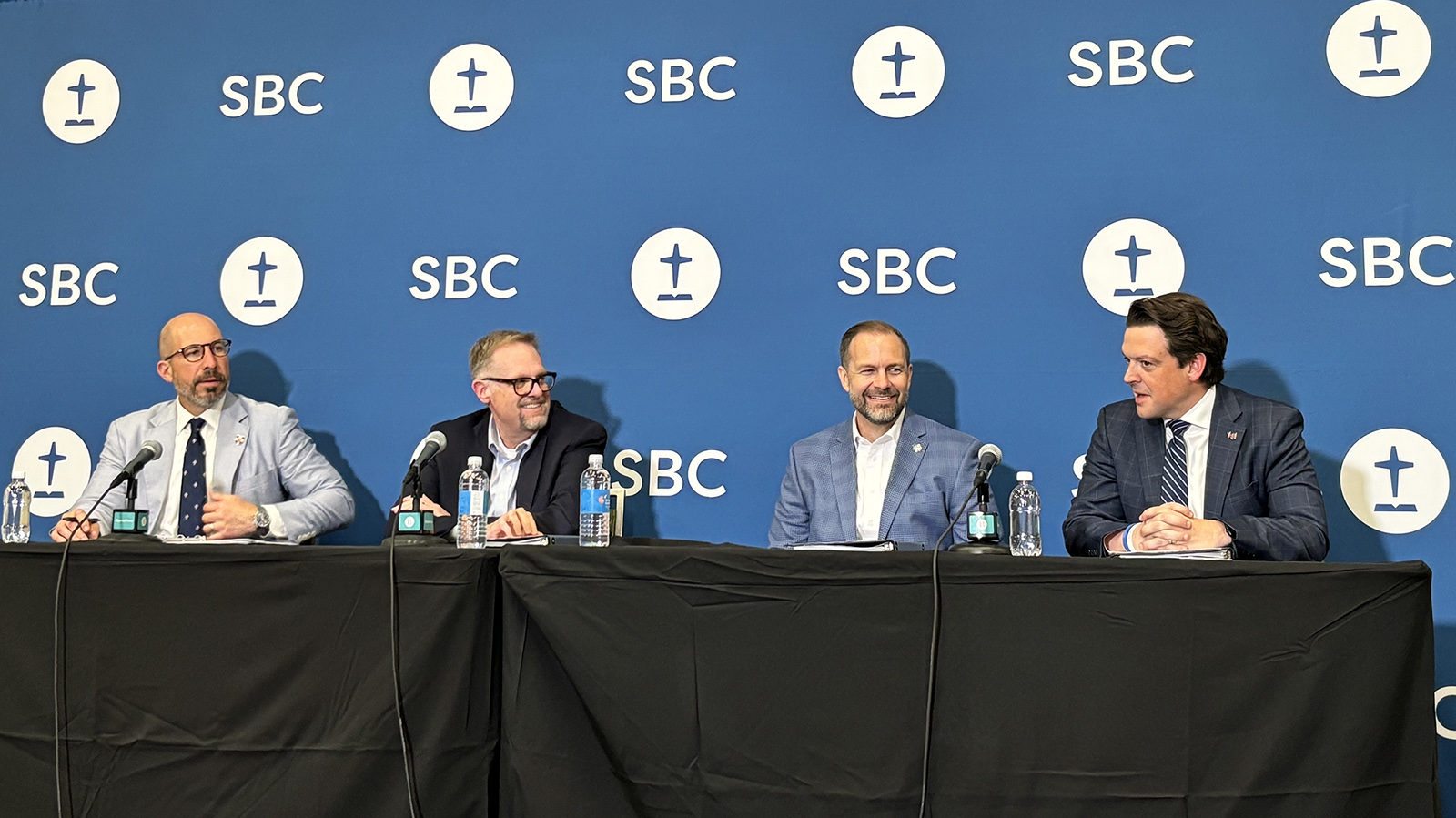
Members of the 2026 SBC Committee on Resolutions, including Jeremy Pierre, from left, Hunter Baker, Evan Lenow and Ryan Helfenbein, hold a press conference June 10, 2026, in Orlando, Fla. (RNS photo/Bob Smietana)
Baker echoed that sentiment, citing the assassination attempts that targeted President Donald Trump as well as the fatal ambush last year of Melissa Hortman, a Democratic state representative in Minnesota, along with the death of Kirk. “We wanted to capture the broader phenomenon,” he said.
The resolution called on Southern Baptists to analyze their public speech and online content, treat others as neighbors rather than enemies and reject the idea that their foremost identity is their political affiliation rather than their Christian commitment.
“We reject any claim that righteous ends justify unrighteous means,” it stated.
In a separate resolution, Southern Baptists reiterated that they “unequivocally condemn this new surge of antisemitism in all its forms, including violence, cultural hatred, and conspiracy theories of Jewish controlled cabals, as sinful, unchristian, and an assault on both biblical truth and basic human dignity.”
Pastor Stephen Feinstein of a Southern Baptist church in Hesperia, California, urged passage of the resolution on antisemitism.
“If you do not believe that antisemitism is rising in our society, you aren’t paying attention,” said Feinstein, whose church website describes him as a Christian convert who is the son of a Jewish father and a Roman Catholic mother. “My youngest daughter asked me if we could change her last name. My name is Feinstein. You shouldn’t have to have your daughter ask that kind of question.”
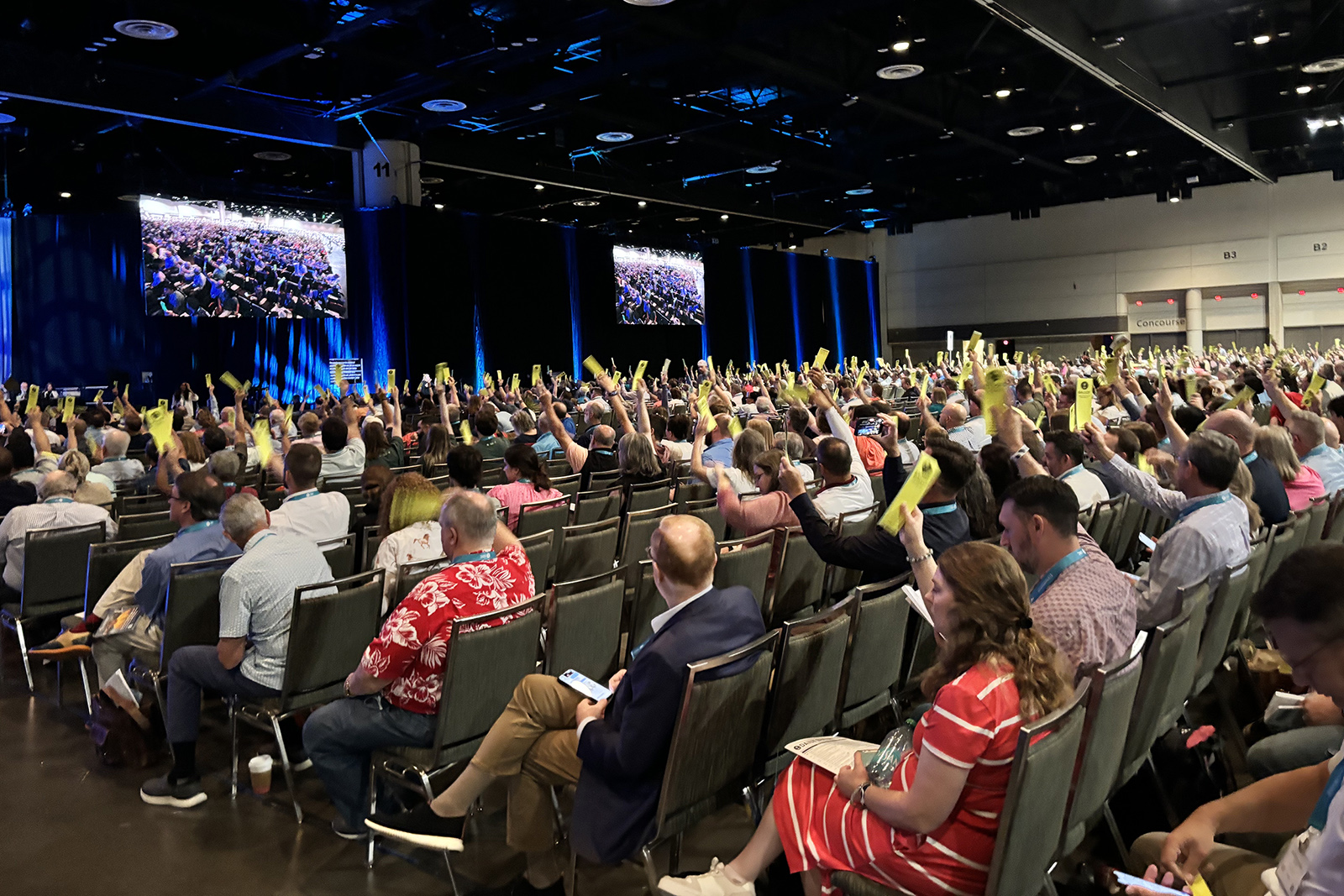
Messengers vote during the Southern Baptist Convention annual meeting, Wednesday, June 10, 2026, at the Orange County Convention Center in Orlando, Fla. (RNS photo/Bob Smietana)
Another resolution said that using digital technology for worship should not take the place of in-person services for all who are able. The statement, titled “On the Nature and Importance of the Physically Gathered Church in a Digital Age,” also affirmed in-person baptism and Communion rather than “virtual or digitally mediated substitutes.”
On Tuesday, the Southern Baptists approved a resolution about the 250th anniversary of the country and religious liberty, acknowledging “sins such as slavery, racism, abortion, injustice, and sexual immorality” in the country’s history. It noted that despite failings the country had ended slavery within its borders and defended freedom from threats of communism abroad.
They added: “we call upon Southern Baptists to pursue national renewal through biblically informed civic engagement, including advocating for just laws that are rooted in God’s natural law and consistent with the witness of holy Scripture, and electing public officials who will do the same.”
Another adopted resolution expressed appreciation for bivocational and volunteer pastors who work in other jobs while serving local congregations. Yet another encouraged all Southern Baptist congregations to expand their inclusion of children and adults with disabilities, including identifying barriers to physical access to enable families to participate in church.
One measure reaffirmed their opposition to assisted suicide, as more states have legalized the practice, and urged policymakers and medical practitioners to prioritize care such as hospice, palliative support and effective pain management.
And a resolution, passed in light of attention given to pastors and other ministry leaders embroiled in scandal, expressed gratitude for those who “labored faithfully over many years and finished well, keeping the faith and maintaining a testimony above reproach to the end.”
RNS national reporter Bob Smietana contributed to this report.
RELATED: Meet the pastors who support the ICE raids