






(RNS) — Brazil’s loss to Norway on July 5 eliminated the team that has won more FIFA World Cups than any other nation — five — and is the only one to have played in every edition of the tournament. But they haven’t tasted victory in more than 20 years.
The glorious days of Pelé earned him the admiration of fans far beyond Brazil. He led the team to FIFA World Cup victory three times between 1958 and 1970 and helped give the national team — the Seleção — a passionate global following that reached well past Latin America.
The players Ronaldo, Ronaldinho and Rivaldo, who lifted the trophy in 2002, charmed fans of the world’s most popular sport with their dribbling and “jogo bonito” (beautiful game).
The newer generations of the national team have spent years being measured against those memories. But after this early exit in the round of 16, fans and commentators online have circulated a theory. The team’s change in playing style, they argue, mirrors the religious transformation that’s been under way in Brazil for decades: The more evangelical the country has become, the worse their national team has performed.
Or, as one widely shared post put it, Brazil is suffering a “historic loss of aura.” Another popular line in the debate simply says: “If we pray like a gringo, then we play like a gringo.”
These fans link Catholicism, once the country’s overwhelming majority faith, to improvisation, the samba and the dribbling of past generations. Popular Catholicism in Brazil is often understood as more communal and festive, making fewer severe demands of religious commitment on its adherents, while evangelicalism in Brazil is more often associated with prohibitions and austerity. The fans supporting the theory associate evangelical growth in the country — and in the faith most current players themselves profess — to a more structured, austere, rigid way of playing.
The census numbers behind the internet theory are real. Brazil’s transition away from a Catholic majority has been one of the defining religious stories of Latin America over the past 40 years. Evangelical Christians, who made up roughly 9% of Brazilians in 1991, reached 27% by 2022, while Catholics fell from 83% to 57% over the same period.
Of the eight nations that have won the World Cup, six (Brazil, Italy, Argentina, Uruguay, Spain and France) are majority Catholic. The other victors, England and Germany, also have a fair share of Catholics.
More than three-fourths of Brazil’s current team are evangelical Christians.
“But transposing that onto the players’ behavior and performance is a stretch,” said Pedro Feitoza, a historian of religion in Latin America and assistant professor at the University of Edinburgh. He attributes the theory mostly to nostalgia for the past, when Brazilian Catholics made up a strong majority.
The reasons for the shift are many, Feitoza told RNS, including the legal ease of opening a new church in Brazil. In many evangelical denominations, leaders rarely go through seminary training. And the movement’s responsiveness to pressures faced by lower-income Brazilians offers a sense of belonging and community along with the promise of upward mobility. There is also a tradition of individual evangelism, in which congregants are encouraged to convert friends, neighbors and relatives.
Still, close observers agree that Brazil’s national team has changed the way it plays.
“The traditional Brazilian style was boldness, dribbling, individual plays, less concern with tactics, offensive play,” Júlio Nascimento, a Brazilian sports journalist, told RNS. But he attributed the change to the way Brazilian players now leave for Europe very young and develop within a European style of play. They become pragmatic and tactically obedient, he said, with individual talent subsumed by the system.
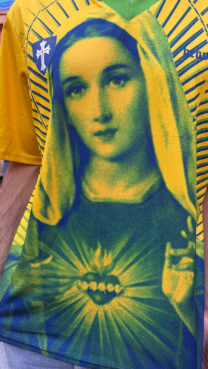
An image of the Virgin Mary on a Brazil jersey during a Brazil-Scotland watch party in a public square on June 24, 2026, in New Haven, Connecticut. ( Helen Teixeira/RNS Photo)
Pedro Alamino, a Brazilian sports content creator who covers soccer, largely agreed. Soccer as a whole has changed, he said: Where dribbling and individual genius used to carry more weight, physical conditioning now counts for more. The national team’s identity is now shaped by Europe, the biggest market in this sport. For him, the game has lost some of the greater emphasis on a “winning spirit” and fighting mentality that it had in the past.
If there’s one change that reshaped players’ conduct off the field more than any other factor, both commentators agreed, it’s the rise of social media, and with it, players exposing far more of their personal lives than earlier generations did. But when asked whether this shift in off-field conduct could be attributed to religion, both were skeptical.
Evangelical players have long been part of Brazil’s winning teams. Seven players on Brazil’s 1994 World Cup-winning squad — including goalkeeper Cláudio Taffarel and defender Jorginho — were evangelical Christians, and several of them famously formed a prayer circle at midfield after the deciding penalty kick against Italy in the final. FIFA has since restricted political, religious or personal statements on national team uniforms, but such expressions of faith persist online, including among current players. Kaká, who won the Ballon d’Or (award for best player in the world) in 2007, was one of the most visible evangelical stars in Brazilian soccer.
And while the number of evangelicals on the team did rise around the same time Brazil’s results dropped off, Nascimento called that a coincidence. “To try to explain why the national team isn’t winning, people look for explanations,” he said.
The pace of evangelical growth has slowed in recent years. “As generations pass, believers develop different ways of relating to Brazilian culture,” Feitoza said, noting that evangelical symbols — worship music, for instance — are now part of mainstream Brazilian pop culture, and the friction between evangelicals and the Catholic majority has softened over time. “Being evangelical today, in 2026, is certainly different from what it was to be evangelical in 2000, or in the late 1990s,” he said.
Feitoza also cautioned against treating the two traditions as more distinct than they are in practice. Many symbols and practices attributed to evangelicalism are also absorbed and practiced within Brazilian Catholicism. Even the contrast between the festive spirit of popular Catholicism and the austerity and rigidity of evangelicalism has grown less visible in practice. “In Brazil’s complex religious reality,” he said, “in the end, both are drinking from a shared religious culture.”
Soccer, and especially the World Cup, has always done double duty, carrying national identity and cultural narratives along with the game. In a country where the national team’s reputation functions as a form of soft power and a pillar of national identity in ways few other countries share, 24 years without a title, with no clear turnaround in sight, is a hard “jejum” (fast) to sit through.
Even if the theory fails as an explanation for what happened on the field, its popularity may say something true about a deeper need many Brazilians feel to explain a loss that goes beyond soccer itself — the loss of such a strong Catholic majority in Brazil. The new Brazil is still working out what to make of its own faith, let alone its soccer.