



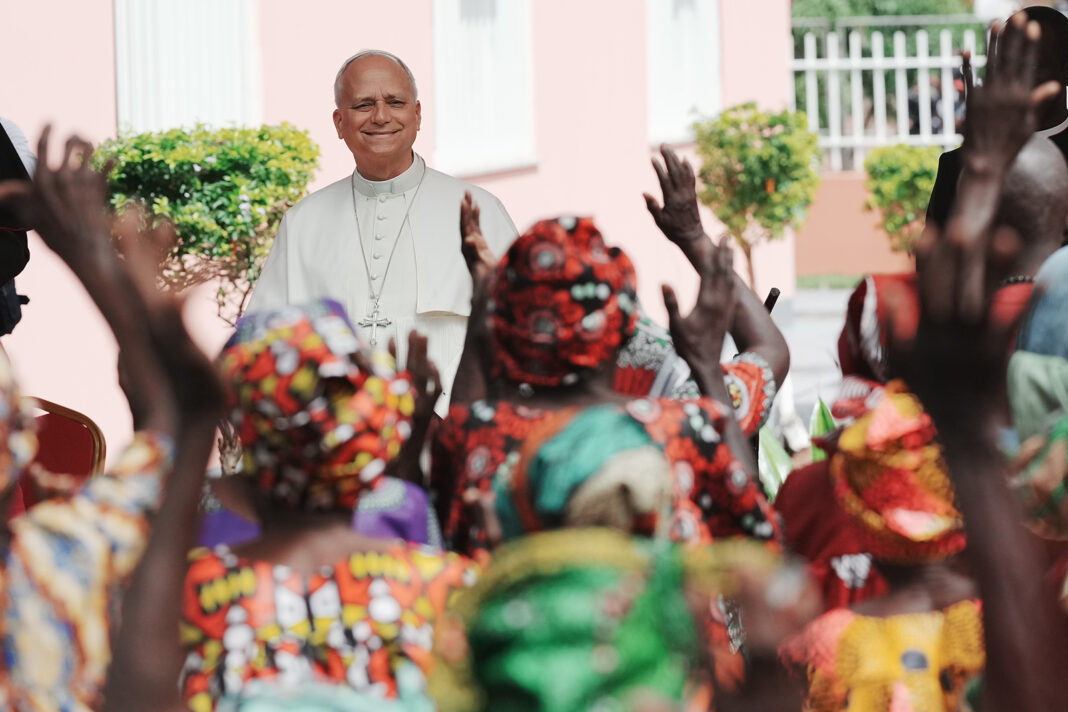
MALABO, Equatorial Guinea (RNS) — Pope Leo XIV departed Equatorial Guinea on Thursday afternoon (April 23), concluding an 11-day tour of four African nations that blended pastoral connection with pointed calls for justice, leaving behind both renewed hope and questions about what comes next.
Hours after presiding over his final Mass in Malabo, the pope boarded his return flight to Rome, ending a journey that took him through Algeria, Cameroon, Angola and Equatorial Guinea. Across the continent, religious leaders told Religion News Service that his message of peace, accountability and human dignity resonated with faithful, particularly among communities facing conflict, poverty and political uncertainty.
The visit, in which Leo emphasized reconciliation, social justice and the ethical use of resources, is already being described by clergy and lay leaders as a defining moment that reaffirmed Africa’s importance within the global Catholic Church, while also challenging leaders to confront long-standing structural problems.
In Cameroon’s Anglophone region, where years of conflict have displaced thousands and disrupted daily life, the pope’s presence carried powerful symbolic weight. The Rev. Killian Ndonui Nshamikara, a priest serving in Bamenda, said the visit brought reassurance to communities living under fear and uncertainty.
“The Holy Father came at a moment when many people feel forgotten and exhausted,” he said. “His presence reminded us that the church stands with those who suffer and that our pain is not invisible to the wider world.”
He said the pope’s call for reconciliation offered a moral framework for healing in a deeply divided society. “It was not only a message for politicians or armed groups,” Nshamikara said. “It was also directed at ordinary people, encouraging us to begin rebuilding trust in our families, our parishes and our communities.”
Local clergy said the pope’s decision to include Cameroon in his itinerary, despite security concerns, reinforced the idea that the church must be present in places of difficulty, not only in stable environments. Throughout the trip, Leo spoke with unusual directness about governance and economic justice, condemning corruption, exploitative practices and systems in Africa that concentrate wealth among a few while leaving many behind.

Pope Leo XIV is cheered by faithful while visiting a nursing home in Saurimo, Angola, Monday, April 20, 2026. (AP Photo/Andrew Medichini)
In Angola, Pastor Daniel Kafunda, a Pentecostal leader in Luanda, the country’s capital, said the pope’s message resonated across denominational lines.
“When he spoke about resources being used for the good of all, many people felt he was addressing our reality without hesitation,” Kafunda said. “There is wealth in this country, but there is also visible suffering, and that contrast is something people live with every day.”
Kafunda said the message carried a dual challenge.
“He spoke to leaders about responsibility, but he also reminded citizens that change requires integrity at every level of society,” he said. “That is what made the message powerful because it did not exclude anyone.”

Inmates of the Bata Prison meet with Pope Leo XIV during his visit to Equatorial Guinea, Wednesday, April 22, 2026. (AP Photo/Andrew Medichini)
In Equatorial Guinea, the pope urged leaders to ensure the country’s oil wealth benefits the broader population and to expand care for poor and vulnerable people, including prisoners.
The Rev. Manuel Ondo Owono, a Pentecostal pastor in Malabo, said the message resonated beyond Catholics.
“This visit created a sense of hope, especially among people who feel left out of the country’s progress,” Owono said. “When he spoke about dignity and justice, it was something that many Christians here could connect with immediately.”
He said the visit has also raised expectations. “People are now asking what will happen next,” he said. “It is one thing to hear these messages, but it is another to see them reflected in real change in people’s lives.”
In Algeria, where Catholics are a small minority, the visit, for some, carried a meaningful message about presence and perseverance.
The Rev. Diego Ramón Sarrió Cucarella, bishop of Laghouat, Algeria, said the visit reaffirmed the mission of the resilient Catholic Church in the country.

Pope Leo XIV arrives at Maqam Echahid Martyrs’ Monument in Algiers, April 13, 2026, on the first day of an 11-day apostolic journey to Africa. (AP Photo/Andrew Medichini)
“Even in what we call a ‘desert’ context, the church remains alive,” he said. “Such a reality invites us to depend more fully on God and to grow in solidarity with one another.”
The bishop said the pope’s presence was a reminder that even small Catholic communities are part of the wider church and have a role to play despite their size and challenges.
In Malabo, where the pope concluded his journey, clergy reflected on how the church has evolved over decades.
The Rev. Inocencio Moisés, a Claretian priest in Malabo, said the visit marked an important moment for a country that had not hosted a pope in more than 40 years.
“This visit has reminded us of how much the church has grown, not only in numbers but also in responsibility,” he said. “We are no longer a young church. We are a church that must take leadership in addressing the challenges facing our society.”

Pope Leo XIV watches children perform a dance as he visits the Ngul Zamba (Power of God) orphanage in Yaounde, Cameroon, April 15, 2026, on the third day of his apostolic journey to Africa. (Alberto Pizzoli, Pool Photo via AP)
He said the pope’s visit offered encouragement and a challenge.
“It is a moment of joy, but also a moment that calls us to deeper commitment,” he said. “We are being asked to live our faith in ways that respond to the realities around us.”
Across Africa, the dominant response to the visit has been one of encouragement. Many Catholics see it as a clear sign the continent is increasingly a priority for the global church, which continues to grow rapidly in the region.
At the same time, the pope’s visit has sparked more nuanced conversations, particularly in countries where government corruption issues remain sensitive. Some observers have questioned whether such high-profile visits risk being interpreted as legitimizing existing power structures, even when the pope’s message includes strong criticism of injustice.
Religious leaders acknowledged the complexity, emphasizing the need for the church to maintain its moral voice while continuing to engage with political authorities in constructive ways.
As Leo’s plane departed Malabo, the ceremonies that marked his visit came to an end, but the expectations it created remain in place. For many, the true measure of the visit will be whether his message translates into action.
“The visit has planted a seed in people’s hearts,” Owono said. “Now, the responsibility is ours to nurture that seed and make sure it grows into something real.”