VATICAN CITY (RNS) — Pope Francis will likely be remembered for his gestures: his lone walk under the rain in St. Peter’s Square to pray during the pandemic, his embrace of migrants, his unscripted phone calls and off-the-cuff remarks.
But behind the images, the pontificate of Jorge Bergoglio was built on something quieter — “starting processes” as he would say, a strategy aimed not at immediate results, but at shaping the future of the Catholic Church long after his death.
From church reform to episcopal appointments and a renewed focus on the peripheries, Francis planted seeds meant to outlast him.
Halfway through Francis’ papacy, many observers — especially in a Western world accustomed to measuring leadership in terms of mandates, milestones and results — were wondering what the pope had actually accomplished during his pontificate.
Despite fierce pressure from both progressives and conservatives, Francis made relatively few formal doctrinal changes. Those he did enact could be counted on one hand: revising the catechism of the Catholic Church to declare the death penalty inadmissible; repudiating the 15th-century Doctrine of Discovery that justified the subjugation of Indigenous peoples; and opening certain liturgical roles to women by removing canonical restrictions.
“Bergoglio wasn’t the dangerous destabilizer of dogma sitting at the throne of Peter,” said Massimo Borghesi, author of “From Bergoglio to Francis, a Catholic Thought” in an interview on Italian media April 20, even if that’s how many of Francis’ detractors saw him and how the media often portrayed him.

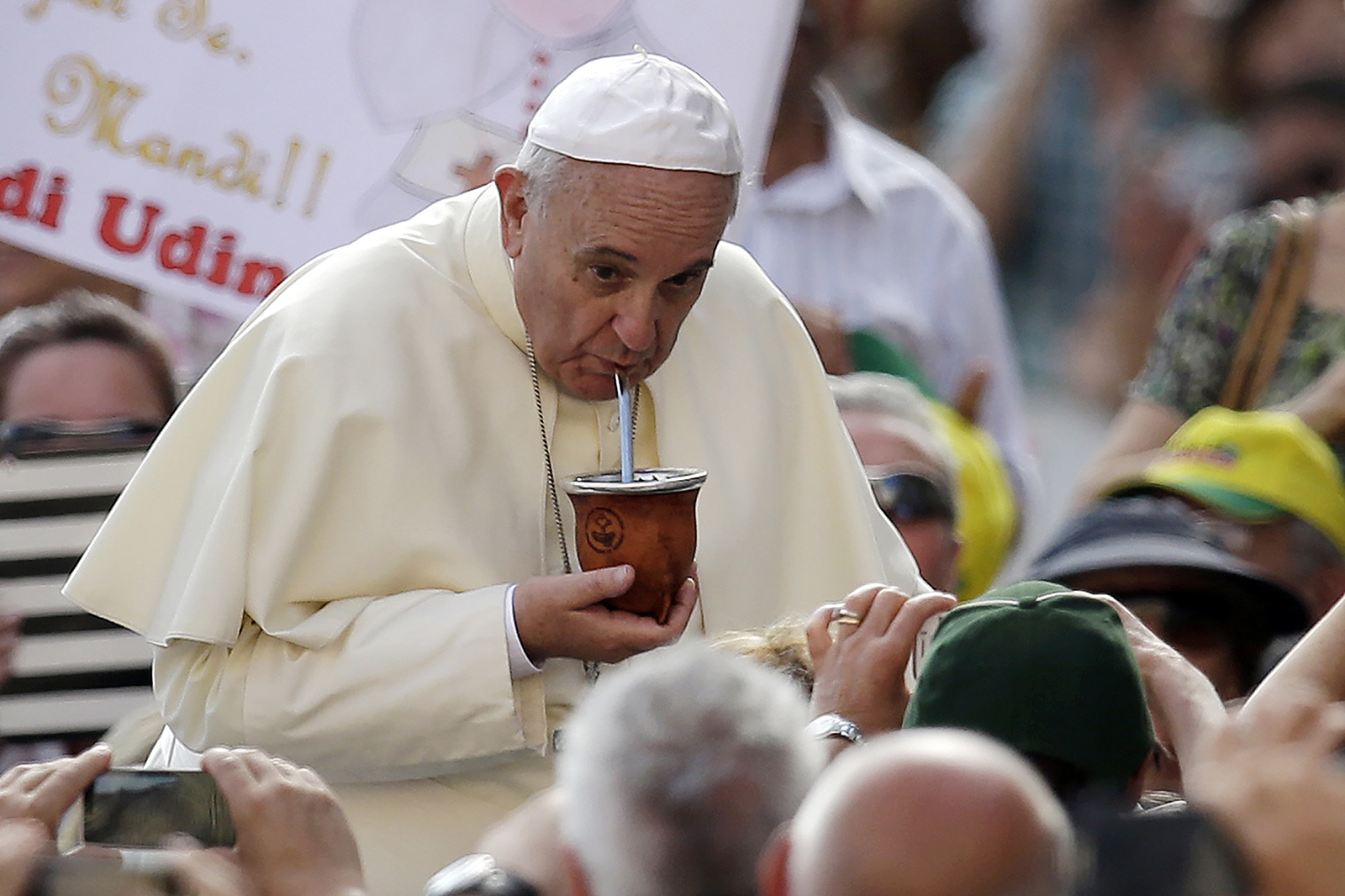
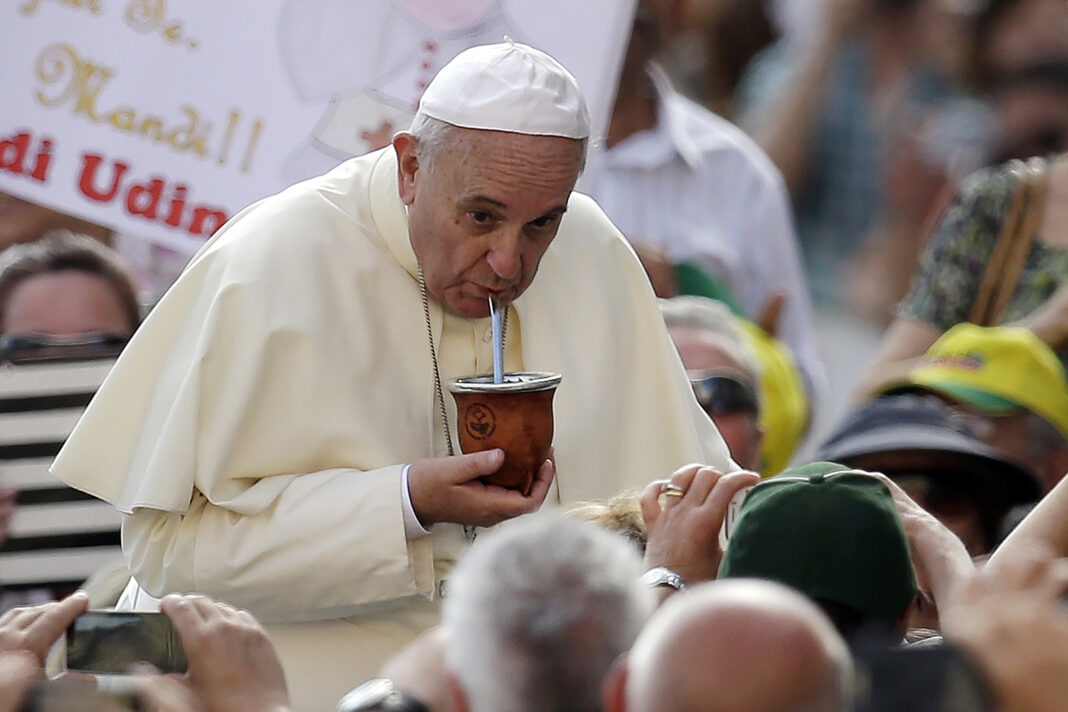
Pope Francis drinks from a mate gourd, a traditional Argentine drink, that was offered by faithful in St. Peter’s Square during the weekly general audience at the Vatican, Aug. 27, 2014. (AP Photo/Gregorio Borgia, File)
Even some of his most controversial moves were structurally modest. His cautious opening to allow divorced and remarried Catholics to receive Communion — after pastoral accompaniment — appeared not as a headline reform but as a footnote in his 2016 apostolic exhortation “Amoris Laetitia,” and only after years of consultation with bishops.
“I would make it clear that not all discussions of doctrinal, moral or pastoral issues need to be settled by interventions of the magisterium,” Pope Francis wrote in the exhortation.
Even Francis’ doctrine czar, Cardinal Víctor Manuel Fernández, seemed concerned with the longevity of Francis’ pontificate. “So, will it have served nothing, that Pope Francis should have been for eleven years the Supreme Pontiff?” he asked a room full of journalists in April 2024.
But a year after Francis’ death, his legacy is not defined by what he changed in doctrine, rather in how he changed the Church’s understanding of itself — and its place in the world.
That vision was laid out early in his programmatic document, “Evangelii Gaudium” (The Joy of the Gospel), where he proposed a governing principle that would define his papacy: “Time is greater than space.” Pope Francis meant that “institutions often prefer space and power over time and process,” explained Ethna Regan, head of the School of Theology in Mater Dei Institute of Education, Dublin City University.

Pope Francis leaves the morning session of the Amazon synod, at the Vatican, Saturday, Oct. 12, 2019. (AP Photo/Alessandra Tarantino)
In the interview, which occurred in 2021 and addressed Francis’ understanding of his reforms over time, Regan interpreted the pope’s thought as a “post-colonial” perspective. “Short term thinking has negative effects on human beings, whether it’s the environment, political policy or ecclesiastical reform,” she said.
That same year, Jesuit Father Drew Christiansen, distinguished professor of ethics and human development at Georgetown University, explained that it was difficult for people, especially in the United States, to understand Francis’ approach to reform, which “begins with the reform of hearts and therefore giving up a sense of power and privilege.”
“The church is not a static institution, it’s a dynamic movement led by the spirit,” Christiansen said, adding that Francis sought not quick fixes but long-term transformation. “It is only in time that you introduce new synthesis, that you grapple with the realities of the age,” he said.
Christiansen credited Francis’ Jesuit background with giving him a spirituality “of contemplation and of action.”
Papal biographer Austen Ivereigh noted that “at the Vatican, the fastest thing was the pope.” Francis would act swiftly when necessary, but if a matter required further discernment and reflection, he would, according to Ivereigh, “buy himself time.”

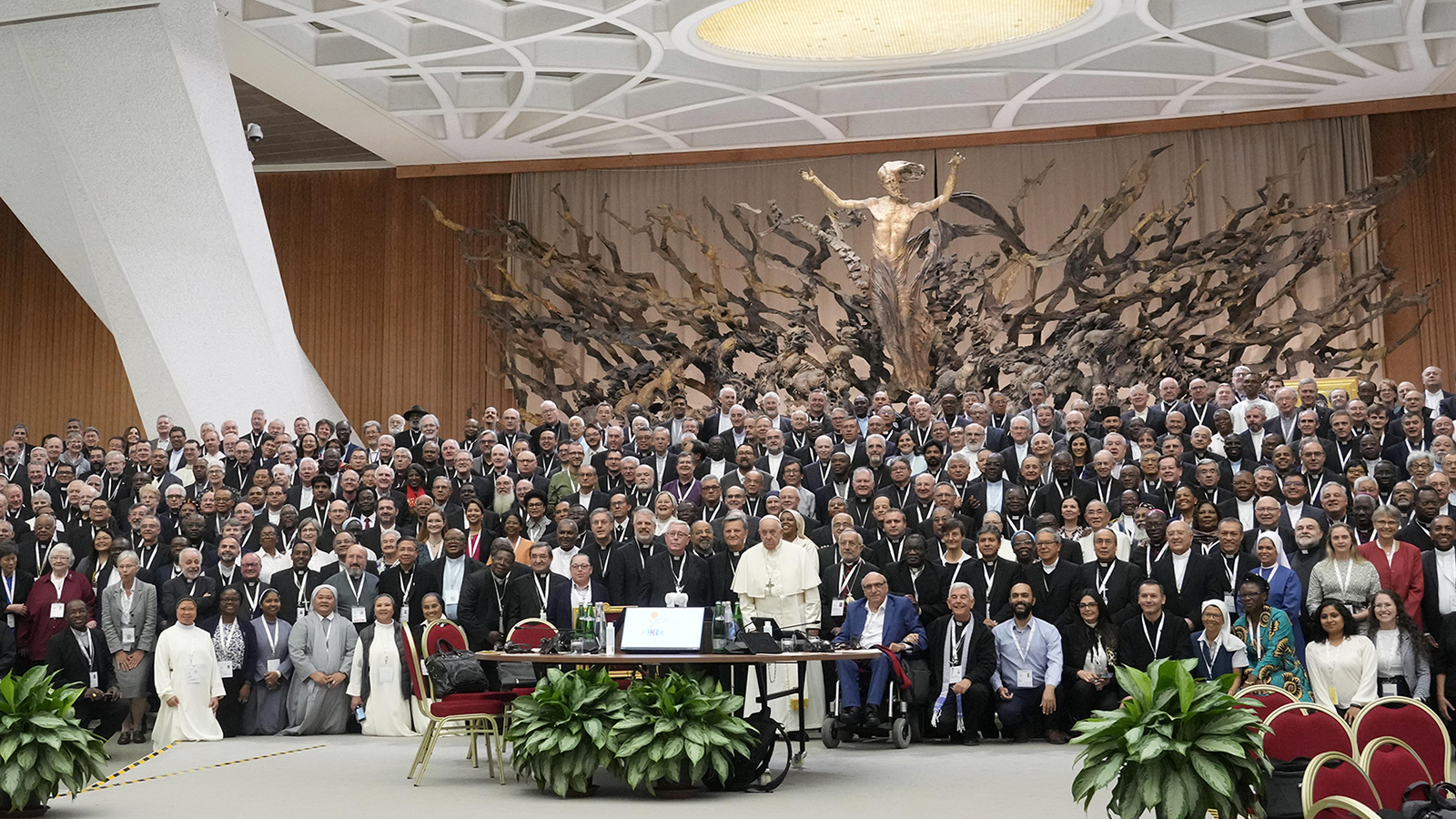
Pope Francis poses for a picture with participants of the Synod of Bishops’ 16th General Assembly in the Paul VI Hall at the Vatican, Oct. 23, 2023. (AP Photo/Gregorio Borgia)
His reform of the offices and departments that make up the Roman Curia was slow-paced, and he would often enact the changes before writing them into law — as if to test them for a time. His long-term vision was nowhere clearer than in his most ambitious project: the Synod on Synodality.
The synod was a multiyear experiment aimed at reshaping the decision-making process in the church. It launched a massive two-year listening process at every level of the church and led to two summits of bishops and church leaders at the Vatican. But the implementation process continues to this day.
“With the synodal process, many times I felt, ‘my God, this is taking so long,’” said Mario Aguilar, scholar at the University of St. Andrews and a friend of the late pontiff, “but that was the point!”
Francis also appointed women and laypeople to senior Vatican roles at an unprecedented level. Those appointments did not rewrite doctrine on women, but they shifted the reality on the ground, and the women who occupy these roles have stated often to Religion News Service that they recognize their roles as pioneers, opening the door for future generations.
Aguilar is part of a network of so-called Scholars for Dialogue, promoted by Francis and comprising academics and intellectuals mostly from the Global South who seek to promote the late pope’s views. Francis empowered theologians and church historians to continue their research without waiting for the Vatican’s approval, Aguilar said, a push that continues to this day.

Pope Francis speaks during his weekly general audience in St. Peter’s Square at the Vatican, on Oct. 18, 2023. (AP Photo/Alessandra Tarantino, File)
Scholars for Dialogue visited the simple white marble tomb of Francis in St. Mary Major to say: “Pope Francis, you left us something very important. We shall continue your legacy,” Aguilar said.
Ivereigh remembers Francis as “very conscious of time, in the sense that he needed to always be ahead of the clock,” despite being willing to spend time with those who needed him. He joins the chorus of people who described Francis as a hard-working man, known for not taking any vacations.
Salvatore Cernuzio, a reporter at Vatican News, writes of his personal relationship with the late pontiff in his book “Father.”
He said that while Francis himself acknowledged being “instinctive at times,” acting decisively and “using strong language, angering embassies and prime ministers,” when it came to big decisions, “he prayed and reflected on things; they were not impulsive decisions.”
He said that was evident in Francis’ desire to be the first pope to visit China — which, in part, led to the signing of the controversial provisional 2018 agreement between the People’s Republic and the Holy See, granting Beijing authority in the selection of bishops.


Students practice flipping boards with photos to reveal a full-mosaic portrait of Pope Francis before a Holy Mass at National Stadium in Bangkok, Thailand, Thursday, Nov. 21, 2019. (AP Photo/Sakchai Lalit)
“He always took a certain pleasure in this idea of being the first — not out of egotism, as some critics wrote, not as a matter of image — but because it was the Church moving forward, the process. He always spoke about initiating processes, not occupying spaces, but opening doors, opening paths,” Cernuzio said.
Cernuzio’s book shows a pope behind the scenes, not unlike the one on the world stage. “A pope who ate ice cream, who had this instinct to pick up the phone when there was something he felt like saying, something he felt like doing,” he said.
Aguilar recalls a similar image as he recounts stories of eating pizza and playing “Monopoly” with the pontiff in Jordan or a time when Francis snuck out of the Vatican to have a meeting with him, wearing a simple black cassock, only to be discovered by the Vatican gendarmes.
Francis’ “first concern was to be a shepherd of souls,” said Cernuzio. “He fulfilled his role, which was to be close to those who were suffering, to those under bombs, wherever they might be.”
A part of that mercy lives on today, in Francis’ last wish: “The vehicle of hope” — a pope-mobile refitted into a mobile pediatric clinic capable of treating up to 200 children a day in Gaza. The move inspired other charitable organizations to join forces with the Catholic charity network Caritas to build nine more mobile clinics to help people in Gaza.
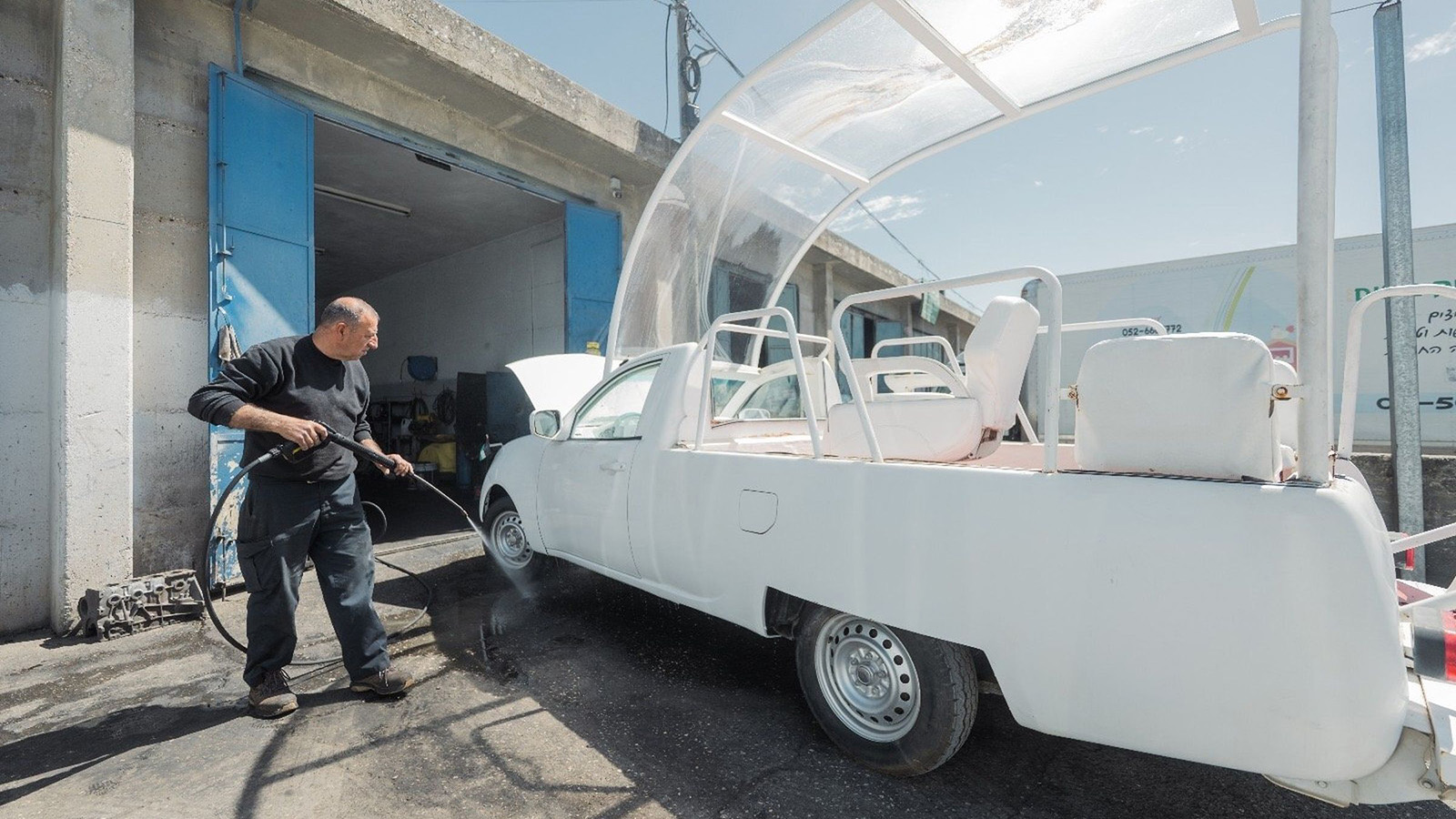
Work being carried out to transform the popemobile used by Pope Francis during his 2014 Holy Land pilgrimage into a mobile health unit for Gaza. (Photo courtesy of Caritas Jerusalem)
But Francis also ensured his vision would outlive him by selecting the cardinals who elected his successor, picking them from dioceses on the peripheries, far from traditional centers of power.
When Leo XIV, a Peruvian American missionary with experience leading the impoverished diocese of Chiclayo, Peru, emerged from the Loggia, many fears that his predecessor’s efforts would be forgotten were dispelled.
“We want to be a synodal Church, a Church that moves forward, a Church that always seeks peace, that always seeks charity, that always seeks to be close above all to those who are suffering,” Leo told the crowds immediately after his election, sending a message that Francis’ most consequential decisions were never meant to be endpoints, but beginnings.