





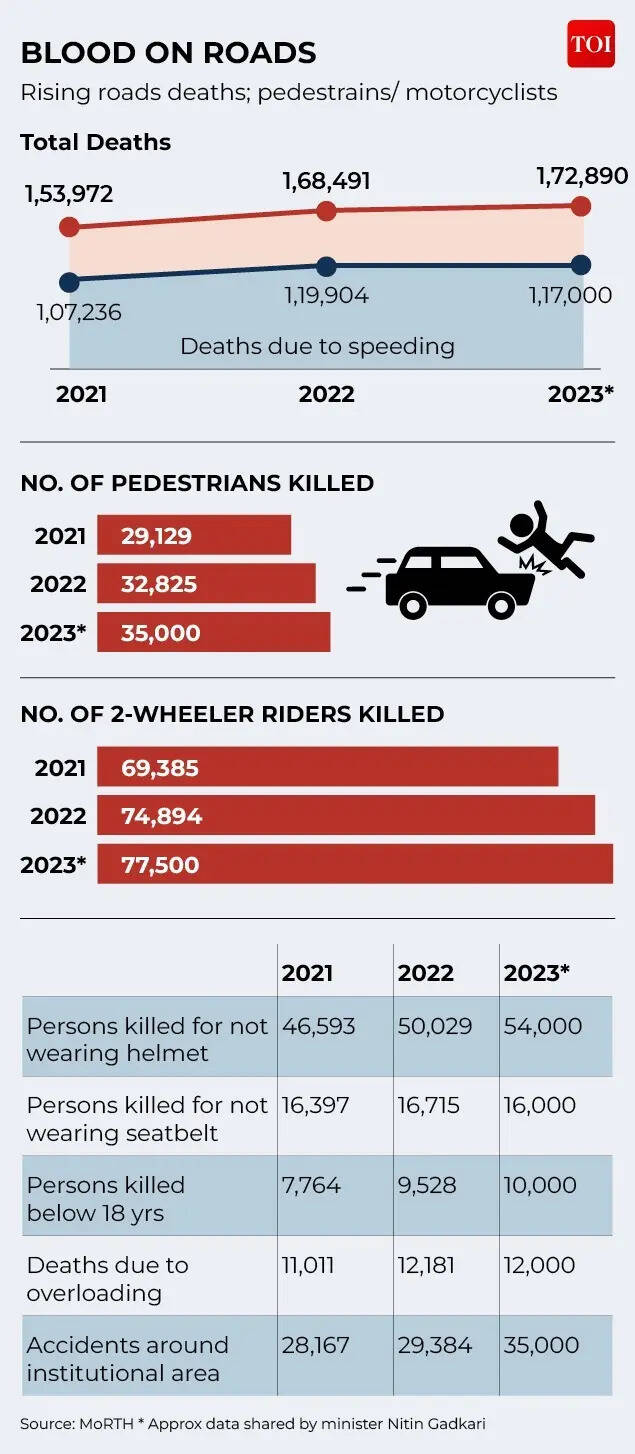
Every fifth person killed on India’s roads is a pedestrian — someone who was simply walking. Not driving, not speeding, not breaking rules. Just walking. Yet, on streets where they legally have the first right of way, pedestrians remain the least protected, caught in a system that prioritises speed over survival.While the Supreme Court has reaffirmed that pedestrians’ right to use footpaths is part of the right to life under Article 21, the reality on the ground reflects systemic neglect, flawed design, and near-total absence of accountability.Between 2019 and 2023, nearly 1.5 lakh pedestrians were killed in road crashes. In 2023 alone, of the 1,72,890 road deaths recorded nationwide.These are not isolated incidents. They are the outcome of a system that consistently fails its most vulnerable users.
A crisis built into road design
This is not merely a behavioural problem. It is structural.A nationwide audit across 24 states reveals the scale of the infrastructure gap. Footpath availability ranges from as low as 3% in Jammu and Kashmir to about 73% in Maharashtra. In states like Bihar, Haryana and Puducherry, usable pavements remain scarce.
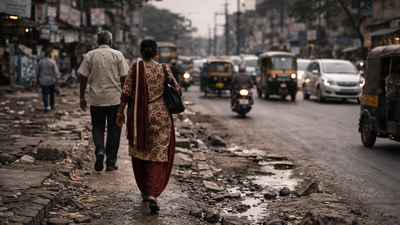
Even where footpaths exist, they are often too narrow, poorly designed, encroached upon, or simply unusable.In New Delhi, nearly 44% of roads lack footpaths entirely. Where pavements exist, they are frequently occupied by parked vehicles, vendors, debris, or construction activity. Studies show that in parts of the city, nearly 70% of pedestrians are forced to walk on the road itself.This is not incidental. It reflects a deeper bias in urban planning.
The pedestrian paradox
The risks faced by pedestrians are not random, they are predictable and repeatable.1. Missing infrastructureMost Indian cities lack continuous sidewalks, safe crossings, and pedestrian signals. Even where footpaths exist, they are often obstructed by parking, vendors, or construction.2. Speed without controlHigher speeds drastically increase fatality risk. A small increase in average speed significantly raises both crash probability and severity. For pedestrians, the difference between survival and death often comes down to a few kilometres per hour.3. Poor enforcementTraffic laws exist, but enforcement remains inconsistent. Speed limits, signal violations, and reckless driving frequently go unchecked.4. Weak planning integrationUrban mobility planning still treats walking as an afterthought rather than the foundation of all movement. Every journey begins and ends on foot — yet this is rarely reflected in policy.
Numbers behind the crisis
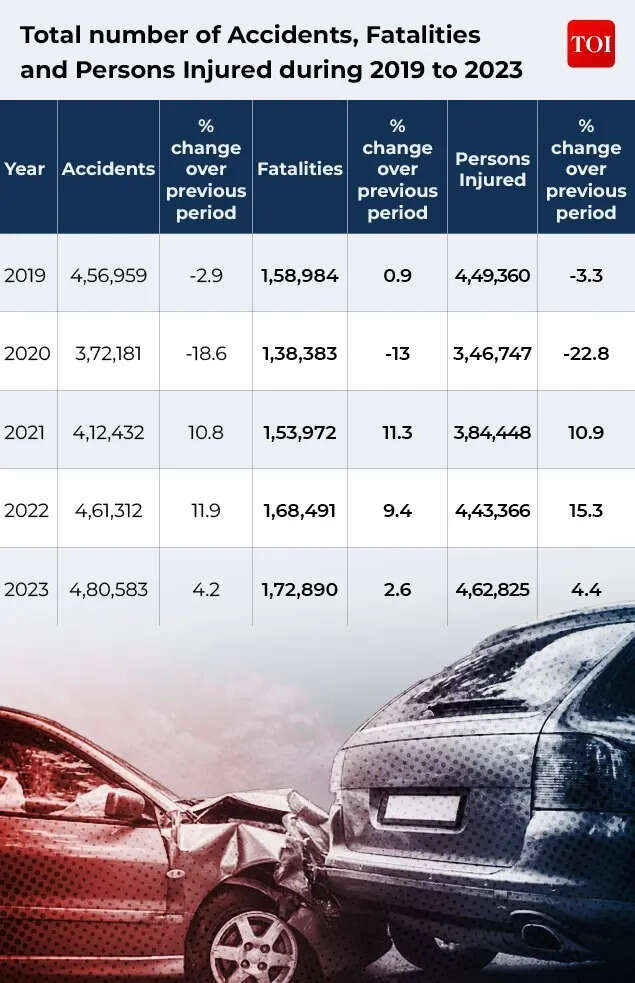
Government data for 2023 underlines the scale of the issue:
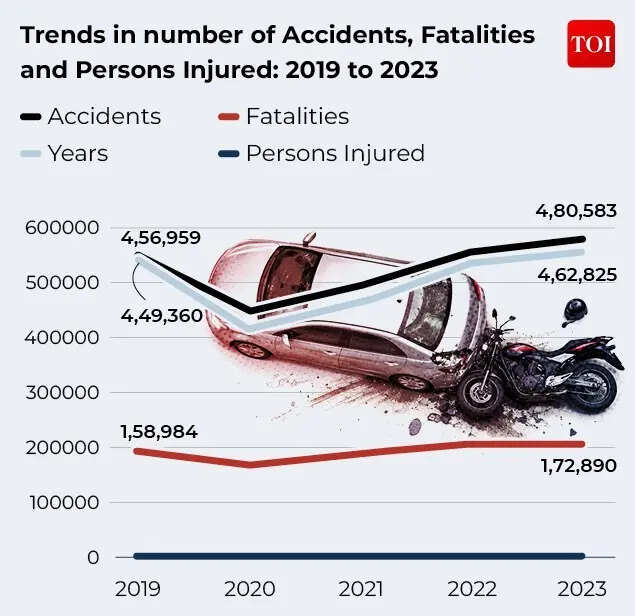
- 4,80,583 road accidents recorded nationwide
- 1,72,890 deaths, the highest in recent years
- Pedestrians accounted for over 20% of fatalities, second only to two-wheeler riders
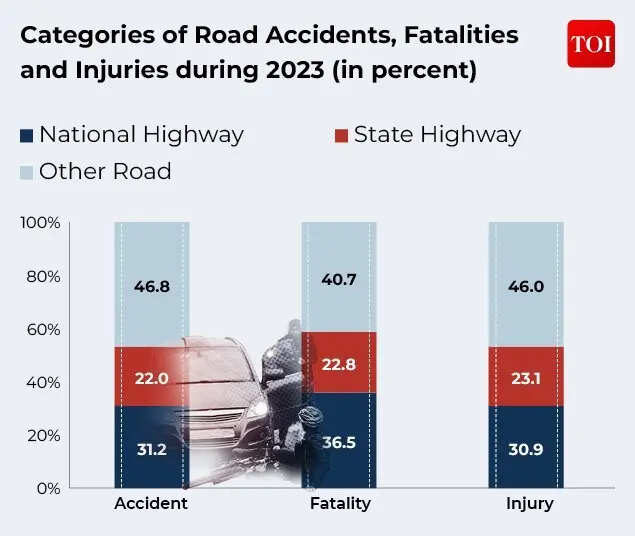
The data also reveals deeper structural issues. A majority of deaths, 68.5% occur in rural areas, where highways and high speeds combine with minimal pedestrian infrastructure.
Overspeeding alone accounts for over 68% of deaths, showing how vulnerable unprotected road users are.Young adults are the worst affected, with 66.4% of victims in the 18–45 age group, highlighting the economic and social cost of these fatalities.
What needs to change
Fixing India’s pedestrian safety crisis requires more than isolated projects. It demands a systemic shift.1. Redesign roads for people, not vehiclesFootpaths, crossings, and traffic calming must become non-negotiable elements of urban design.2. Enforce speed limits aggressivelySpeed management — through cameras, penalties, and road design — is the single most effective intervention.3. Protect the most vulnerableChildren, elderly citizens, and persons with disabilities must be prioritised through accessible infrastructure and safer crossings.4. Use data to target high-risk zonesIdentifying accident “black spots” and redesigning them can significantly reduce fatalities.5. Strengthen law enforcement and awarenessRules matter only when they are followed — and enforced consistently.
A deadly pattern across cities
From metros to smaller cities, a consistent pattern emerges: pedestrians are dying not because walking is dangerous — but because roads are designed without them in mind.In Bengaluru, nearly 28% of all road fatalities are pedestrians. Police data shows hundreds of walkers killed every year, often in crashes that could have been prevented. “Many accidents occur because people are forced onto roads due to broken or encroached pavements,” a traffic officer admitted.In Nagpur, the situation is even more alarming. Nearly one in three accident victims is a pedestrian, with experts directly linking deaths to the absence of continuous footpaths. “Citizens are literally pushed into traffic,” an official said.Even cities with slower traffic are not immune. In Pune, 70 pedestrians have already died in just the first eight months of 2025. Police point to highways cutting through urban areas, lack of crossings, and missing underpasses as key reasons.
Meanwhile, in Chennai, high-speed corridors on the city’s outskirts have turned fatal for walkers. “She was walking on the road because the footpath was encroached,” said a resident, recalling the death of a 61-year-old woman hit by a bus.The problem cuts across regions. In Goa, pedestrian deaths have risen sharply, while in Gurgaon, nearly half of road fatalities in some months involved pedestrians. “Crossing the road feels like risking your life,” said a commuter.
A rare bright spot in Delhi
Amid this grim picture, there are small but significant attempts to rethink road design. Delhi has piloted its first student-friendly street and India’s first dedicated school zone designed with a pedestrian-first approach, aiming to make daily commutes safer for children.The initiative focuses on traffic calming, better crossings, wider footpaths, and safer access around schools — a model experts say could be replicated across cities. However, such efforts remain isolated against the scale of the national crisis.
Behaviour vs infrastructure
Government data shows that overspeeding alone accounts for over 68% of road deaths. But focusing only on driver behaviour misses the larger point: Human error becomes fatal when infrastructure offers no margin for safety.Globally, pedestrians account for about 21% of road deaths, according to the World Health Organization. India’s numbers are similar — but the context is not.In safer countries, pedestrian infrastructure is continuous, accessible, and protected. In India, it is fragmented, inconsistent, and often unusable.“Building proper footpaths and keeping them free is the lowest-cost, highest-impact intervention to prevent crashes,” said Amar Srivastava of the India Road Safety Campaign. “Yet, it is rarely treated as a priority.”
Laws exist, accountability doesn’t
The gap between policy and reality is glaring.The Supreme Court has issued multiple directions: Build accessible footpaths, remove encroachments, install crossings, and hold officials accountable under Section 198A of the Motor Vehicles Act for deaths caused by poor road design.Yet enforcement is virtually absent. In six years, there has not been a single recorded penalty under this provision.Accountability remains diffused across agencies — ensuring that no one is held responsible.
Demand is rising, safety isn’t
India’s mobility story carries a fundamental contradiction: movement is increasing, but safety is not.
Road crashes kill about 1.2 million people globally each year. India alone accounts for roughly 11% of these deaths — despite having far fewer vehicles than many developed nations.This is not just a transport issue. It is a public health crisis, an urban planning failure, and an economic burden.
The missing shift
The problem is not lack of solutions — it is lack of scale.A proposed National Road Safety Board, recommended to standardise design and enforcement, remains largely inactive despite court directives.Meanwhile, cities continue to prioritise private vehicles over pedestrians and public transport.At its core, India’s road culture still follows one principle: The bigger vehicle has the right of way.
The myth of inevitability
There is a persistent belief that road deaths are the price of growth. Global evidence proves otherwise.Countries that adopt a “Safe Systems” approach, designing roads that anticipate human error, have sharply reduced fatalities.“Safe, continuous, and obstruction-free footpaths can save thousands of lives,” Srivastava said. “But it requires political will and administrative focus.”The principle is simple: People will make mistakes. Roads should not make those mistakes deadly.Across India, millions will continue to walk on roads not designed for them — navigating broken pavements, dodging speeding vehicles, and risking their lives for something as basic as mobility.In a country where pedestrians have the first right of way, they remain the most neglected.And until that contradiction is resolved, walking will continue to be one of the most dangerous ways to get from one place to another.